Grid Interconnection Delays: Why Solar Projects Are Waiting Longer Than Ever in 2026
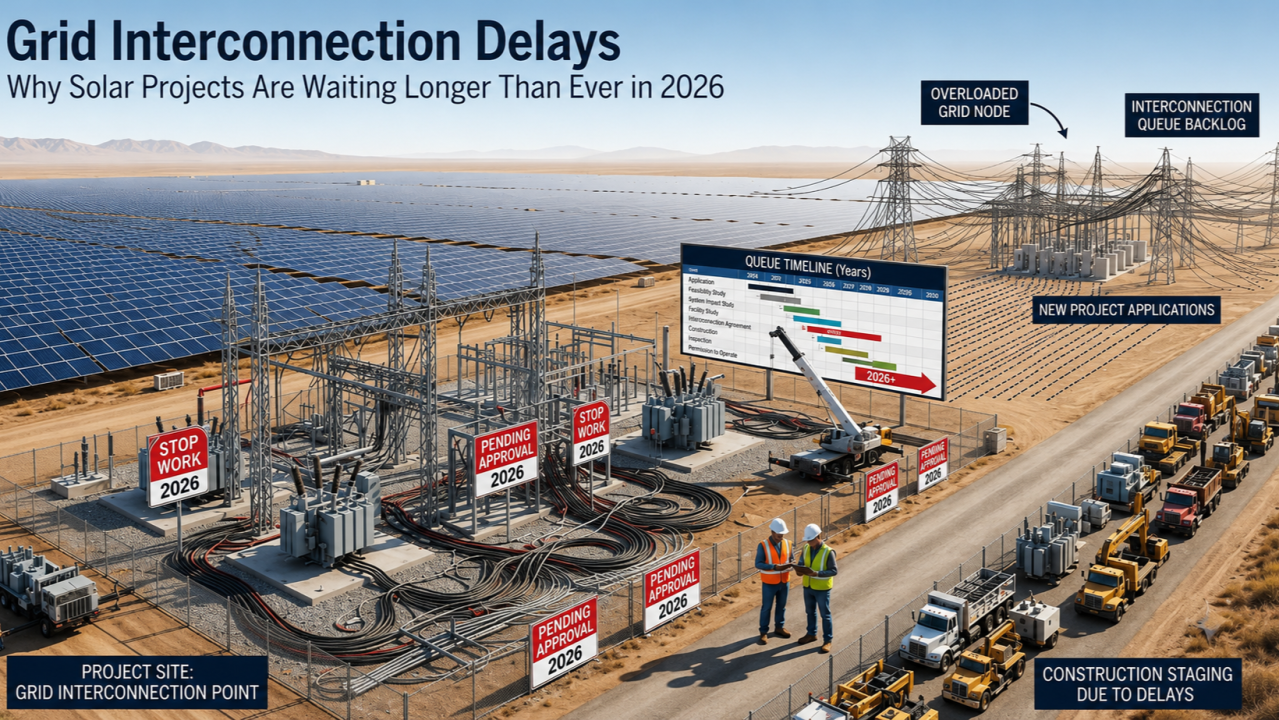
The solar industry continues to expand across the United States and Canada, driven by increasing electricity demand, supportive renewable energy policies, and growing interest in energy independence. However, while more homeowners and businesses are investing in solar energy, many projects are experiencing an unexpected bottleneck after permit approval grid interconnection delays.
For solar installers, EPC companies, and project developers, these delays can postpone installations, impact project cash flow, and reduce customer satisfaction. Understanding the reasons behind interconnection delays and preparing projects correctly from the beginning can significantly improve overall project timelines.
What Is Grid Interconnection?
Grid interconnection is the process of connecting a solar PV system to the local electric utility’s power grid. Before a system can begin exporting electricity, the utility company must review the project, verify compliance with technical requirements, and approve the connection.
The interconnection process generally includes:
-
Utility application submission
-
Technical engineering review
-
Equipment verification
-
Grid capacity assessment
-
Final approval Permission to Operate (PTO)
Even after obtaining a building permit, a project cannot begin generating power until the utility grants final approval.
Why Are Interconnection Delays Increasing in 2026?
Several industry trends are contributing to longer review times.
1. Record Growth in Solar Installations
Residential and commercial solar adoption continues to grow rapidly across North America. Utilities are processing significantly more applications than in previous years, increasing review workloads.
2. Limited Utility Resources
Many utility providers have not expanded their engineering teams at the same pace as the growing number of applications. As a result, application queues continue to increase.
3. Distribution Grid Capacity Challenges
In many regions, existing electrical infrastructure was not originally designed for high levels of distributed solar generation.
Utilities often need to evaluate:
-
Transformer loading
-
Voltage fluctuations
-
Backfeed protection
-
Feeder capacity
-
Distribution system upgrades
These technical studies require additional engineering time.
4. Incomplete or Incorrect Documentation
One of the most preventable causes of delay is inaccurate project documentation.
Common issues include:
-
Incorrect Single Line Diagrams (SLDs)
-
Missing equipment specifications
-
Inaccurate roof layouts
-
Improper conductor sizing
-
NEC code compliance issues
-
Missing utility-required information
When documentation contains errors, utilities request revisions, extending project timelines.
5. Local Utility Requirements Vary
Every utility has its own submission standards. What is acceptable for one utility may not satisfy another. Solar contractors working across multiple jurisdictions must prepare project documentation according to each utility’s specific requirements.
Regional Breakdown: US vs. Canadian Interconnection Landscape in 2026
To successfully manage projects across North America, installers must navigate distinct regulatory frameworks and utility environments in both countries:
-
United States Market Dynamics:
-
Increased grid saturation on local feeders requires more in-depth Supplemental Reviews and Interconnection System Impact Studies (ISIS).
-
Rapid adoption of Battery Energy Storage Systems (BESS) and complex net billing tariffs (such as California’s NEM 3.0) means utilities require highly specialized single line diagrams detailing AC/DC coupling, transfer switches, and grid-export controls.
-
-
Canadian Market Dynamics:
-
Provincial utility bodies (such as Ontario’s IESO, Hydro-Québec, and Alberta’s AESO) enforce strict grid protection and power quality compliance.
-
Cold-weather equipment considerations, snow load structural validations, and unique CEC (Canadian Electrical Code) bonding/grounding criteria must be meticulously documented in the initial plan set.
-
How Interconnection Delays Affect Solar Businesses
Longer approval timelines impact every stage of a solar business.
Common business challenges include:
-
Delayed project revenue
-
Increased project management costs
-
Installation scheduling conflicts
-
Reduced customer satisfaction
-
Higher administrative workload
-
Multiple design revisions
For growing installation companies, these delays can quickly reduce operational efficiency.
The Hidden Financial Cost of Interconnection Delays
When Permission to Operate (PTO) is delayed, the financial impact extends far beyond administrative friction:
-
Capital Tie-Up & Delayed Milestones: Most EPC agreements release final payments only upon PTO issuance. A 60-to-90-day interconnection queue holds up 10% to 20% of remaining project capital.
-
Customer Churn & Referral Loss: Homeowners expecting immediate utility savings become frustrated when systems sit idle on their roofs, leading to poor customer reviews and lost referral leads.
-
Operational Overheads: Engineering and back-office teams spend double the hours managing utility follow-ups, re-submitting plan revisions, and re-scheduling field crews.
AHJ Building Permit vs. Utility Interconnection Approval
To avoid confusion during project management, it is crucial to understand the distinct roles of the local municipality (AHJ) and the electric utility provider:
Feature / Criteria |
Local AHJ Building Permit |
Utility Interconnection Approval |
| Issuing Body | City / County Building Department | Electric Utility Provider |
| Primary Focus | Structural safety, fire setback code, NEC compliance | Grid capacity, transformer loading, voltage stability |
| Key Output | Building / Electrical Permit | Permission to Operate (PTO) |
| Main Delay Factor | Incorrect roof setback plans or missing structural calculations | Grid capacity saturation, incomplete SLDs, missing equipment datasheets |
How Accurate Solar Design Helps Reduce Delays
While installers cannot control utility review timelines, they can significantly improve the quality of every submission. A complete, utility-ready design package helps reviewers process applications faster and minimizes revision requests.
High-quality design documentation typically includes:
-
Accurate Site Plan
-
Professional Roof Layout
-
NEC-Compliant Single Line Diagram
-
Electrical Calculations
-
Structural Information
-
Equipment Datasheets
-
Label Schedule
-
Utility-specific documentation
The fewer corrections required, the faster a project can move toward approval.
Deep Dive: Critical Components of an Interconnection-Ready Design
Submitting plan sets that pass utility review on the first attempt requires extreme accuracy across three core design layers:
-
Precision Single Line Diagrams (SLDs): Clearly marking point-of-interconnection (POI), main panel busbar ratings, utility disconnect switch locations, rapid shutdown devices, and overcurrent protection sizing.
-
Site Plan & Setback Mapping:
Providing accurate aerial mapping that highlights the path of conduit, meter location, safety disconnect accessibility for utility technicians, and property boundaries. -
Manufacturer Equipment Specifications: Including complete UL-listed datasheets for solar modules, string/microinverters, combiners, smart meters, and battery energy storage hardware.
Best Practices for Faster Utility Approval
To reduce delays, installers should:
-
Verify utility requirements before design begins
-
Submit complete documentation
-
Use accurate production calculations
-
Perform thorough design quality checks
-
Follow current NEC standards
-
Double-check equipment compatibility
-
Ensure plan sets are permit-ready before submission
A proactive approach saves both time and project costs.
How RS Solar CAD Group Supports Solar Installers
At RS Solar CAD Group, we help solar installers, EPC companies, and engineering firms streamline their project workflow with accurate, permit-ready design services.
Our services include:
-
Solar Permit Plan Sets
-
Residential Solar Design
-
Commercial Solar Design
-
Proposal Design
-
Single Line Diagrams
-
PE/Engineering Coordination
-
CAD Drafting
-
AHJ-Compliant Documentation
-
Fast Turnaround Support
Our goal is to help clients submit complete, high-quality design packages that reduce revisions and keep projects moving efficiently.
Our Quality Assurance Process for Zero-Revision Submissions
To ensure your applications move through utility review without kickbacks, our team adheres to a multi-stage Quality Assurance workflow:
-
Step 1: Jurisdiction & Utility Pre-Check
We review utility-specific standards, interconnection limits, and local AHJ codes prior to drafting. -
Step 2: Precision Drafting & Engineering
Draftsmen prepare CAD layouts, string sizing, and electrical diagrams according to current NEC/CEC regulations. -
Step 3: Internal Senior Technical Review — Every plan set undergoes a peer review covering ampacity calculations, breaker ratings, conduit schedules, and equipment compatibility.
-
Step 4: Rapid Post-Submission Support — If a utility requests clarification, our team delivers quick plan modifications to keep your pipeline moving.
Final Thoughts
Grid interconnection delays are becoming one of the biggest challenges facing the solar industry in 2026. While installers cannot eliminate every utility delay, they can significantly improve project success by submitting accurate, code-compliant, and utility-ready documentation from the start.
A well-prepared permit package not only reduces revision requests but also improves communication with utilities, shortens approval timelines, and creates a better experience for customers.
As solar adoption continues to grow across North America, companies that invest in design quality and documentation accuracy will be better positioned to complete projects faster and scale their operations successfully.
Frequently Asked Questions (FAQ)
What is grid interconnection?
Grid interconnection is the approval process required to connect a solar PV system to the local utility grid before it can export electricity.
Why are solar interconnection approvals taking longer in 2026?
Growing solar adoption, limited utility resources, grid capacity studies, and incomplete project documentation are contributing to longer review timelines.
Can better solar designs reduce approval delays?
Yes. Accurate, utility-ready permit packages help reduce revision requests and make the review process smoother.
What documents are required for solar interconnection?
Typical requirements include a site plan, roof layout, single line diagram (SLD), equipment specifications, electrical calculations, and utility application forms.
How can RS Solar CAD Group help?
RS Solar CAD Group provides permit-ready solar plan sets, proposal designs, NEC-compliant SLDs, and engineering support to help installers submit accurate documentation and minimize revisions.
How long does the grid interconnection process usually take?
The timeline varies depending on the utility company, project size, and local regulations. Residential projects may take a few weeks, while larger commercial systems can take several months if additional engineering studies or grid upgrades are required.
What is the difference between a solar permit and grid interconnection approval?
A solar permit is issued by the local Authority Having Jurisdiction (AHJ) and allows the installation to begin. Grid interconnection approval is provided by the utility company and allows the solar system to connect to the electrical grid and export power.
Can an incomplete permit plan set delay utility approval?
Yes. Missing information, incorrect drawings, or non-compliant documentation can lead to revision requests from utilities or AHJs, significantly increasing project timelines.
What documents are commonly required for a utility interconnection application?
Most utilities require:
-
Site Plan
-
Roof Layout
-
Single Line Diagram (SLD)
-
Equipment Datasheets
-
Electrical Calculations
-
Load Calculations (if applicable)
-
Utility Application Forms
-
Label Schedule
Requirements may vary depending on the utility company.
Why do utility companies perform grid impact studies?
Utilities conduct grid impact studies to ensure that adding a new solar system will not negatively affect voltage levels, transformer capacity, or overall grid reliability.
Can battery storage systems affect the interconnection process?
Yes. Solar systems with battery storage often require additional technical reviews and documentation because utilities need to evaluate how energy will be stored, discharged, and exported to the grid.
How can solar installers reduce revision requests?
Installers can minimize revisions by:
-
Preparing accurate permit-ready designs.
-
Following current NEC requirements.
-
Verifying utility-specific submission guidelines.
-
Reviewing all documents before submission.
-
Using experienced solar design professionals.
Why is an accurate Single Line Diagram (SLD) so important?
The Single Line Diagram is one of the most critical documents in a solar project. It shows the complete electrical configuration of the system and helps reviewers verify safety, code compliance, and equipment compatibility.
Do interconnection requirements differ between U.S. states and Canadian provinces?
Yes. Every utility company and jurisdiction has its own technical standards, application process, and documentation requirements. Installers should always review the latest local guidelines before submitting an application.
How does RS Solar CAD Group help reduce project delays?
RS Solar CAD Group provides:
-
Permit-Ready Solar Plan Sets
-
Proposal Design
-
NEC-Compliant Single Line Diagrams
-
Residential & Commercial Solar Design
-
Fast Turnaround Support
-
Accurate CAD Drafting
-
Engineering Coordination
Our goal is to help solar installers submit complete, high-quality documentation that minimizes revisions and supports a smoother approval process.
What are the most common reasons utilities request design revisions?
Some of the most common reasons include:
-
Incorrect equipment specifications
-
Missing labels or notes
-
Inaccurate conductor and breaker sizing
-
Incomplete site plans
-
Code compliance issues
-
Missing utility-required forms.
Why is working with an experienced solar design partner important?
An experienced design partner understands utility requirements, AHJ standards, and industry best practices. This helps installers reduce design errors, speed up approvals, improve customer satisfaction, and keep projects on schedule