The Future of Solar in the USA: What 2026 Means for the Next Decade
The U.S. solar industry is entering a new phase.
A year ago, much of the conversation around American solar focused on record-breaking installations, expanding domestic manufacturing, federal incentives, and expectations of continued rapid growth. In 2026, the picture is more complex.
Solar remains one of the largest sources of new electricity capacity in the United States, but the industry is now being shaped by changing federal policies, evolving tax-credit rules, trade restrictions, domestic manufacturing, rising electricity demand, AI and data-center growth, permitting challenges, interconnection delays, and the growing importance of battery storage.
Despite these challenges, the long-term opportunity remains significant.
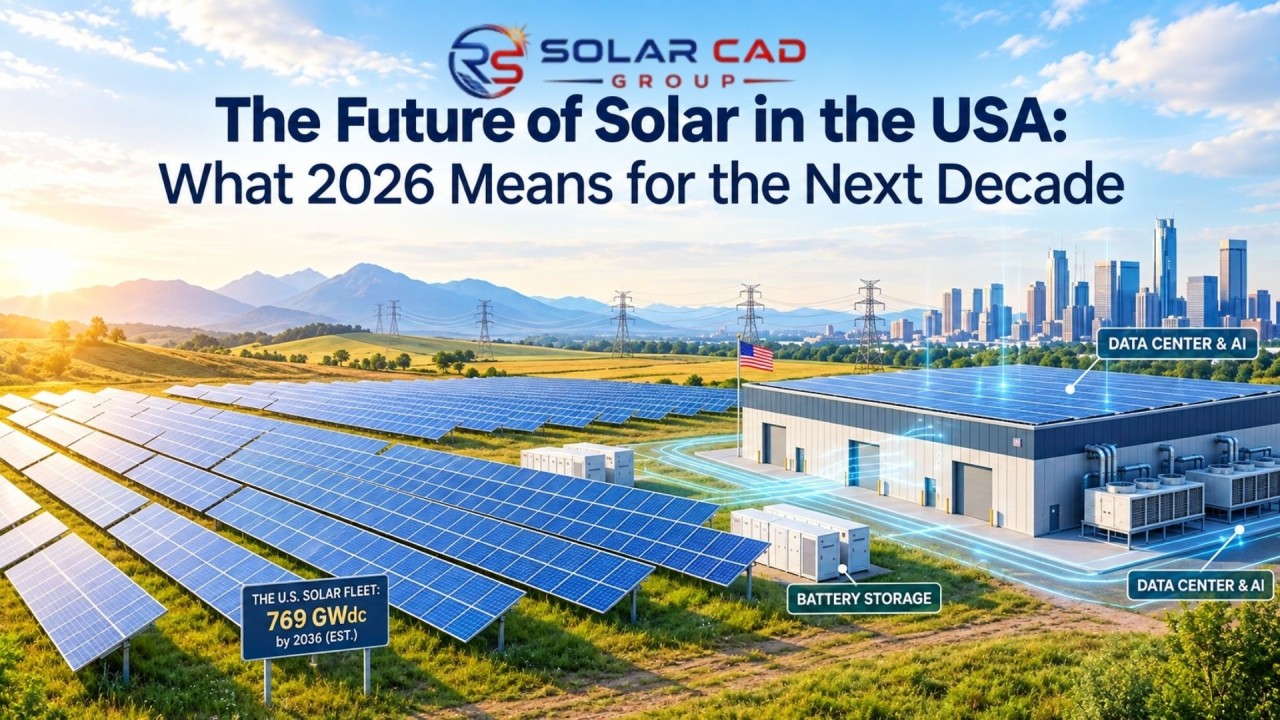
According to Wood Mackenzie’s latest outlook, the United States is expected to add approximately 490 GWdc of solar capacity between 2026 and 2036, bringing the total U.S. solar fleet to approximately 769 GWdc. The outlook also indicates that annual solar additions could remain around the mid-40 GWdc range through the early 2030s.
This means the future of U.S. solar is no longer simply a story about record installation numbers.
It is increasingly a story about scale, flexibility, supply chains, project execution, and the ability of the industry to adapt to a changing energy market.
From Record Growth to a More Complex Market
The U.S. solar market continued to expand in 2025, adding approximately 43 GW of new solar capacity. Solar remained the largest source of new electricity-generating capacity added to the U.S. grid for the fifth consecutive year.
However, the market entered 2026 with a different set of conditions.
During the first quarter of 2026, the United States added approximately 7.8 GWdc of solar capacity. Solar accounted for around 60% of all new electricity-generating capacity added during the quarter. When solar and battery storage were combined, they represented approximately 91% of new capacity additions.
The second quarter showed stronger activity.
The U.S. added approximately 11.4 GWdc of new solar capacity in Q2 2026, with utility-scale solar accounting for the majority of those installations.
These figures demonstrate an important change in the market.
The U.S. solar industry is not simply moving in one direction. Quarterly installations can rise or fall depending on project timing, policy deadlines, equipment availability, financing, and development conditions.
For developers and EPCs, this makes project planning and execution increasingly important.
What Will Drive Solar Growth Through 2031 and Beyond?
Wood Mackenzie’s current outlook indicates that U.S. solar additions are expected to remain at a large scale over the coming years.
The base-case outlook points toward approximately 44 GWdc of annual solar additions through 2031, while the longer-term outlook projects around 490 GWdc of new solar capacity between 2026 and 2036.
This represents a substantial expansion of the U.S. solar fleet.
However, the market may not experience the same type of rapid year-over-year growth seen during previous periods.
Instead, growth could increasingly depend on:
- Electricity demand
- Utility-scale project development
- Data-center expansion
- Solar-plus-storage deployment
- Policy and tax-credit requirements
- Equipment availability
- Domestic manufacturing
- Interconnection capacity
- Permitting timelines
- Project financing
For solar companies, this creates a market where having a strong project pipeline is only one part of the equation.
The ability to move projects efficiently from sales to design, permitting, engineering, and construction will also be important.
AI and Data Centers Are Changing the Electricity Demand Equation
One of the biggest developments influencing the U.S. energy market is the rapid growth of artificial intelligence and data centers.
AI applications require significant computing power, while the data centers supporting these systems require large and continuous amounts of electricity.
As technology companies expand their data-center infrastructure, electricity demand is becoming an increasingly important issue for utilities, developers, and policymakers.
Wood Mackenzie reported increased utility-scale solar contracting activity in 2026, with technology companies becoming an important source of electricity demand as AI infrastructure expands.
This creates a new dynamic for the solar industry.
Solar is no longer being considered only in the context of traditional renewable-energy development. It is also becoming part of the broader conversation around how the United States will meet increasing electricity demand.
Solar can be developed at large scale, and when combined with battery storage, it can also provide electricity beyond the hours of peak solar production.
For developers and EPCs, this growing demand could translate into additional project opportunities but also greater pressure to move projects through development efficiently.
Solar Plus Storage Will Become More Important
Solar generation is strongest during daylight hours, while electricity demand can continue into the evening.
Battery storage can help address this mismatch by storing electricity when solar production is high and making that electricity available later.
This is one reason the future of U.S. solar is becoming increasingly connected with energy storage.
Solar and storage together represented a very large share of new U.S. electricity-generating capacity during Q1 2026.
As the market develops, solar-plus-storage projects can introduce additional design and engineering requirements.
A project may need:
- PV system design
- Battery storage integration
- Electrical engineering
- Equipment coordination
- Interconnection documentation
- Fire-code considerations
- AHJ requirements
- Detailed permit plan sets
- Engineering review and stamping
- Project revisions
For solar contractors, this means the technical workflow can become more complex even when the underlying project appears straightforward.
Federal Policy Has Become a Major Project-Timing Factor
Federal policy remains one of the most important variables affecting the U.S. solar market.
Changes under the One Big Beautiful Bill Act (OBBBA) have altered the clean-energy tax-credit environment and introduced additional considerations around project timing, supply chains, and foreign-entity restrictions.
One of the major developments during 2026 was the effort by developers to establish eligibility for projects before important deadlines.
Wood Mackenzie estimated that a substantial volume of utility-scale solar projects had been safe-harbored ahead of the July 4, 2026 beginning-construction deadline.
That deadline has now passed.
For projects that qualified through applicable safe-harbor provisions, attention has shifted toward meeting the relevant placed-in-service requirements and continuing development and construction on schedule.
This has made project timing even more important.
A delay in design, permitting, engineering, procurement, or construction can affect the overall project schedule and, depending on the project, its ability to meet applicable requirements.
Trade Policies Are Reshaping Solar Supply Chains
Another major factor influencing the U.S. solar market is the changing international trade environment.
Solar developers and manufacturers are dealing with tariffs, trade investigations, foreign-entity restrictions, sourcing requirements, and changing procurement conditions.
These developments can affect:
- Module prices
- Cell availability
- Equipment procurement
- Project costs
- Domestic-content strategies
- Supplier selection
- Construction schedules
The U.S. has made significant progress in expanding domestic solar manufacturing, particularly module manufacturing.
However, the supply chain is not yet completely domestic.
Wood Mackenzie reported in 2026 that U.S. module production had expanded significantly, while domestic solar-cell manufacturing remained much smaller than module manufacturing capacity.
This means many U.S. module factories continue to depend on imported cells and other international components.
For developers and EPCs, supply-chain planning therefore needs to happen earlier in the project lifecycle.
Domestic Solar Manufacturing Continues to Expand
Despite the challenges, domestic solar manufacturing remains an important area of investment.
The expansion of U.S. manufacturing capacity has increased the country’s ability to produce solar modules domestically and has created additional manufacturing opportunities across the supply chain.
However, future investment decisions can still be influenced by trade policies, sourcing requirements, production costs, and access to components.
The result is a solar manufacturing industry that is becoming increasingly strategic to the U.S. energy market.
For developers, this can create opportunities to diversify procurement and reduce certain supply-chain risks.
At the same time, manufacturers must continue adapting to changes in the global solar market.
Permitting and Interconnection Remain Critical Challenges
Even when a solar project has a customer, financing, and equipment, it still needs to move through several technical and regulatory stages before construction can begin.
A typical project may move through:
Sales Proposal → Site Assessment → System Design → Engineering → Permit Plan Set → AHJ Review → Revisions → Utility Interconnection → Construction
Any delay in one stage can affect the next.
Permitting and interconnection continue to be important challenges for solar developers across the United States.
Requirements can also vary significantly between jurisdictions.
A project may require different documentation depending on the local AHJ, utility, project size, system configuration, or applicable codes.
This is why accurate documentation and an efficient revision process are becoming increasingly important.
Why Fast and Accurate Solar Design Matters More Than Before
The next phase of U.S. solar growth will require more than simply installing additional panels.
Projects need to move efficiently from an initial sales opportunity to a construction-ready package.
A strong design workflow can help contractors:
- Prepare accurate sales proposals
- Reduce unnecessary design revisions
- Meet AHJ requirements
- Develop permit-ready plan sets
- Coordinate electrical and structural requirements
- Manage engineering documentation
- Respond to customer changes
- Keep projects moving toward construction
For an EPC or installer managing a large pipeline, delays in technical documentation can quickly affect multiple projects.
The objective is not simply to produce drawings.
The objective is to create accurate, usable project documentation that supports the next stage of development.
The Opportunity for Solar Contractors and EPCs
The changing U.S. solar market is creating a different competitive environment for solar contractors and EPCs.
Companies may have access to growing project pipelines, but they also need enough technical capacity to process those projects efficiently.
Depending on their project requirements, contractors may need support with:
- Sales Proposals
- PV System Design
- Permit Plan Sets
- Electrical Engineering
- Structural Engineering
- PE Stamping
- AHJ Revisions
- Utility Interconnection Documentation
- Solar + Storage Design
For companies experiencing increasing project volumes, specialized external design and engineering support can provide additional technical capacity without requiring every function to be handled internally.
This can allow EPCs and installers to focus more heavily on sales, customers, project management, and construction, while specialized partners handle selected technical requirements.
What Could Define the U.S. Solar Market in the Coming Years?
Several trends are likely to remain important as the industry moves toward 2030 and beyond.
1. Electricity Demand Will Continue Changing
AI, data centers, manufacturing, electric vehicles, and broader electrification are changing the U.S. electricity-demand landscape.
Solar will increasingly be considered as part of the broader solution for meeting new electricity requirements.
2. Solar and Storage Will Become More Closely Connected
As electricity demand extends beyond daylight hours, storage can become an increasingly important part of solar project planning.
Solar-plus-storage projects will also require more detailed engineering and permitting workflows.
3. Supply Chains Will Remain Strategic
Trade policies and domestic manufacturing requirements will continue to influence equipment sourcing and project economics.
Developers will need to evaluate supply-chain considerations earlier in the project lifecycle.
4. Permitting Speed Will Matter
A strong project pipeline does not automatically translate into completed projects.
Permitting, interconnection, engineering capacity, and revision cycles will continue to influence how quickly projects reach construction.
5. Technical Partners Will Become More Valuable
As project requirements become more complicated, EPCs and installers may increasingly rely on specialized design and engineering partners.
This can help companies manage larger project volumes while maintaining technical quality and project timelines.
RS Solar CAD Group’s Perspective
At RS Solar CAD Group, we see the changing U.S. solar market from the project-design and engineering side.
Today’s solar contractors need more than a basic PV layout.
They need a workflow that can support the journey from proposal to permit to engineering.
Our team supports solar contractors, EPCs, and installers with:
- Fast Sales Proposals
- Permit Plan Sets
- PE Engineering & Stamping Support
- Electrical & Structural Design
- Design Revisions and Project Updates
- Solar + Storage Design Support
- Scalable Support for Growing Project Pipelines
Our focus is to help solar companies manage project documentation efficiently while adapting to changing technical and regulatory requirements.
When project timelines become tighter, having a reliable design and engineering workflow can help contractors keep projects moving.
Looking Ahead: What the Next Decade Could Bring
The future of U.S. solar will not be defined by one single factor.
It will be shaped by the interaction of electricity demand, technology, policy, manufacturing, financing, permitting, energy storage, and project execution.
The latest market data shows that solar continues to play a major role in America’s new power capacity. The United States added approximately 43 GW of solar in 2025, followed by 7.8 GWdc in Q1 2026 and 11.4 GWdc in Q2 2026.
At the same time, Wood Mackenzie’s long-term outlook points toward approximately 490 GWdc of additional solar capacity between 2026 and 2036, potentially bringing the total U.S. solar fleet to around 769 GWdc.
This shows that the long-term opportunity remains significant, even though the market is becoming more complex.
The next phase of U.S. solar may therefore be less about simply installing more panels and more about how efficiently the industry can develop, design, permit, engineer, procure, and build projects.
For solar contractors, EPCs, developers, and installers, being prepared for changing project requirements will become increasingly important.
The companies operating in this market will need to manage:
- Changing federal and state policies
- Equipment and supply-chain uncertainty
- Increasing electricity demand
- Solar-plus-storage projects
- AHJ and permitting requirements
- Utility interconnection requirements
- Engineering and stamping requirements
- Faster project timelines
- Growing project pipelines
The next decade of U.S. solar will not simply be about how much solar is installed.
It will also be about how efficiently and intelligently the industry can deliver it.
At RS Solar CAD Group, we believe accurate design, responsive engineering support, and efficient permit documentation will remain an important part of that process.
Let’s stay future-ready.
Let’s keep building smarter.
Team RS Solar CAD Group
Design. Permit. Engineer. Deliver.
Frequently Asked Questions About the Future of U.S. Solar
1. Is the U.S. solar industry still growing in 2026?
Yes. Although annual installation levels and quarterly growth can fluctuate because of policy, trade, financing, and project-timing factors, solar continues to represent a major share of new U.S. electricity capacity.
2. How much solar capacity is the U.S. expected to add over the next decade?
Wood Mackenzie’s current outlook projects approximately 490 GWdc of additional solar capacity from 2026 through 2036. The total U.S. solar fleet could reach approximately 769 GWdc by 2036.
3. Why is AI increasing demand for solar power?
AI applications require large amounts of computing power, and the data centers supporting these applications consume significant amounts of electricity. As data-center capacity expands, additional generation will be needed to support growing electricity demand.
4. Will battery storage become more important for U.S. solar projects?
Yes. Battery storage is becoming increasingly integrated with solar projects because it can help shift electricity generated during periods of strong solar production to periods when electricity demand is higher.
5. What are the biggest challenges facing U.S. solar developers?
Some major challenges include changing federal policies, tax-credit requirements, tariffs and trade restrictions, equipment procurement, interconnection delays, permitting requirements, financing conditions, and technical workforce requirements.
6. Is solar manufacturing increasing in the United States?
Yes. U.S. solar manufacturing capacity has expanded significantly, particularly in module manufacturing. However, the domestic supply chain is still developing, and the United States continues to rely on imported components such as solar cells and other materials.
7. Why are permitting and engineering important for solar projects?
A solar project cannot move into construction simply because the system has been designed. Depending on the project and jurisdiction, it may require detailed permit plan sets, electrical and structural engineering, PE stamping, AHJ review, utility documentation, and revisions.
8. How can solar contractors handle growing project volumes?
Solar contractors and EPCs can use standardized workflows, specialized design and engineering teams, project-management systems, and external technical support to process larger project pipelines efficiently.
9. What services does RS Solar CAD Group provide?
RS Solar CAD Group supports solar contractors, EPCs, and installers with sales proposals, PV system design, permit plan sets, electrical and structural engineering support, PE stamping support, revisions, and solar-plus-storage design support.
10. Why is fast solar design important in the current U.S. market?
As project timelines become more sensitive to policy requirements, equipment availability, customer deadlines, and construction schedules, delays during the design and permitting stages can affect the entire project. Fast and accurate technical documentation can help contractors move projects more efficiently toward permitting and construction.
11. What is the future of solar in the USA?
The U.S. solar market is expected to remain an important part of the country’s expanding electricity-generation capacity. Growth will increasingly be influenced by AI and data-center demand, electrification, battery storage, domestic manufacturing, policy changes, and the industry’s ability to overcome permitting, interconnection, and supply-chain challenges.
The next phase of U.S. solar is likely to be defined not only by capacity growth, but also by better project execution, faster workflows, stronger supply chains, and more integrated solar-plus-storage solutions.
Design. Permit. Engineer. Deliver.