The December 2026 Solar Price Shift: How New U.S. Trade Rules Could Affect Solar Projects

Introduction: Why December 2026 Matters for the U.S. Solar Industry
The U.S. solar industry is approaching an important policy change that could influence equipment sourcing, project budgets, procurement decisions, and the economics of new solar installations.
On August 6, 2026, the U.S. government announced new trade measures covering polysilicon and certain products derived from it, including materials used throughout the solar manufacturing supply chain. The measures are scheduled to take effect on December 4, 2026.
These measures combine minimum import prices for specified products with additional tariffs on certain downstream products. Their stated objective is to strengthen domestic manufacturing and reduce vulnerabilities in strategically important supply chains.
However, the implications extend beyond manufacturers. Solar installers, engineering, procurement and construction (EPC) companies, distributors, and project developers may also need to reconsider their procurement strategies and financial assumptions.
For businesses that prepare solar proposals months before installation, even a potential change in module costs can create an important planning challenge. A project quoted at one equipment price may not be installed until weeks or months later, when purchasing conditions could be different.
This does not mean that every solar project will automatically become more expensive on December 4. The actual impact will depend on equipment sourcing, existing inventory, applicable trade measures, supplier contracts, project timelines, and market conditions.
Understanding these factors now can help solar businesses make more informed decisions rather than reacting after a cost change affects an active project.
1. Understanding the New U.S. Solar Trade Measures
Before examining the possible impact on solar projects, it is important to understand what the government has announced and how the measures work.
The policy was introduced under Section 232 of the Trade Expansion Act of 1962. This provision allows the U.S. government to take certain trade actions when imports are determined to threaten national security.
In this case, the investigation examined imports of polysilicon and related products.
The resulting measures establish minimum import prices for specified products at different stages of the supply chain. They also impose additional duties on certain downstream products.
The measures are intended to support U.S. production of materials used in solar panels and other strategically important industries.
What is a minimum import price?
A minimum import price, or MIP, establishes a specified price threshold for covered imports.
It is different from a conventional percentage-based tariff.
For example, imagine that a particular imported product would otherwise enter the market at a price below an applicable minimum threshold. The new rules may affect the economics of importing that product and the price at which it can compete in the U.S. market.
However, the precise financial outcome depends on the applicable rule, the product’s classification, its origin, and the transaction involved.
An MIP does not mean that every solar panel sold in America must immediately be priced at the same amount. Nor does it mean that all products already sitting in U.S. warehouses automatically become more expensive on the effective date.
The distinction matters because solar modules are only one part of a much larger supply chain.
What is the difference between an import price floor and a tariff?
A minimum import price establishes a price threshold for covered imports.
A tariff is a duty imposed on imported goods according to the applicable customs rules.
The two measures can operate together, but they are not interchangeable.
For example, a product may be subject to a minimum import price and an additional duty. Its total landed cost may also include freight, insurance, customs-related expenses, and other applicable charges.
Consequently, a solar business should not calculate the financial impact by simply adding 15% to every solar panel quotation.
The correct calculation requires confirmation of the applicable product classification, country of origin, customs treatment, and other duties that may apply.
2. Which Solar Products Are Covered?
The policy addresses multiple stages of the polysilicon supply chain.
Understanding these stages helps explain why a change affecting raw materials can eventually influence the economics of finished solar modules.
A. Polysilicon
Polysilicon is a high-purity form of silicon used in solar manufacturing.
It is processed into solid silicon forms that can subsequently be converted into wafers, cells, and finished modules.
Because it sits near the beginning of the manufacturing chain, its cost and availability can influence downstream production economics.
The U.S. measures establish a minimum import price of $21 per kilogram for covered polysilicon imports.
B. Silicon ingots and wafers
Polysilicon is processed into silicon ingots, which are then sliced into thin wafers.
These wafers form the foundation of conventional crystalline-silicon solar cells.
The announced minimum import price for covered silicon ingots and wafers is $100 per kilogram.
Changes affecting these materials may influence manufacturers that rely on imported wafers to produce solar cells or assemble finished modules.
C. Solar cells
Solar cells convert sunlight into electricity through the photovoltaic effect.
Individual cells are interconnected to produce the electrical output of a solar module.
The announced minimum import price for covered solar cells is $0.22 per watt.
The impact on a particular manufacturer will depend on its sourcing arrangements, production process, and applicable trade treatment.
D. Finished solar modules
Solar modules contain interconnected photovoltaic cells protected by materials designed to withstand outdoor operating conditions.
They are the familiar panels installed on residential rooftops, commercial buildings, carports, and utility-scale solar projects.
The announced minimum import price for covered solar modules is $0.38 per watt.
This figure is a policy threshold for covered imports, not a universal retail price for every panel sold in the United States.
Actual module prices can differ according to technology, efficiency, supplier, contractual terms, product origin, and other market conditions.
Why does this matter?
A module manufacturer may purchase imported cells, assemble them into panels, and sell those panels to a U.S. distributor. A change affecting imported cells could influence that manufacturer’s costs even if the finished module is assembled in the United States.
This is one reason why looking only at the location where a panel is assembled may not provide a complete picture of its supply chain.
Policy reference: The White House proclamation of August 6, 2026.
3. What Is the December 4, 2026, Effective Date?
The new measures are scheduled to apply to covered goods entered for consumption, or withdrawn from warehouse for consumption, on or after 12:01 a.m. Eastern Time on December 4, 2026.
This customs-based effective date is important.
It is not necessarily determined by the date a customer signs a solar installation contract, receives a proposal, or places an order with a distributor.
Consider three examples.
Scenario 1: Equipment already in U.S. inventory
A distributor has purchased solar modules and completed the relevant import process before the effective date. The modules are now stored in a U.S. warehouse.
The new measures do not automatically mean that every such module must be repriced solely because December 4 arrives. The applicable customs history, inventory status, supplier contract, and commercial pricing decisions still matter.
Scenario 2: Equipment arriving around the effective date
A solar company orders modules in November, but the shipment reaches the United States around December 4.
The company should not assume that placing the order before the deadline guarantees treatment under the earlier rules.
The relevant customs entry and other applicable provisions need to be checked with the importer, customs broker, or qualified trade professional.
Scenario 3: Equipment purchased for a project in January 2027
An installer is preparing a proposal in October 2026 for a project expected to begin in January 2027.
The installer should request current pricing and ask the supplier how the new measures may affect the equipment being quoted.
This is particularly important if the quotation will remain valid for several weeks or months.
The lesson is simple: a project date, purchase-order date, shipment date, and customs entry date are not necessarily the same thing.
Solar businesses should verify the applicable rules instead of relying on assumptions about when an order was placed.
4. Will Solar Panel Prices Increase in the United States?
One of the most important questions for solar installers and project developers is whether the new policy will make solar panels more expensive.
The answer requires a distinction between the policy’s expected economic effects and the actual prices businesses will pay.
Wood Mackenzie, in its October 2, 2026, analysis, projected that the new measures could push utility-scale module prices above $0.40 per watt and raise modeled commercial and industrial system costs by approximately 11% and utility-scale system costs by approximately 20%.
These are research projections, not guaranteed price increases for every supplier or project.
The actual impact could vary considerably.
Why might module prices rise?
Several mechanisms could contribute to higher prices.
First, imported inputs may become more expensive.
Manufacturers that rely on imported cells, wafers, or other covered materials may face higher costs under the new framework.
Second, suppliers may revise their quotations.
Manufacturers and distributors may adjust prices in anticipation of higher replacement costs, even before every part of the supply chain has fully transitioned.
Third, sourcing alternatives may be limited.
If a manufacturer cannot immediately replace an affected supplier with a competitively priced alternative, it may have limited ability to absorb the additional costs.
Fourth, inventory timing matters.
Distributors with substantial existing inventory may continue selling equipment purchased under earlier market conditions for some time.
This can delay the effect on transaction prices.
Fifth, competition can influence the final result.
Suppliers may respond differently depending on their inventory, contracts, production capacity, customer relationships, and access to alternative sources.
As a result, two installers purchasing similar modules may receive different quotations.
Does a 15% tariff mean a 15% increase in the final solar system price?
No.
The announced policy includes a 15% additional duty on specified products and a separate minimum import price framework. Its application depends on the covered goods and the applicable customs provisions.
Even where an additional duty applies, its effect on a complete solar project will not necessarily equal 15%.
A solar installation includes multiple cost components, such as:
- Solar modules
- Inverters
- Mounting systems
- Electrical equipment
- Engineering and design
- Permitting and inspections
- Installation labor
- Transportation and logistics
- Project management and other overhead
If one equipment category becomes more expensive, the percentage increase in the complete project cost will depend on how much that category contributes to the original budget.
Furthermore, not every component is necessarily covered by these particular measures.
For accurate budgeting, companies should use current supplier quotations and product-specific customs guidance rather than applying a blanket percentage to every project.
5. Why Solar Installers and EPC Companies Should Pay Attention
Solar installers and EPC companies may not import solar cells or polysilicon directly. Nevertheless, they can be affected by changes in the prices quoted by manufacturers and distributors.
The impact is especially relevant when companies prepare proposals well before equipment is purchased.
The challenge of long project timelines
Consider a commercial rooftop project that requires several stages:
- Initial customer inquiry
- Site information collection
- Preliminary system design
- Proposal preparation
- Customer review and approval
- Final engineering and permitting
- Equipment procurement
- Installation and inspection
The project may begin with preliminary pricing but reach equipment procurement weeks or months later.
If module prices change during this period, the original assumptions may no longer reflect the latest purchasing conditions.
This creates a commercial risk for businesses that promise fixed prices without understanding how long their supplier quotations remain valid.
Example: A hypothetical commercial solar project
Suppose an EPC company prepares a proposal based on the following illustrative budget:
|
Cost category |
Original budget |
|
Solar modules |
$100,000 |
|
Inverters and electrical equipment |
$45,000 |
|
Mounting and balance of system |
$35,000 |
|
Engineering, permitting and other project costs |
$20,000 |
|
Total project cost |
$200,000 |
These figures are hypothetical and are used only to demonstrate the calculation.
If the module component increased by 10%, the module cost would rise from $100,000 to $110,000.
The revised total project cost would be $210,000, assuming all other costs remained unchanged.
That would represent a 5% increase in the original total project cost, not a 10% increase across the entire project.
The example illustrates why EPC companies should distinguish between changes in module prices and changes in total project costs.
It also shows why accurate cost estimates and clear quotation terms are important.
6. How the New Measures Could Affect Residential Solar Projects
Residential solar installers typically work with standardized equipment packages, established supplier relationships, and relatively short installation cycles.
However, these characteristics do not eliminate pricing risk.
A residential installer may advertise a package price based on an assumed module cost. If that cost changes before the installer purchases equipment, the business must decide how to respond.
Possible responses include:
- Updating prices for new customer proposals.
- Confirming supplier quotations before finalizing contracts.
- Reviewing how long equipment prices remain valid.
- Maintaining a reasonable contingency for uncertain costs.
- Evaluating alternative modules that meet the project’s technical requirements.
Installers should also distinguish between equipment costs and the complete installed price.
A change in module pricing does not automatically determine the final amount a homeowner will pay. Financing, labor, installation complexity, incentives, taxes, and other factors may also influence the economics of a residential project.
Companies should avoid promising customers that prices will rise by a particular percentage unless that increase is supported by their actual quotations and project calculations.
7. What About Commercial and Utility-Scale Solar Projects?
Commercial and utility-scale projects can face additional challenges because their equipment requirements, procurement arrangements, and development timelines may be more complex.
Large projects often involve detailed financial models, equipment specifications, construction schedules, and agreements with electricity buyers.
A change in module costs can affect these calculations.
Commercial and industrial projects
Commercial projects may involve rooftop installations, warehouses, manufacturing facilities, office buildings, or ground-mounted systems serving businesses.
Developers may need to reconsider:
- Equipment budgets
- Expected project returns
- Financing assumptions
- Procurement schedules
- Customer pricing
- Contractual responsibility for cost changes
For example, if an EPC company has committed to a fixed project price but its equipment supplier has not committed to a corresponding fixed price, the EPC company may be exposed to the difference.
The actual risk depends on the contract terms.
Utility-scale projects
Utility-scale projects generally involve larger equipment volumes and more extensive procurement planning.
A small change in module cost per watt can translate into a significant dollar amount when applied to a large project.
Developers may need to review their equipment supply agreements, construction budgets, expected power purchase agreement revenue, and financial assumptions.
However, it is important to recognize that equipment price changes do not affect every project equally. Projects with previously secured equipment, different sourcing arrangements, or contractual price protections may have different levels of exposure.
The key is to identify the risk at the project level rather than assume that the entire market will respond in the same way.
8. Will These Measures Increase U.S. Solar Manufacturing?
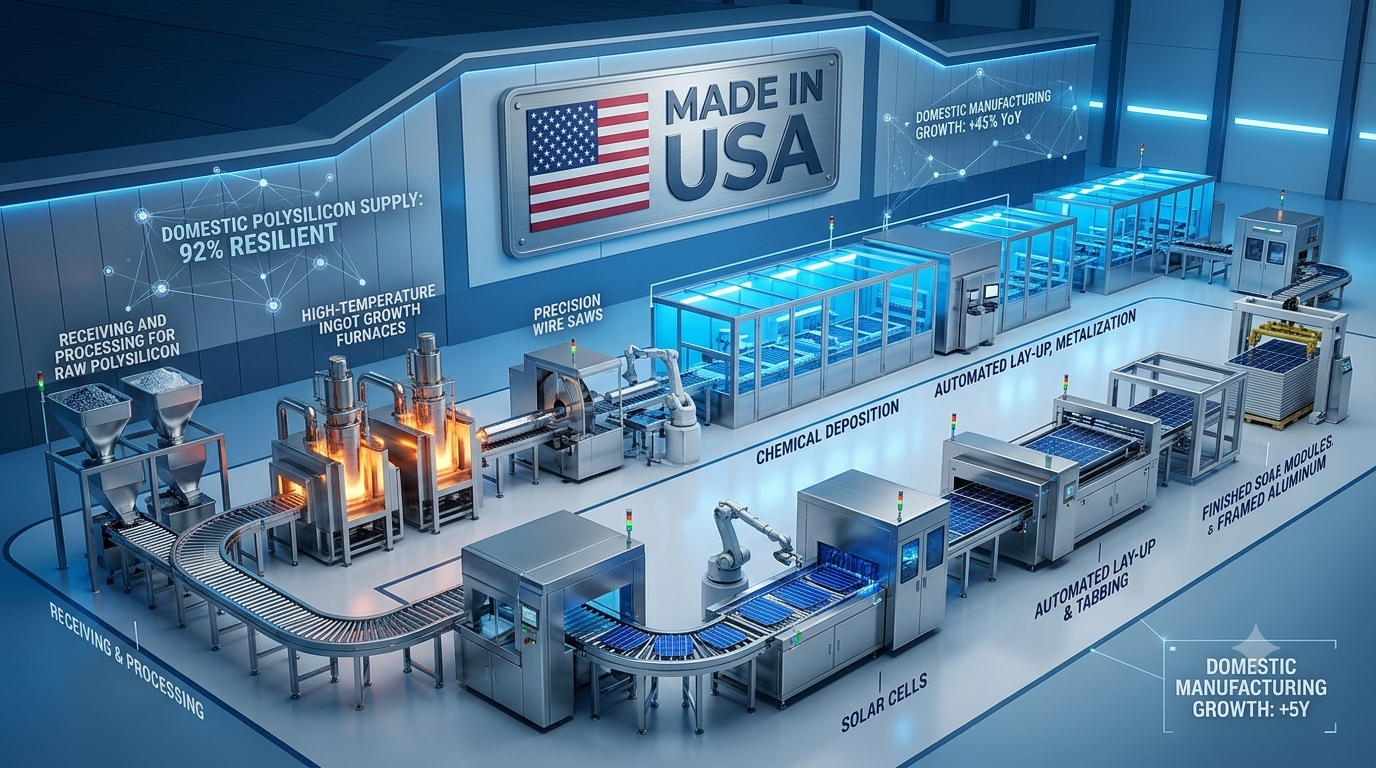
Strengthening domestic production is a central objective of the policy.
The United States has expanded its solar module assembly capacity, but manufacturing capacity at different stages of the supply chain has not necessarily developed at the same pace.
Producing finished modules domestically does not automatically mean that every input used in those modules is also manufactured in the United States.
A manufacturer may assemble panels domestically while purchasing cells or wafers from overseas suppliers.
This distinction matters because trade measures affecting imported upstream materials can increase the costs faced by downstream manufacturers.
Potential benefits
The new measures could improve the competitive position of some U.S. producers by changing the economics of imported materials.
They may also encourage companies to evaluate domestic investments in polysilicon, ingots, wafers, and solar cells.
Greater domestic production could eventually support supply-chain diversification and create opportunities for U.S. manufacturing.
Potential challenges
Building manufacturing facilities requires capital, suitable infrastructure, equipment, skilled workers, and time.
Companies must also consider production costs, customer demand, technology changes, and future policy conditions.
A policy that makes imported products more expensive does not automatically make domestic production immediately available or economically competitive at every stage.
In its October 2026 analysis, Wood Mackenzie noted that the measures may benefit manufacturers that already have more integrated production capabilities, while the economics of establishing new upstream manufacturing capacity remain challenging.
Therefore, the long-term result will depend on actual investment decisions and the ability of domestic manufacturers to expand production competitively.
For solar installers, the important question is not simply whether U.S. manufacturing will increase. It is whether reliable, competitively priced equipment will be available when a project needs it.
9. What Should Solar Installers and EPC Companies Do Before December 4?
Businesses do not need to predict every possible market movement to improve their preparedness.
They can begin with practical steps that strengthen procurement planning, cost estimates, and customer communication.
Step 1: Review current supplier quotations
Identify quotations that will expire before equipment is expected to be purchased.
Ask suppliers to clarify:
- How long the quoted price remains valid.
- Whether the equipment is already in U.S. inventory.
- Whether the supplier expects to revise pricing.
- Whether the quotation depends on a particular shipment or customs arrangement.
- Which costs are included and which remain subject to change.
A supplier’s answer should be documented rather than treated as a general market guarantee.
Step 2: Identify projects with delayed procurement
Review projects that have been quoted but have not yet reached the equipment purchasing stage.
Prioritize projects with long approval processes or installation dates extending into 2027.
Determine whether the original equipment assumptions are still current.
Step 3: Check contract terms
Review customer agreements and supplier contracts to understand how price changes are handled.
Pay particular attention to quotation validity, equipment substitutions, price-adjustment provisions, delivery schedules, and responsibility for additional costs.
Businesses should seek qualified legal advice when contract interpretation is uncertain.
Step 4: Build alternative cost scenarios
Instead of relying on one forecast, prepare several scenarios.
For example:
- Base case: Current supplier quotations remain available.
- Moderate-cost scenario: Some equipment costs increase.
- Higher-cost scenario: Replacement equipment becomes more expensive and procurement is delayed.
These scenarios should be based on clearly stated assumptions rather than unsupported predictions.
This approach helps businesses understand how sensitive a project’s budget and profitability are to equipment costs.
Step 5: Confirm product sourcing and applicable duties
Do not assume that all solar modules are treated identically.
Ask suppliers for accurate product-origin and sourcing information. Importers should confirm applicable tariff classifications, country-of-origin rules, and customs requirements with qualified professionals.
Other trade measures may also apply to particular products or origins.
Step 6: Communicate early with customers
If an equipment quotation is valid only for a limited period, make that limitation clear.
Where appropriate, explain that final equipment pricing depends on supplier confirmation and applicable market conditions.
Clear communication is preferable to promising a fixed price based on assumptions that have not been verified.
Step 7: Maintain accurate project documentation
Keep current records of:
- Equipment specifications
- Supplier quotations
- Proposal versions
- Design assumptions
- Project revisions
- Procurement dates
- Customer approvals
Good documentation makes it easier to understand why a project budget changed and which assumptions need to be updated.
10. Why Accurate Solar Proposals and System Design Matter During Cost Uncertainty
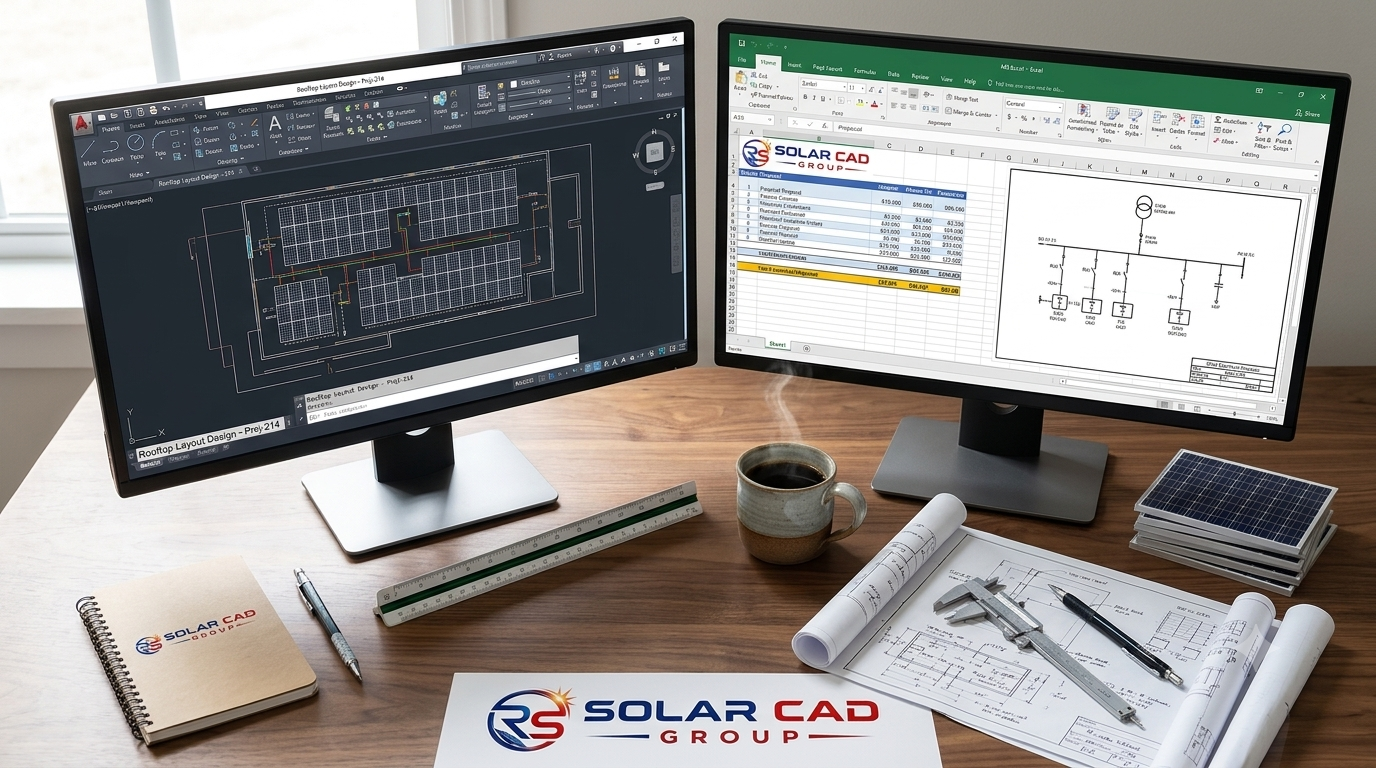
When equipment prices are uncertain, businesses may focus primarily on purchasing and supplier negotiations.
These activities are important, but the quality of the project design and proposal also matters.
A proposal should accurately reflect the intended system configuration, equipment assumptions, and project requirements.
If the equipment changes, the company may need to review the design and associated documentation before proceeding.
Solar proposal design
Solar proposals help installers communicate a project’s estimated system capacity, expected configuration, and commercial assumptions.
Accurate proposals make it easier to compare equipment options and communicate changes to customers.
When supplier pricing changes, the company can review the relevant assumptions rather than rebuilding the entire proposal without a clear record of the original design.
PV system and layout design
A well-prepared PV layout helps establish the intended module arrangement and system configuration.
Roof conditions, available installation areas, shading, setbacks, equipment specifications, and applicable project requirements all influence the final design.
The goal is not simply to fit as many panels as possible. It is to develop a technically appropriate layout for the specific site.
When a project requires an equipment substitution, the design should be reviewed to confirm that the revised components remain compatible with the system.
Permit-ready plans and revisions
Solar projects must satisfy applicable permitting and inspection requirements.
Changes to equipment or system configuration may require updates to drawings and associated documentation, depending on the nature of the change and the authority having jurisdiction (AHJ).
Accurate plans can help teams coordinate design, permitting, and construction more effectively.
However, design support cannot guarantee approval by an AHJ or eliminate every possible revision.
Electrical drawings and engineering support
Electrical documentation helps communicate how the system’s components are connected and how the proposed system is intended to operate.
Depending on the project, documentation may include electrical drawings, Single-Line Diagrams (SLDs), and engineering reviews.
When equipment specifications change, the relevant electrical design assumptions must be checked rather than simply replacing one product name in a drawing.
The broader lesson is that cost management involves more than buying equipment at the lowest price. It also requires accurate project assumptions, appropriate system design, and reliable documentation.
11. How RS Solar CAD Group Can Support Solar Businesses

As the U.S. solar market responds to changing equipment costs and trade policies, installers and EPC companies need dependable design support to help manage project workloads.
RS Solar CAD Group provides solar design and engineering support for solar businesses working across the U.S. and Canadian markets.
Our services include:
Solar Proposal Design: Proposal support to help solar businesses present system configurations and project information clearly.
PV System & Layout Design: Site-specific photovoltaic system layouts based on available project information and applicable technical requirements.
Permit-Ready Plan Sets & Revisions: Drawing preparation and revision support to help teams address project documentation requirements.
Structural & Electrical Engineering: Engineering support and applicable professional engineering stamps, subject to project scope, jurisdiction, and professional review requirements.
Single-Line Diagrams & NEC-Based Design: Electrical documentation developed with applicable project requirements and relevant code considerations in mind.
Utility Interconnection & HOA Documentation: Support with the documentation required for utility interconnection applications and homeowners association submissions, as applicable to the project.
Our aim is to help solar businesses manage their design and documentation workload while maintaining a clear and organized project workflow.
Accurate design documentation does not eliminate market uncertainty or guarantee project approval. It can, however, support better coordination between proposals, engineering, permitting, and construction.
For businesses reviewing their 2027 project pipeline, dependable design support can be one part of a broader strategy for managing changing costs and delivery schedules.
12. Frequently Asked Questions
1. What is changing in the U.S. solar industry on December 4, 2026?
Certain Section 232 trade measures covering imported polysilicon and specified derivatives are scheduled to take effect on December 4, 2026. The framework includes minimum import prices at several supply-chain stages and additional duties on specified products.
2. Will every solar panel become more expensive on December 4?
No. The policy does not establish one universal selling price for every solar panel. The effect on a particular product depends on whether it is covered, its sourcing and customs treatment, supplier pricing, inventory, and other market conditions.
3. Does the 15% tariff apply to every solar product?
No. The announced additional duty applies to specified products under the proclamation. Businesses should confirm the treatment of individual products with a qualified customs professional.
4. What are the announced minimum import prices?
The proclamation establishes minimum import prices for covered products of $21/kg for polysilicon, $100/kg for silicon ingots and wafers, $0.22/W for solar cells, and $0.38/W for solar modules.
These thresholds should not be confused with universal market prices for all domestically sold products.
5. Will the new policy affect residential solar installations?
It could affect residential installers through changes in equipment sourcing and supplier quotations. The actual effect on a homeowner’s installation price will depend on equipment costs, labor, financing, installer margins, and other project-specific factors.
6. How could commercial solar projects be affected?
Commercial projects may be exposed to changes in module procurement costs, project budgets, and financial assumptions. Projects with long development timelines may need more frequent supplier-price reviews.
7. Should installers purchase all their equipment before December 4?
Not necessarily. Purchasing decisions should consider confirmed pricing, storage costs, delivery schedules, cash flow, equipment requirements, contract terms, and the actual applicability of the new measures.
Buying equipment early is not automatically the most economical option for every company.
8. Will the policy eliminate U.S. dependence on imported solar components?
Not immediately. Expanding domestic manufacturing requires investment, production capacity, infrastructure, and competitive operating costs. The extent of any reduction in import dependence will depend on future manufacturing growth and supply-chain development.
9. What should an EPC company do if module prices change after a proposal has been sent?
The company should review the supplier quotation, confirm the revised equipment cost, check its customer contract, and determine whether the proposal or project budget needs updating. Any price adjustment should be communicated in accordance with the applicable agreement.
10. Why is solar design important when equipment prices change?
Equipment substitutions can affect system configuration, electrical compatibility, layouts, and project documentation. Reviewing the design helps ensure that changes are evaluated technically rather than treated as a simple purchasing decision.
11. Can accurate solar design guarantee permit approval?
No. Approval depends on the project’s compliance with applicable requirements and the decisions of the relevant authority. Accurate, complete documentation can support the review process but cannot guarantee an outcome.
12. What is the most important action solar businesses should take before December 2026?
Review supplier quotations, identify projects with future procurement dates, confirm applicable trade requirements, and evaluate the financial impact of possible equipment-cost changes. These steps provide a more reliable basis for decisions than assuming a single price increase will affect the entire market.
Conclusion: Prepare for the Change, but Make Decisions Based on Verified Costs
The U.S. solar industry’s December 2026 trade measures represent an important development in the relationship between solar manufacturing, international trade, and project economics.
By establishing minimum import prices for covered products and additional duties on specified downstream goods, the policy seeks to strengthen domestic manufacturing and reshape parts of the solar supply chain.
At the same time, its effects will not be identical for every manufacturer, distributor, installer, or project developer.
Some businesses may face higher equipment costs. Others may continue to benefit from existing inventory, established contracts, or different sourcing arrangements. The extent of any price changes will depend on how suppliers, manufacturers, and customers respond as the measures take effect.
For U.S. solar installers and EPC companies, the most practical response is to review supplier pricing, understand contract exposure, plan procurement carefully, and keep project budgets aligned with verified equipment costs.
Accurate proposals, appropriate PV layouts, complete permit documentation, and reliable engineering support can also help businesses coordinate project requirements as market conditions evolve.
The objective is not to predict every market movement. It is to make better-informed decisions, reduce avoidable project uncertainty, and prepare for changing conditions without relying on assumptions.
Need Solar Design and Engineering Support?
RS Solar CAD Group supports solar installers and EPC companies with solar proposal design, PV system and layout design, permit-ready plan sets, revisions, and engineering documentation.
Whether you are preparing new residential installations or managing a commercial solar project pipeline, our team can help support your design and documentation requirements.
Website: www.rssolarcadgroup.com
Email: sales@rscadgroup.com
Contact RS Solar CAD Group to discuss your upcoming solar design and engineering needs.
Important Information
This article provides general industry information and is not legal, customs, tax, or financial advice. Trade measures, product classifications, exemptions, and implementation requirements may change. Businesses should consult official government guidance and qualified professionals before making procurement or compliance decisions.