What Happens to Solar Panels After 25 Years? India’s Growing Solar Waste Challenge
Introduction: The Hidden Challenge Behind India’s Solar Energy Revolution
India’s solar energy revolution is transforming the country’s power sector. From residential rooftop installations and commercial buildings to large utility-scale solar parks, solar power is becoming an increasingly important part of India’s energy future.
Solar panels help reduce dependence on conventional energy sources, support clean electricity generation, and contribute to India’s renewable energy ambitions. As installations continue to grow, the country is building a larger and more diverse solar infrastructure.
However, there is an important question that deserves greater attention:
What happens to millions of solar panels when they stop producing electricity efficiently or reach the end of their useful life?
Solar panels are generally designed to operate for approximately 25 to 30 years, although their actual lifespan depends on manufacturing quality, environmental conditions, maintenance, and operating performance. Many panels continue producing electricity beyond this period, but their output may gradually decline.
As India’s solar installations mature, managing damaged, outdated, and end-of-life panels will become an increasingly important challenge.
According to information provided by the Government of India in March 2026, estimates supported by the Council on Energy, Environment and Water (CEEW) suggest that cumulative waste from existing and projected solar installations could reach approximately 600 kilotonnes by 2030.
That is equivalent to around 600,000 metric tonnes of solar waste.
This estimate highlights why solar waste management needs attention well before the first generation of India’s large solar installations reaches the end of its expected lifespan.
The challenge is not simply about disposing of old panels. It is about protecting the environment, recovering valuable materials, developing recycling infrastructure, and ensuring that the clean energy transition remains sustainable throughout the entire lifecycle of solar equipment.
1. How Long Do Solar Panels Actually Last?
Solar panels are long-term investments designed to generate electricity for decades.
Most conventional crystalline silicon solar panels are expected to remain operational for approximately 25 to 30 years. However, this does not mean that every panel suddenly stops working after its 25th anniversary.
Instead, solar panels gradually lose some of their electricity-generating capability over time. This process is known as degradation.
For example, a panel that originally produces 400 watts may generate somewhat less power after years of exposure to sunlight, heat, humidity, dust, and other environmental conditions.
The actual reduction depends on the panel’s technology, quality, installation conditions, and operating environment.
Several factors influence how long a solar panel remains useful:
Manufacturing quality: Well-manufactured panels with durable materials may perform reliably for decades.
Climate conditions: High temperatures, humidity, salt exposure, and extreme weather can accelerate certain types of deterioration.
Installation quality: Improper mounting, structural movement, or poor handling can contribute to physical damage.
Maintenance: Appropriate inspection and maintenance can help identify problems before they become serious.
Technological improvements: Newer panels may produce more electricity from the same roof area, encouraging some system owners to consider upgrading older equipment before it completely fails.
Importantly, reaching the end of a manufacturer’s performance warranty does not automatically mean that a panel must be discarded.
A panel may continue generating useful electricity even after its warranty period expires. Its suitability for continued use should be assessed based on its condition, safety, electrical performance, and the requirements of the installation.
This distinction matters because the goal should not be to replace panels simply because they have become old. Instead, system owners should determine whether continued operation, repair, reuse, refurbishment, or recycling offers the most appropriate solution.
2. Why Is Solar Panel Waste Becoming a Major Concern in India?
India’s growing solar capacity creates an important environmental and industrial opportunity. At the same time, it creates a future responsibility to manage the equipment installed today.
There are several reasons why solar waste deserves attention now.
A. India’s Solar Installations Are Expanding Rapidly
Solar panels installed during the early stages of India’s solar expansion will eventually reach the end of their useful lives.
As more residential, commercial, industrial, and utility-scale installations are commissioned, the quantity of equipment requiring maintenance, replacement, and eventual recycling will increase.
The challenge is particularly important for large solar projects containing thousands or millions of individual modules.
Replacing a small number of panels on a residential rooftop is very different from managing the retirement of equipment across a large solar park.
Both situations require appropriate handling, but utility-scale projects can generate substantial volumes of material within a relatively short period.
B. Solar Panels Can Become Waste Before 25 Years
One common misconception is that solar waste will appear only when panels reach the end of their expected lifespan.
In reality, panels can become unusable much earlier.
Possible causes include:
- Damage during transportation or installation.
- Broken glass caused by physical impact.
- Manufacturing defects.
- Electrical faults and damaged connections.
- Severe weather events, including hailstorms, cyclones, and flooding.
- Moisture-related deterioration or corrosion.
- Damage caused by inadequate mounting or installation practices.
- Replacement of older equipment during solar project upgrades.
For example, a commercial solar installation may suffer storm damage after only eight years of operation.
Even if most panels remain functional, damaged modules may require removal and replacement. Those removed modules must then be assessed for safe reuse, repair, or recycling.
This creates an early stream of solar waste long before the original installation reaches its expected lifespan.
C. Technology Is Improving
Solar technology continues to evolve.
Newer modules may provide higher power output, improved efficiency, or different physical characteristics compared with older models.
As a result, some project owners may decide to upgrade existing systems to increase electricity generation or make better use of available space.
However, replacing older panels is not automatically the most sustainable choice.
Project owners need to consider the cost of replacement, the remaining useful life of existing equipment, installation expenses, electrical compatibility, and the environmental impact of manufacturing new modules.
Where older panels remain safe and economically useful, continuing to operate them may be preferable to premature replacement.
Where replacement is justified, a responsible plan for the removed equipment becomes essential.
D. Solar Waste Requires Specialised Handling
Solar panels are not ordinary household rubbish.
A typical crystalline silicon solar module contains several materials bonded together, including glass, aluminium, silicon-based solar cells, polymers, and electrical conductors.
Depending on the module’s design and manufacturing technology, it may also contain small quantities of other metals and substances that require appropriate handling.
If panels are broken, dismantled improperly, or discarded without suitable controls, materials may be lost and environmental risks may increase.
For this reason, solar waste should be managed through appropriate collection, storage, transportation, and treatment systems rather than being treated as an ordinary discarded construction material.
3. How Much Solar Waste Could India Generate by 2030 and 2050?
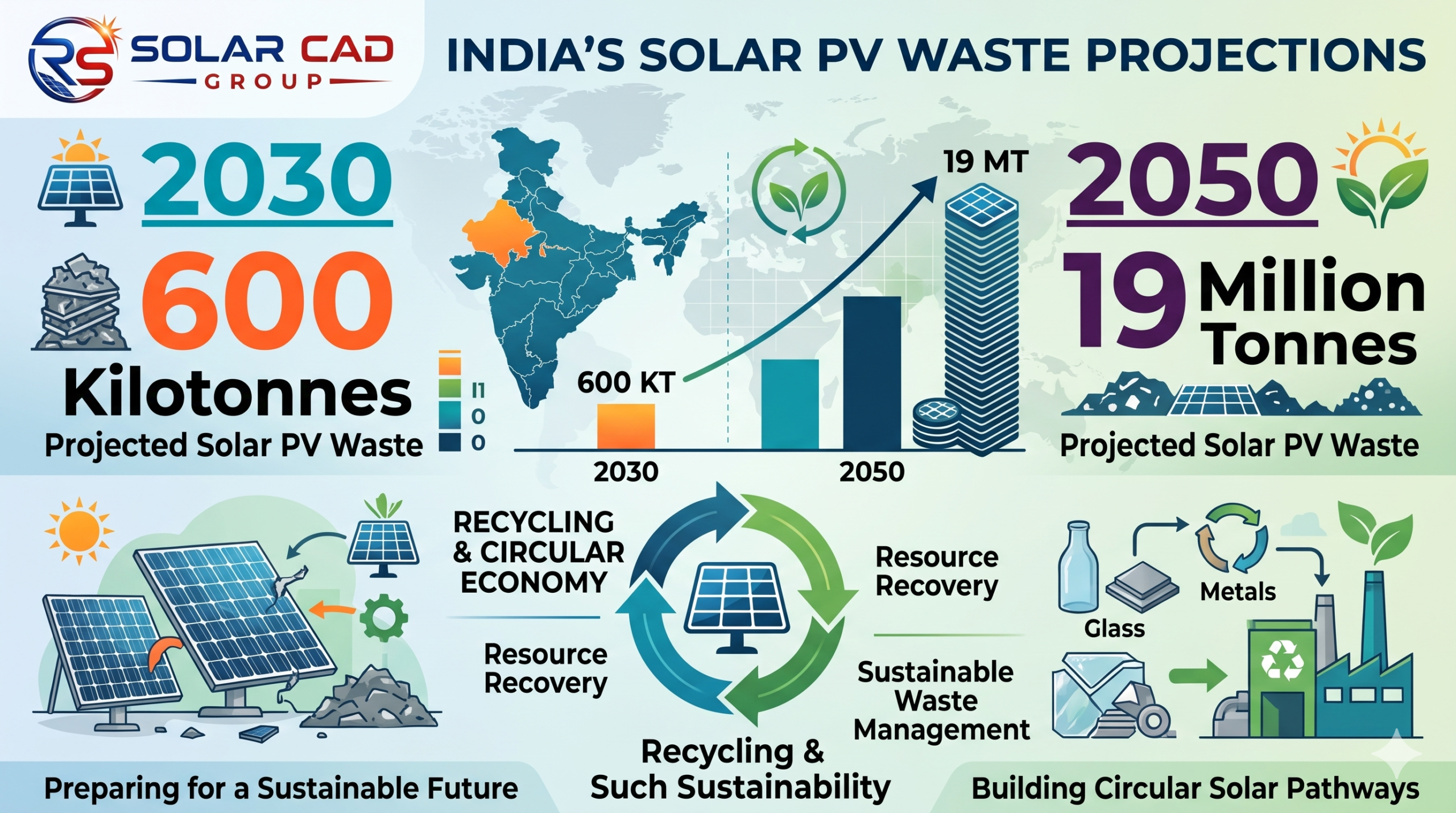
Understanding the potential scale of the problem helps explain why solar recycling infrastructure needs to develop alongside new installations.
In March 2026, the Government of India reported an estimate that cumulative waste from existing and projected solar capacity installations could reach approximately 600 kilotonnes by 2030.
Earlier research by CEEW, published in 2024, projected that India’s cumulative solar photovoltaic waste could reach approximately 19 million tonnes by 2050.
These figures demonstrate the potential long-term scale of the challenge.
However, it is important to understand what the numbers represent.
They are estimates rather than measurements of waste that has already accumulated. Different studies may use different assumptions about future installations, panel lifetimes, early failures, and the categories of waste included.
Therefore, projections should be interpreted according to their underlying methodology rather than treated as exact predictions.
What Do These Estimates Mean for the Solar Industry?
Consider a hypothetical large solar project containing 100,000 panels.
If a substantial proportion of those panels eventually require replacement, the project owner must organise more than the installation of new equipment.
The process may also involve:
- Identifying the panels that need replacement.
- Assessing whether removed panels remain usable.
- Arranging safe disconnection and dismantling.
- Transporting modules to suitable collection or treatment facilities.
- Recording the equipment removed from the project.
- Recovering recyclable materials.
- Managing components that cannot be reused or recycled through the available processes.
Now consider these requirements across hundreds of projects.
The resulting need for logistics, trained workers, testing services, recycling facilities, and material recovery systems could create an entirely new segment of India’s renewable energy industry.
The key takeaway is that solar waste is not a distant problem that begins in 2050. Planning for it must begin while new solar capacity is still being developed.
4. What Happens to Solar Panels When They Stop Working?
A solar panel reaching the end of its useful life does not necessarily have to be sent directly for disposal.
Depending on its condition, there are several possible pathways.
Step 1: Inspection and Performance Assessment
The first step is to determine why the panel has been removed from service.
A panel with reduced output may still be functional. Another panel may have broken glass, damaged electrical connections, moisture ingress, or other defects that make continued use unsafe.
Assessment may include visual inspection, electrical testing, and other appropriate diagnostic procedures.
The objective is to establish whether the equipment can continue operating safely or whether it needs repair, refurbishment, or recycling.
Step 2: Reuse or Refurbishment
Some removed panels may retain useful performance and can potentially be reused.
For example, a panel removed during a project upgrade may still produce electricity at an acceptable level.
Following suitable testing and safety checks, it may be possible to reuse such equipment in an appropriate application.
However, reuse should not be based on appearance alone. Electrical safety, insulation condition, performance, mounting compatibility, and applicable technical requirements must be considered.
Refurbishment may also be appropriate for certain components or equipment, depending on the nature of the defect and the availability of qualified service providers.
Step 3: Material Recovery
Panels that cannot reasonably be reused may be sent to appropriate recycling facilities.
The recycling process aims to recover materials that can potentially return to manufacturing or other industrial applications.
Recovered materials may include:
- Glass.
- Aluminium from frames.
- Copper from certain electrical components.
- Silicon-containing materials.
- Silver and other metals, depending on the module technology and the recycling process.
The quantity, purity, and economic value of recovered materials depend on the panel design, condition, processing technology, and recovery method.
Step 4: Responsible Management of Remaining Materials
Not every component can necessarily be recovered economically using currently available processes.
Some materials may remain mixed, contaminated, or difficult to separate.
These materials require appropriate treatment or disposal according to applicable environmental requirements.
A successful recycling system therefore needs to consider the entire panel rather than focusing exclusively on the most valuable components.
The ultimate objective is to recover as much useful material as practicable while minimising environmental harm and the amount of waste requiring final disposal.
5. What Materials Can Be Recovered From Old Solar Panels?
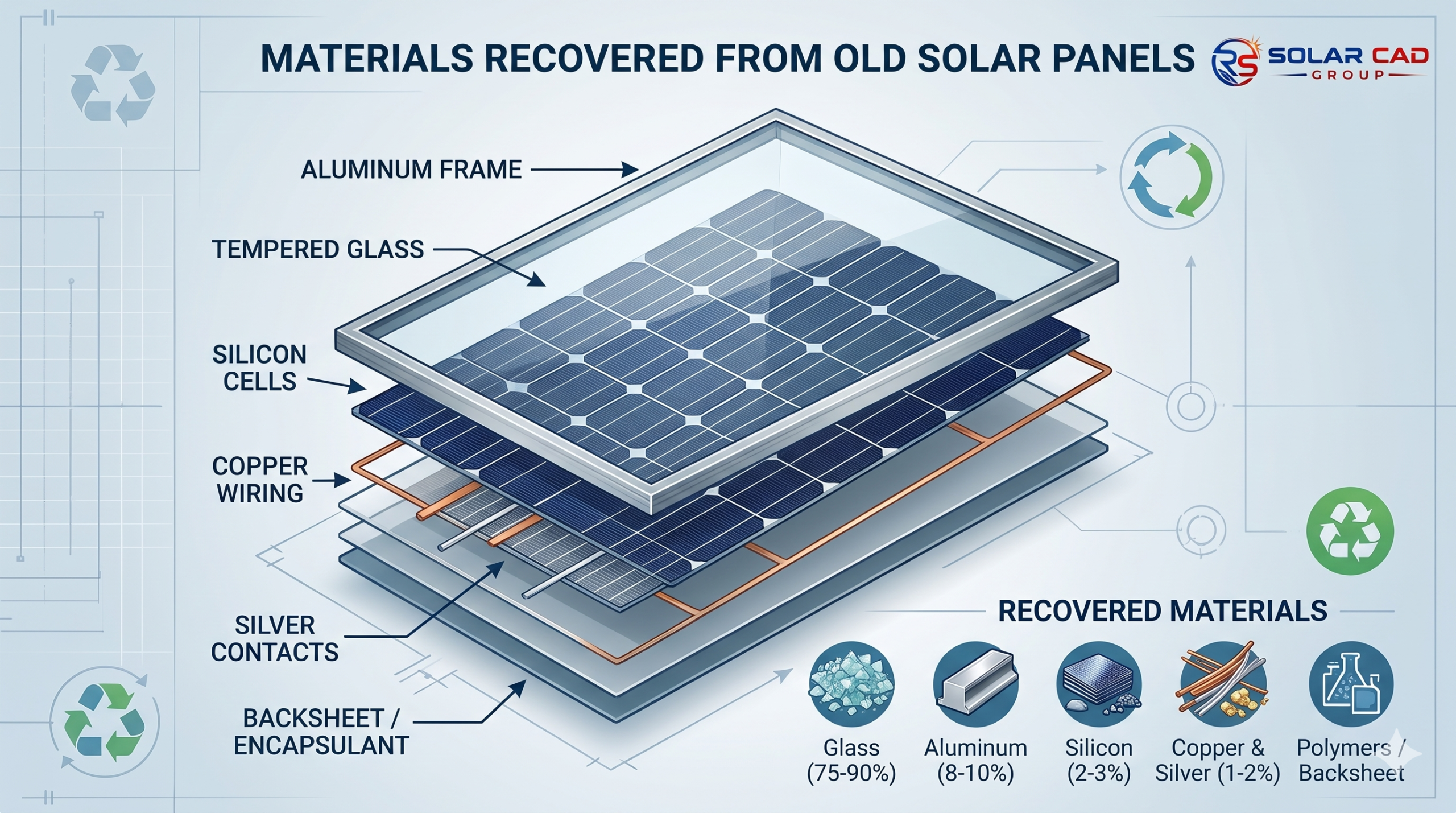
One of the most important opportunities in solar recycling is the recovery of materials that would otherwise be lost.
Glass
Glass generally makes up the largest share of the mass of a conventional crystalline silicon solar module.
The front glass protects the solar cells from external conditions while allowing sunlight to pass through.
If recovered at a suitable level of quality, glass may be used in appropriate recycling applications.
However, removing glass from a solar module without excessive contamination or damage can be technically challenging because it is bonded to other layers.
Aluminium
Aluminium is commonly used in solar panel frames.
It has established recycling markets and can often be recovered more straightforwardly than some of the materials embedded within the module.
Recovering aluminium can reduce the need for new raw materials and support resource efficiency.
Silicon
Silicon is the principal semiconductor material in conventional crystalline silicon solar cells.
Recovering it for reuse in high-quality solar manufacturing can be more technically demanding than recovering a panel’s aluminium frame.
Processing requirements depend on the purity needed, the condition of the material, and the intended application.
Silver and Copper
Silver is used in electrical contacts in many crystalline silicon solar cells, while copper is used in certain conductors and electrical components.
These materials can have economic value, but the amount present in an individual panel is limited.
Their recovery must therefore be assessed in relation to collection costs, processing efficiency, material prices, and the scale of the recycling operation.
Polymers and Other Components
Solar modules contain polymer materials that help bind and protect internal components.
These layers contribute to the durability of the panel but can make material separation difficult.
Depending on the technology, some components may be recovered, while others require specialised processing.
The real value of solar recycling lies in recovering useful materials safely and efficiently, not simply in breaking old panels into smaller pieces.
6. How Does Solar Panel Waste Affect the Environment?
Solar power generates electricity without the direct combustion emissions associated with conventional fossil-fuel power generation during operation.
However, solar panels still have environmental impacts throughout their lifecycle, including raw-material extraction, manufacturing, transportation, installation, and end-of-life management.
Responsible waste handling is therefore an essential part of making solar energy more sustainable.
Improper Disposal Can Cause Environmental Problems
Damaged panels discarded in unsuitable locations can create several concerns.
Broken glass presents physical hazards, while exposed electrical components and damaged wiring may create additional safety risks.
Certain panel technologies contain substances that require appropriate management. The environmental risk depends on the material, its chemical form, the condition of the panel, and how the waste is handled.
It would be inaccurate to assume that every solar panel is highly toxic. Equally, it would be irresponsible to assume that all discarded panels can be treated as harmless rubbish.
Appropriate handling and processing are necessary to reduce the risk of pollution and unsafe working conditions.
Valuable Resources Can Be Lost
Producing new solar panels requires raw materials, energy, industrial processing, and transportation.
When recoverable materials from old panels are discarded, the opportunity to use those materials again is lost.
Recycling can help retain resources within the economy and potentially reduce demand for some newly extracted materials.
The actual environmental benefit depends on the quality of recovered materials, the efficiency of the recycling process, and whether recovered materials can replace newly produced alternatives.
Waste Management Affects the Overall Sustainability of Solar Energy
The environmental performance of a solar installation should not be judged only by how much electricity it generates.
Its wider lifecycle also matters.
Responsible sourcing, durable equipment, efficient installation, maintenance, and end-of-life management can all contribute to a more sustainable solar industry.
In other words, producing clean electricity is only one part of the story. Managing the equipment responsibly throughout its lifecycle is another.
7. India’s Solar Waste Regulations: What Does the Government Require?
India has established a regulatory framework that includes solar photovoltaic modules, panels, and cells within the E-Waste (Management) Rules, 2022.
These rules took effect on 1 April 2023 and have been amended from time to time.
The framework includes requirements relating to producers and manufacturers, waste inventories, storage, reporting, and recycling.
According to the Ministry of New and Renewable Energy’s published explanation of the rules, relevant requirements include the following:
Producer registration: Manufacturers and producers covered by the rules must comply with applicable registration requirements.
Inventory and reporting: Solar photovoltaic waste must be accounted for separately, with the required records and annual returns maintained through the prescribed system.
Storage requirements: The rules provide for the storage of solar photovoltaic waste generated up to 2034–2035 in accordance with the applicable requirements and CPCB guidelines.
Recycling and material recovery: Solar PV recyclers must comply with the applicable material-recovery requirements and relevant environmental procedures.
The Central Pollution Control Board (CPCB) has a role in the implementation of the framework, including relevant guidance and reporting arrangements.
These requirements are important because solar waste management involves more than the physical act of recycling. It also requires traceability, accountability, and compliance with applicable regulations.
What Does This Mean for Solar Companies?
Manufacturers, project owners, installers, and recycling businesses should understand which obligations apply to their activities.
For example, a solar installation company replacing damaged modules should establish an appropriate process for handling the removed equipment rather than assuming that the responsibility ends once the replacement panels have been installed.
Businesses should also verify current regulatory requirements, applicable CPCB guidance, and any relevant state-level requirements before deciding how waste will be transported or processed.
Regulatory compliance should be treated as part of project planning, not as an administrative task to be considered only after the panels have been removed.
8. Why Is Solar Panel Recycling Difficult in India?
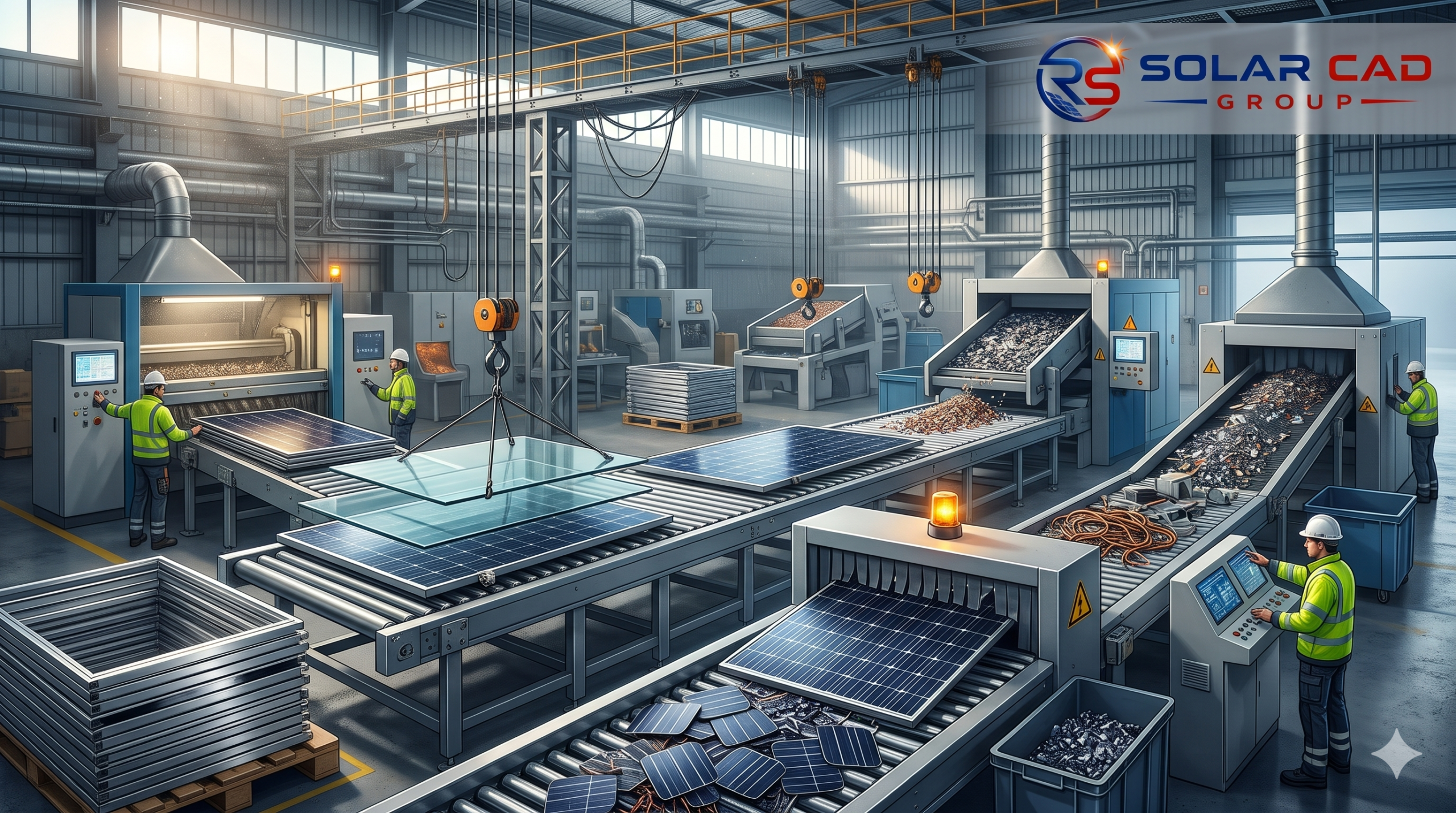
Although solar panels contain valuable materials, recycling them at scale is not always straightforward.
Several practical challenges must be addressed.
Challenge 1: Collection and Transportation
Solar panels are relatively large, and their glass components can break if they are handled improperly.
Collecting panels from geographically dispersed rooftop installations may be expensive compared with collecting waste from a single large solar park.
A practical recycling system needs efficient collection routes, suitable packaging, safe storage, and reliable transport arrangements.
Challenge 2: Separating Different Materials
Solar panels are designed to remain durable under outdoor conditions.
Glass, polymers, solar cells, and other components are bonded together to protect the panel from moisture and physical damage.
This durability creates a challenge at the end of the panel’s life because separating individual materials can require specialised equipment and processing.
The process must recover useful materials without creating excessive contamination or secondary waste.
Challenge 3: Recycling Economics
A recycling facility must consider the cost of collecting panels, transporting them, processing them, employing trained workers, and managing residual materials.
The revenue from recovered materials may not always cover the full cost.
The economic viability of recycling depends on the scale of operations, material prices, recovery rates, technology, and regulatory requirements.
This makes it important to develop recycling systems that are both environmentally responsible and commercially sustainable.
Challenge 4: Limited Awareness
Many solar system owners understand the installation and maintenance of solar panels but may not have considered what will happen when equipment is damaged or becomes outdated.
Without clear information about collection and recycling options, panels may remain in storage or enter unsuitable waste streams.
Greater awareness among homeowners, installers, commercial property owners, and solar project developers can help ensure that waste is directed towards appropriate facilities.
Challenge 5: Different Panel Technologies
Not all solar panels have the same design or material composition.
Crystalline silicon modules and thin-film modules, for example, can require different treatment approaches.
A recycling system must identify the technology involved and use an appropriate process rather than assuming that every panel can be recycled in exactly the same way.
9. Can Solar Waste Become a New Business Opportunity for India?
India’s growing solar waste challenge could also create opportunities for new businesses, skilled employment, and industrial innovation.
The objective should be to build a recycling ecosystem that is commercially viable while meeting environmental and safety requirements.
Solar Panel Collection Services
Businesses could specialise in collecting damaged or retired panels from residential rooftops, commercial buildings, factories, and large solar installations.
Such services would need suitable handling procedures, transport arrangements, and connections with authorised or otherwise appropriately compliant downstream facilities.
Testing and Refurbishment
Some removed panels may retain useful performance.
Businesses providing inspection, electrical testing, refurbishment, and equipment assessment could help determine whether panels are suitable for continued use or need recycling.
These services would need appropriate technical expertise and transparent reporting of equipment condition.
Recycling Technology
Companies developing improved methods for separating glass, metals, silicon, and other materials could help improve recovery rates and reduce processing costs.
Innovation may focus on better material separation, automation, process efficiency, and the recovery of materials that are difficult to reclaim using conventional techniques.
Recovered Material Markets
Recovered materials are valuable only when there are suitable uses and buyers for them.
Developing reliable markets for recycled glass, aluminium, silicon-containing materials, and other recovered components will be important for making recycling operations economically sustainable.
Manufacturers and recyclers can contribute by establishing quality standards and building dependable supply relationships.
Data and Waste Management Services
Solar waste management also creates a need for accurate equipment records.
Businesses could provide services to track module inventories, record replacements, coordinate collections, and document material recovery.
For large solar installations, better records could help project owners understand the condition and expected replacement needs of their equipment.
The opportunity is not limited to recycling plants. It also includes collection, testing, logistics, equipment management, material recovery, and supporting technologies.
10. What Can Solar Installers and EPC Companies Do Today?
Solar installers and engineering, procurement, and construction (EPC) companies play an important role in the solar equipment lifecycle.
Although many of today’s installations will continue operating for years, companies can begin preparing for end-of-life management now.
Maintain Accurate Equipment Records
Project documentation should identify the installed modules, relevant specifications, installation dates, and available warranty information.
These records can help determine which equipment may require inspection or replacement in the future.
Accurate documentation also makes it easier to identify the technology involved when a panel needs to be removed.
Improve Installation Quality
Proper handling during transportation and installation can reduce avoidable panel damage.
Installers should follow manufacturer instructions, use appropriate lifting and handling methods, and ensure that mounting systems are installed correctly.
Preventing early damage can reduce unnecessary replacements and the resulting waste.
Develop a Replacement and Collection Procedure
Companies should establish a process for handling panels removed during repairs, upgrades, or system replacement.
The procedure should cover safe removal, electrical isolation, temporary storage, transportation, and transfer to an appropriate reuse or recycling facility.
Responsibilities should be clear before a project begins.
Work With Suitable Recycling Partners
Installers and EPCs can develop relationships with recycling providers that have the appropriate capabilities and comply with applicable requirements.
Before selecting a provider, businesses should understand its collection arrangements, material recovery processes, documentation practices, and handling of residual waste.
Include End-of-Life Planning in Project Decisions
When considering an upgrade, businesses should compare the expected benefits of replacing existing equipment against the costs and environmental implications.
A technically sound assessment can help prevent premature replacement while ensuring that damaged or unsafe panels are handled appropriately.
Educate Customers
Residential and commercial customers should understand that removed solar panels need a responsible destination.
Installers can explain available collection options and make end-of-life handling part of the wider customer service process.
By planning ahead, companies can help avoid last-minute disposal problems and build greater confidence among their customers.
11. The Role of Solar Design and Engineering in Reducing Future Waste
Solar waste management is not only a recycling issue. It is also connected to decisions made during project planning and system design.
Good engineering cannot eliminate all equipment failures, but it can help reduce avoidable problems and support longer-term system performance.
Accurate Site Assessment
Understanding roof conditions, shading, mounting requirements, and site-specific environmental factors can help designers develop suitable system layouts.
A poorly planned installation may face operational or structural problems that could have been avoided through better assessment.
Appropriate Equipment Selection
Panels and associated equipment should be selected according to project requirements, environmental conditions, manufacturer specifications, and applicable standards.
The objective is to create a system that performs reliably under its expected operating conditions.
Proper Layout and Mounting Considerations
Panel positioning, structural support, mounting arrangements, and access for maintenance all influence the practical operation of a solar installation.
Well-considered designs can make inspection and maintenance easier while helping installers follow appropriate mounting and safety requirements.
Documentation and Future Modifications
Clear design documentation can help future technicians understand the system’s configuration.
When repairs, upgrades, or replacements become necessary, accurate drawings and equipment records can support more efficient decision-making.
This is particularly important for commercial and utility-scale installations where modifications may affect large numbers of modules.
Designing for Long-Term Value
The cheapest installation is not necessarily the most economical over its entire life.
Project decisions should consider reliability, maintenance requirements, replacement costs, operational performance, and eventual waste management.
For the solar industry, long-term value means more than generating electricity at the lowest initial cost. It also means managing equipment responsibly throughout its useful life.
12. What Is a Circular Economy, and Why Does It Matter for Solar Energy?
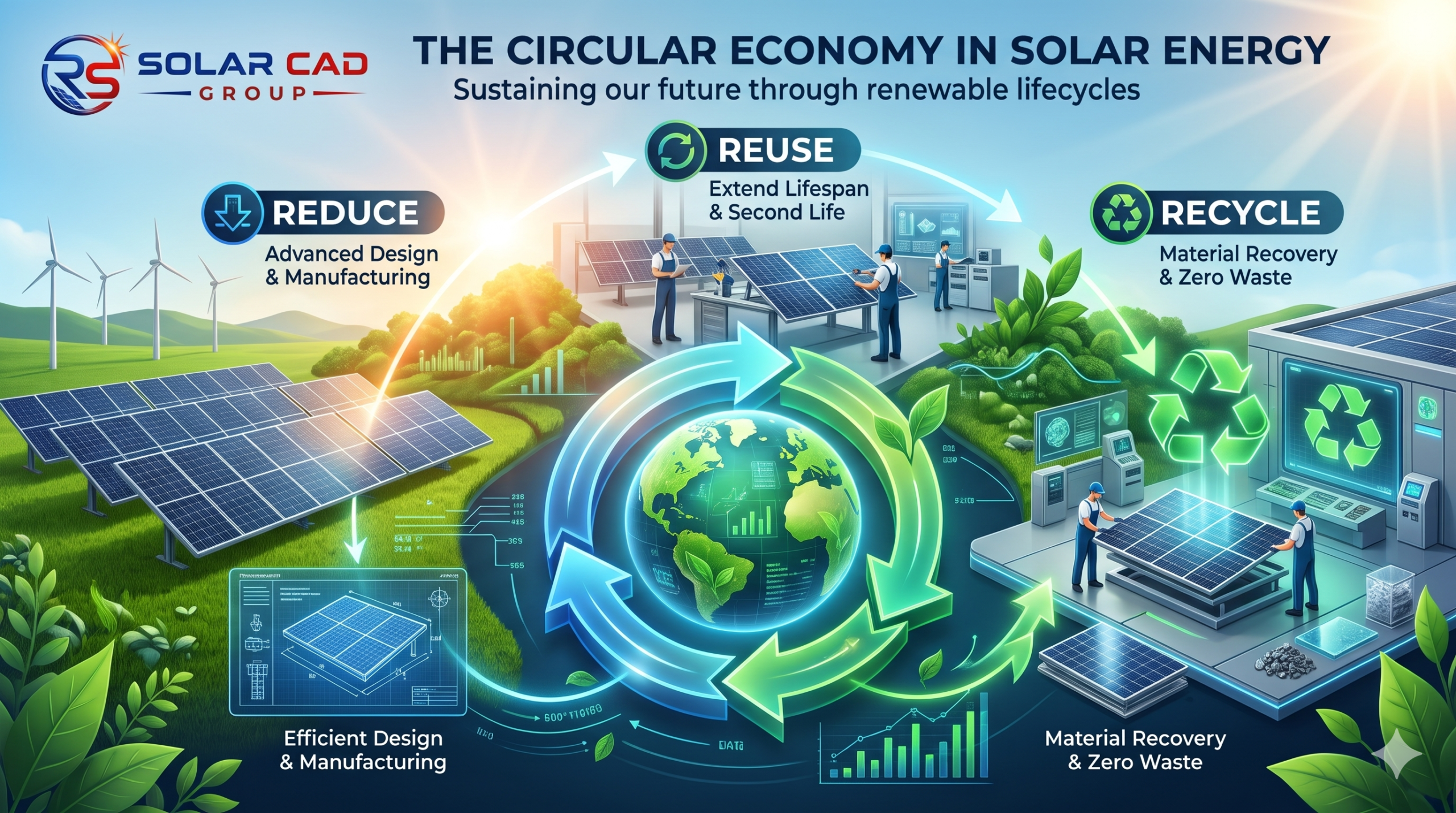
A circular economy aims to keep products and materials in use for as long as practical, reduce waste, and recover resources rather than continually relying on new raw materials.
This approach is particularly relevant to solar energy because panels contain materials that may remain useful after the original equipment has been removed from service.
A circular solar economy can be understood through three main principles.
Reduce
Prevent unnecessary waste by improving manufacturing quality, handling, installation, and maintenance.
Reducing premature failures can extend the useful life of equipment and lower the volume of modules requiring replacement.
Reuse
Where technically and economically appropriate, inspect and reuse panels or components that remain safe and functional.
Reuse should be supported by suitable testing, transparent condition assessments, and compliance with relevant safety requirements.
Recycle
Recover valuable materials from equipment that cannot reasonably be reused.
Effective recycling can help return materials to industrial supply chains while reducing the need for final disposal.
These three principles work together.
A panel that can safely remain in service should not automatically be recycled. A panel that is unsafe or unsuitable for reuse should not be kept in operation simply to avoid creating waste.
The correct approach depends on the condition of the equipment, its remaining useful life, available processing technology, and environmental considerations.
For India, developing a circular solar economy could support resource efficiency, industrial innovation, and a more comprehensive approach to renewable energy sustainability.
13. What Should India Do Next?
Addressing the solar waste challenge will require coordination among government agencies, manufacturers, solar developers, installers, recyclers, researchers, and consumers.
Several priorities deserve attention.
- Expand recycling capacity. India needs suitable facilities capable of processing growing volumes of solar waste and recovering materials efficiently.
- Strengthen collection networks. Collection and transportation systems should serve both large solar parks and smaller distributed installations.
- Improve waste tracking. Reliable information about panel inventories, damaged modules, replacements, and recovered materials can help businesses and policymakers plan ahead.
- Encourage technology development. Research into material separation, recovery efficiency, and cost-effective recycling can improve the commercial viability of solar waste management.
- Support appropriate reuse. Where equipment remains safe and useful, testing and refurbishment can help extend its service life.
- Improve industry awareness. Installers, project owners, and consumers should understand their responsibilities and the available options for managing discarded panels.
- Develop commercially sustainable models. Recycling businesses need practical ways to manage collection costs, processing expenses, material prices, and compliance requirements.
- Maintain clear regulatory guidance. Stakeholders need to understand applicable requirements for storage, transportation, reporting, recovery, and final treatment.
These priorities are interconnected. Building a recycling plant alone will not solve the problem if waste cannot be collected efficiently or recovered materials have no reliable market.
Likewise, strong regulations will be more effective when suitable infrastructure and trained personnel are available.
India’s long-term success will depend on developing the complete system, from the moment a panel is removed from service to the final recovery or treatment of its materials.
14. The Future of Solar Energy Must Include Responsible Waste Management
India’s solar energy expansion represents an important step towards a cleaner and more diversified electricity system.
But the success of the solar transition should not be measured only by the number of new installations or the amount of electricity generated.
It should also be measured by how effectively the industry manages the equipment it has already installed.
As solar projects mature, the country will need better collection systems, reliable recycling infrastructure, suitable material recovery technologies, and clear responsibilities for everyone involved in the solar value chain.
This challenge also offers an opportunity to build new industries around recycling, refurbishment, logistics, testing, and recovered materials.
The transition will not happen overnight. It will require investment, technical expertise, industry collaboration, and consistent attention to environmental responsibility.
However, preparing early can help India avoid preventable waste, recover valuable resources, and strengthen the long-term sustainability of its renewable energy sector.
Conclusion: Clean Energy Needs a Clean End-of-Life Strategy
Solar panels are designed to generate electricity for decades, but no equipment lasts forever.
When panels become damaged, outdated, or unsuitable for continued use, their next destination matters.
Sending them to an appropriate recycling or treatment facility can help recover useful materials and reduce the risks associated with improper disposal. Where panels remain safe and functional, continued use or refurbishment may also be appropriate.
India’s projected solar waste volumes make it clear that end-of-life management should become a normal part of solar project planning rather than an afterthought.
For manufacturers, installers, EPC companies, policymakers, and recycling businesses, the time to prepare is now.
The future of solar energy is not just about producing clean electricity. It is about creating a complete lifecycle in which resources are used responsibly, waste is minimised, and valuable materials remain in circulation for as long as possible.
As India continues expanding its solar capacity, responsible solar waste management can become an important part of building a genuinely sustainable energy future.
Frequently Asked Questions (FAQs)
1. What happens to solar panels after 25 years?
Solar panels do not automatically stop working after 25 years. Many continue producing electricity, although their output may decline over time. Depending on their condition and safety, they can remain in service, be refurbished, be reused in suitable applications, or be sent for recycling.
2. How much solar waste could India generate by 2030?
The Government of India reported in March 2026 that estimates supported by CEEW suggest cumulative waste from existing and projected solar capacity installations could reach approximately 600 kilotonnes by 2030. This is a projection, not a measurement of waste already generated.
3. Can solar panels be recycled?
Yes. Many solar panel materials, including glass and aluminium, can be recovered. Other materials, such as silicon and certain metals, may also be recovered using suitable processes. The amount recovered depends on the panel’s technology and the recycling method.
4. Are old solar panels hazardous to the environment?
The environmental risk depends on the panel’s technology, condition, material composition, and handling method. Broken or improperly discarded panels can create physical and environmental risks. Appropriate storage, transportation, and recycling help reduce these risks.
5. Does India have rules for solar panel waste management?
Yes. Solar photovoltaic modules, panels, and cells are covered under the E-Waste (Management) Rules, 2022, which took effect on 1 April 2023 and have been amended from time to time. Applicable requirements include provisions concerning producers, inventories, storage, reporting, and material recovery.
6. Can damaged solar panels be repaired?
Some panels or associated components may be repairable, but the decision depends on the nature of the damage and the safety of the equipment. Panels with broken glass or electrical damage require appropriate assessment by qualified personnel before any decision about reuse.
7. Why is solar panel recycling important for India?
Recycling can help recover valuable materials, reduce avoidable waste, support resource efficiency, and create opportunities for new businesses. It also helps India prepare for the growing volume of equipment that will eventually need replacement or end-of-life treatment.
8. What can solar installers do to reduce solar waste?
Installers can improve handling and installation quality, maintain accurate equipment records, identify damaged modules early, educate customers, and establish appropriate procedures for collecting and transferring removed panels to suitable reuse or recycling facilities.
9. Will all solar panels need replacement after 25 years?
No. The 25-year period is a general industry reference, not a universal expiration date. Some panels may continue operating beyond that period, while others may require replacement much earlier because of damage, defects, or changing project requirements.
10. How can solar waste support India’s circular economy?
Solar waste can supply materials for recovery and reuse, support specialised recycling businesses, and create opportunities for innovation in collection and processing. A circular approach aims to extend equipment life where appropriate and recover useful resources when equipment can no longer be used.
A More Sustainable Solar Future Starts Today
India has an opportunity to build a solar industry that considers not only how panels are installed and operated, but also what happens when they are removed from service.
Through better planning, responsible handling, suitable recycling infrastructure, and collaboration across the industry, solar waste can be managed as a resource challenge rather than an unavoidable environmental burden.
At RS Solar CAD Group, we believe that careful solar project planning and engineering are important parts of developing reliable solar installations. As the industry evolves, long-term performance, responsible project execution, and sustainability will remain important considerations for solar professionals.
Explore our solar design and engineering support services at www.rssolarcadgroup.com.
Let’s work towards a solar future that is cleaner, smarter, and more sustainable throughout the entire lifecycle of a project.