From Solar Design to Permit Approval: How Efficient Workflows Can Reduce Project Delays.
The U.S. solar industry is continuing to evolve, and solar installers, EPCs, contractors, and developers are managing increasingly complex project requirements. As project pipelines grow, completing a solar installation successfully depends on much more than selecting the right panels and inverter.
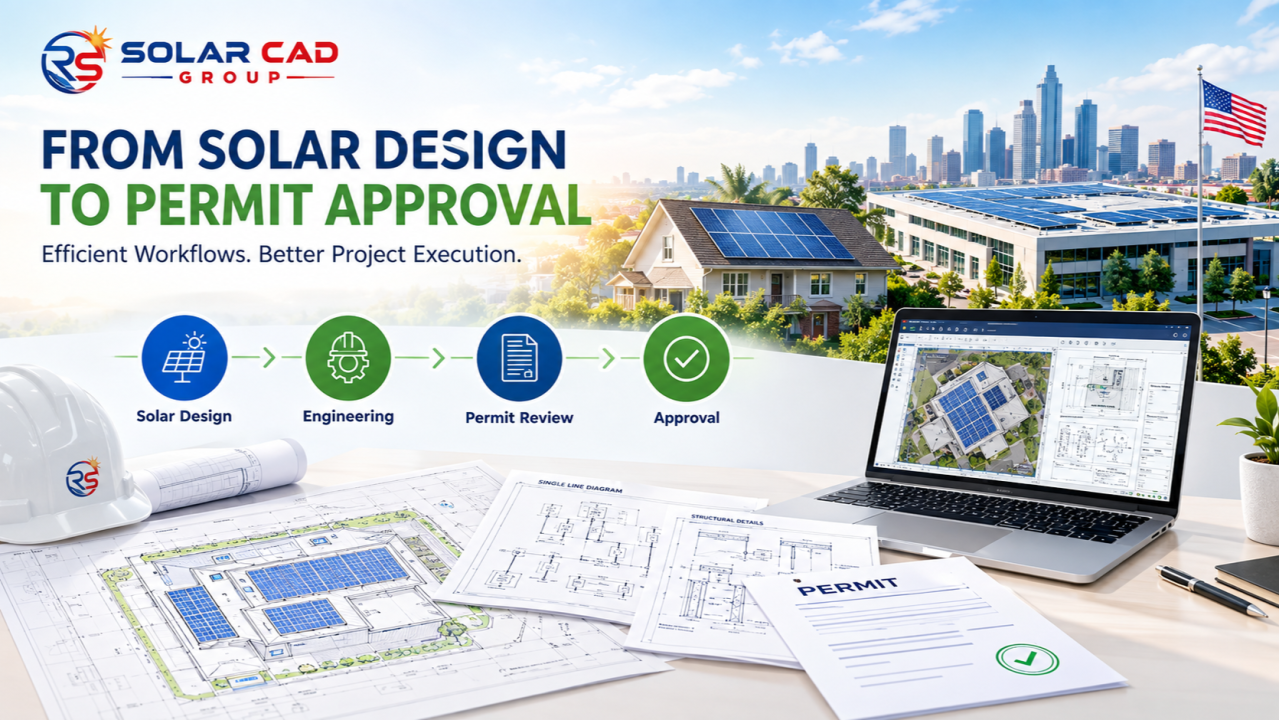
Before a project reaches the installation stage, it typically moves through multiple steps: project information collection, site assessment, solar proposal, system design, electrical and structural engineering, documentation, professional stamping where required, permit submission, utility coordination, revisions, and final approval.
When these stages are well connected, a project can move through the workflow more efficiently. When information is incomplete or different teams are working from different versions of the project, delays can occur.
For this reason, an efficient solar design-to-permit workflow is becoming an important part of successful project execution.
This article explains how solar companies can improve the connection between design, engineering, permitting, and revisions and how an experienced solar design partner can help support growing project pipelines.
Why the Solar Design-to-Permit Workflow Matters
A solar project can look straightforward from the outside: design the system, obtain approval, and install it.
In practice, each stage depends on the information produced by the previous stage.
A simplified workflow can look like:
Project Intake → Site Information → Solar Proposal → System Design → Engineering → Permit Documentation → Quality Check → PE/Engineering Stamp → Permit Submission → AHJ Review → Revisions → Approval → Installation
Every step has the potential to affect the next one.
For example, if the system size changes after the electrical drawings have already been prepared, the affected documents may also need to be updated.
Similarly, if the roof layout changes, the structural details, equipment locations, electrical information, and permit drawings may require updates.
This is why a connected workflow is important.
The objective is not simply to complete each task individually. The objective is to ensure that project information remains accurate and consistent throughout the entire process.
Where Solar Project Delays Commonly Begin
Permit delays are often associated with AHJs, utilities, or reviewing authorities. However, some delays can originate before the permit package is even submitted.
Common issues include:
Incomplete Project Information
If the design team does not receive complete information at the beginning, additional clarification may be required later.
Incorrect Site Information
Roof dimensions, roof planes, obstructions, electrical service information, or site conditions that are not properly represented can result in design changes.
Equipment Changes
Changing modules, inverters, batteries, disconnects, or other equipment after the design has been prepared can create additional documentation work.
Design and Engineering Inconsistencies
If the solar layout, structural documentation, and electrical drawings do not match, corrections may be required before or after submission.
Missing Permit Requirements
Different AHJs and utilities may have different documentation requirements. Missing a required document can delay the review process.
Poor Revision Management
When several versions of drawings are being circulated, teams can accidentally work from outdated information.
These problems demonstrate why quality control and workflow coordination should begin before permit submission.
1. Begin With Accurate Project Information
The first stage of an efficient workflow is collecting the correct project information.
Depending on the project, this may include:
- Project address
- Customer information
- Roof information
- Site photos
- Existing electrical service
- Utility information
- Property information
- Existing equipment
- Proposed system size
- Module specifications
- Inverter specifications
- Battery or ESS information
- Mounting system information
- Project-specific requirements
The more complete the project information is at the beginning, the easier it becomes for the design team to prepare accurate documentation.
A standardized project-intake process can help solar companies identify missing information before the design begins.
2. Develop the Solar Proposal
The proposal stage connects the sales process with the technical side of the project.
A solar proposal may include the proposed system size, module count, inverter configuration, estimated production, layout, and other project information.
For example, tools such as Aurora Solar and HelioScope can be used for solar proposal and system analysis depending on the company’s workflow.
However, the proposal should not become disconnected from the final design.
If the final system differs significantly from the original proposal, the project may require additional coordination.
A strong workflow therefore ensures that important project information is carried consistently from the proposal stage into the final design.
3. Create the Solar PV Layout
Once the required information is available, the system layout can be developed.
The PV layout may need to consider:
- Roof planes
- Panel orientation
- Module placement
- Roof obstructions
- Setbacks
- Fire-access pathways
- Equipment locations
- Inverter placement
- Battery location
- Conduit routing
- Electrical service location
- Ground-mount configuration where applicable
For commercial projects, the design may also involve larger system capacities, more complex equipment configurations, structural considerations, and site-specific requirements.
An accurate layout provides the foundation for the rest of the project documentation.
4. Coordinate Electrical Design
Solar electrical design is another critical part of the workflow.
Depending on the project, electrical documentation can include:
- Single-line diagrams
- Three-line diagrams where required
- Conductor sizing
- Overcurrent protection
- Disconnects
- Inverter configuration
- Rapid shutdown
- Grounding
- Equipment specifications
- Main service information
- Interconnection details
The electrical design should correspond with the actual system layout and equipment.
For example, if the number of modules or inverter configuration changes, the relevant electrical documentation may also need to be updated.
Maintaining consistency between the physical layout and electrical drawings helps reduce unnecessary corrections.
5. Coordinate Structural Design
Structural requirements are particularly important for rooftop solar projects.
Depending on the location and project requirements, structural documentation may consider:
- Roof type
- Mounting system
- Attachment details
- Structural members
- Wind loads
- Snow loads
- Existing roof conditions
- Equipment loading
- Ground-mount structural requirements
Structural documentation should correspond with the proposed solar array and mounting system.
If the panel layout changes significantly, structural information may need to be reviewed again.
This is another reason why design and engineering teams should work from the same project information.
6. Prepare Permit-Ready Plan Sets
A solar permit package needs to present the project clearly to the reviewing authority.
Depending on the jurisdiction and project type, a permit plan set may include:
- Cover sheet
- Site plan
- Roof plan
- PV layout
- Electrical plan
- Single-line diagram
- Equipment schedule
- Structural details
- Mounting details
- Warning labels
- Placards
- Code calculations
- Electrical calculations
- Structural calculations
- Required engineering documentation
The exact requirements can vary by AHJ, utility, location, system size, and project type.
Therefore, permit documentation should be prepared according to the requirements applicable to the project rather than relying on a generic package for every jurisdiction.
7. Design With NEC and Local Requirements in Mind
Solar designs must consider applicable electrical and building requirements.
Depending on the project, the design process may need to address relevant NEC requirements, local amendments, utility requirements, fire requirements, structural requirements, and AHJ-specific requirements.
This is particularly important for companies working across different states and jurisdictions.
A design that is acceptable in one location may require modifications in another.
An experienced solar design team can help installers organize project documentation around the applicable requirements and identify potential issues before submission.
8. Use a Pre-Submission Quality Check
One of the most useful ways to reduce avoidable revisions is to review the project before submission.
A quality-control checklist can include:
Project Information
- Correct project address
- Correct customer information
- Correct system size
- Correct utility information
PV System
- Correct module count
- Correct module model
- Correct inverter configuration
- Accurate panel layout
Electrical
- Accurate SLD
- Correct conductor information
- Correct breaker information
- Correct disconnect information
- Correct service information
Structural
- Correct mounting system
- Appropriate attachment details
- Required structural calculations
Site and Roof Plan
- Accurate roof layout
- Required setbacks
- Access pathways
- Equipment locations
- Required clearances
Compliance
- Applicable NEC requirements
- AHJ requirements
- Utility requirements
- Required engineering documentation
This final review can help identify inconsistencies before the project reaches the reviewer.
9. Engineering and PE Stamping
Some projects require engineering review and professional stamping.
Depending on jurisdiction and project requirements, professional engineering involvement may be needed for structural or other project documentation.
This makes engineering coordination another important part of the overall workflow.
A solar company can benefit from having the design team coordinate engineering requirements early rather than waiting until the permit package is nearly complete.
Early coordination can help identify:
- Required calculations
- Engineering scope
- Structural requirements
- Stamping requirements
- Project-specific documentation
This can make the overall workflow more organized.
10. Manage Permit Revisions Efficiently
Even a carefully prepared permit package may receive comments or revision requests.
The important thing is how efficiently those comments are handled.
A good revision process should include:
AHJ Comments → Review → Identify Required Changes → Update Drawings → Quality Check → Resubmission
The revised drawings should also remain consistent with the rest of the project documentation.
If one drawing is updated but related documents are not, new inconsistencies can appear.
A centralized revision process can therefore help maintain document accuracy throughout the project lifecycle.
Why Standardized Workflows Matter for Growing Solar Companies
For a company handling a small number of projects, manual coordination may be manageable.
As project volume increases, however, the same process can become difficult to manage without standardization.
Imagine a company processing dozens or hundreds of projects.
If every project follows a different workflow, teams may spend more time:
- Checking missing information
- Asking for clarification
- Correcting documents
- Searching for the latest drawing
- Repeating design work
- Managing revisions
- Communicating between departments
A standardized workflow can make these activities more predictable.
The goal is not to remove human review. Instead, it is to create a repeatable process where each team knows what information is required and what needs to happen next.
The Role of an Outsourced Solar Design Team
Solar installers and EPCs do not always need to build a large internal design department to handle every project.
An external solar design team can work as an extension of the company’s internal operations.
This can be particularly useful when:
- Project volume increases
- Internal designers are overloaded
- Permit deadlines are approaching
- Specialized engineering support is required
- A company wants to expand into new markets
- Additional revision support is needed
- The company wants to focus internal resources on sales and installation
Outsourcing can provide additional capacity while allowing the solar company to maintain control over project management and customer relationships.
RS Solar CAD Group: Supporting Solar Companies From Design to Permitting
RS Solar CAD Group provides solar design and engineering support for solar installers, EPCs, contractors, and related companies in the United States and Canada.
Our goal is to help solar companies manage their design and documentation requirements through a structured and dependable workflow.
Our services include:
Solar Proposal Design
We support solar companies with proposal designs and system layouts that can help them present projects to customers and move projects toward the next stage.
Solar Permit Plan Sets
Our team prepares solar permit documentation for residential and commercial projects based on applicable project requirements.
Electrical Design
Our electrical design support can include single-line diagrams, electrical layouts, equipment information, and other project documentation.
Structural Design Support
For applicable projects, structural design and documentation can support rooftop and ground-mount solar requirements.
NEC-Compliant Documentation
Our design workflow considers applicable electrical requirements and project-specific documentation needs.
PE / Engineering Stamping
Where required, we can coordinate professional engineering and stamping support as part of the project workflow.
Interconnection Support
Solar projects often require utility-related documentation. Our team can support documentation associated with interconnection requirements.
HOA and CEC Documentation
Depending on the project and location, our team can support documentation required for HOA or applicable compliance processes.
Revisions and Design Updates
Permit review can result in comments and revisions. Our team can support updates to drawings and documentation to help projects move through the review cycle.
Why Solar Companies Work With a Dedicated Design Partner
Working with an external design team can provide more than additional drafting capacity.
For a growing solar company, the right design partner can become part of its operational workflow.
Instead of treating design as a separate task, the design team can support the project from:
Proposal → PV Layout → Engineering → Permit Set → Stamping → Revision → Resubmission
This creates a more connected process.
For installers and EPCs managing multiple projects, this can help the internal team spend more time on customer relationships, sales, installation coordination, and project management while the design team handles technical documentation.
Building a Scalable Solar Workflow
The future of solar project execution is not only about installing more systems. It is also about creating workflows that can handle increasing project volumes while maintaining quality.
A scalable process should be:
Accurate – Project information should remain consistent.
Repeatable – Teams should follow a defined workflow.
Collaborative – Sales, design, engineering, permitting, and installation teams should remain connected.
Quality-Controlled – Projects should be reviewed before submission.
Flexible – The workflow should accommodate different AHJs, utilities, project sizes, and design requirements.
Scalable – The process should be able to support higher project volumes without creating unnecessary bottlenecks.
When these elements work together, solar companies can create a more organized path from the initial proposal to permit approval.
Final Thoughts
Solar permitting is not a single step. It is the result of multiple connected processes working together.
A project begins with accurate information, moves through proposal and system design, requires electrical and structural coordination, becomes a complete permit package, may require engineering and professional stamping, and can then move through AHJ review and revisions before approval.
The stronger the connection between these stages, the easier it becomes to identify problems early and maintain project consistency.
For growing solar companies, improving the workflow between design, engineering, permitting, and revisions can be an important part of managing project volume effectively.
With the support of a dedicated solar design and engineering partner such as RS Solar CAD Group, installers and EPCs can extend their design capacity and create a more organized workflow for residential and commercial solar projects.
The goal is simple:
Better coordination. Better documentation. Fewer avoidable delays. A smoother path from solar design to permit approval.
Frequently Asked Questions
1. What is a solar design-to-permit workflow?
It is the complete process of moving a solar project from initial project information and proposal design through PV layout, engineering, permit documentation, submission, revisions, and approval.
2. What can cause delays between solar design and permit approval?
Common causes include incomplete project information, design inconsistencies, incorrect equipment details, missing documentation, code-related issues, engineering requirements, and AHJ or utility revision requests.
3. How can solar companies reduce unnecessary permit revisions?
Companies can use standardized project intake, accurate design practices, pre-submission quality checks, coordinated engineering, and organized revision management.
4. Why is accurate solar design important for permitting?
The solar design provides information that is reflected in other project documents. Errors in the initial design can therefore affect electrical, structural, and permit documentation.
5. What does a solar permit plan set typically contain?
Depending on the jurisdiction, it may include site plans, roof plans, PV layouts, electrical drawings, single-line diagrams, equipment schedules, structural details, calculations, labels, and engineering documents.
6. Do solar projects require PE stamping?
Requirements vary by jurisdiction, project type, system size, and applicable regulations. Where professional engineering or stamping is required, it should be coordinated as part of the project workflow.
7. Can solar design companies support permit revisions?
Yes. A solar design team can review AHJ comments, update drawings and documentation, perform quality checks, and prepare revised documents for resubmission.
8. What is the advantage of outsourcing solar design?
Outsourcing can provide additional design capacity, specialized technical support, and revision assistance without requiring a solar company to build a larger internal design team for every project.
9. Does RS Solar CAD Group support commercial solar projects?
Yes. RS Solar CAD Group provides design and engineering support for residential and commercial solar projects, including larger and more complex project requirements.
10. What services does RS Solar CAD Group provide?
RS Solar CAD Group supports solar companies with proposal design, permit plan sets, electrical design, structural design support, SLD/NEC documentation, interconnection support, HOA/CEC documentation, engineering/PE stamping coordination, and revisions.
11. Who can work with RS Solar CAD Group?
Our services are designed for solar installers, EPCs, contractors, and other solar companies that need additional design and engineering capacity for their projects.
12. How can I contact RS Solar CAD Group?
You can contact the RS Solar CAD Group team for project requirements, design support, and service information.
Email: sales@rscadgroup.com Website: www.rssolarcadgroup.com
Need a More Efficient Solar Design Workflow?
If your solar company is handling increasing project volumes or spending too much time managing designs, revisions, and permit documentation, a dedicated design partner can help extend your project capacity.
Connect with RS Solar CAD Group to discuss your next solar project and explore a design workflow built around accuracy, coordination, and efficient project execution.
RS Solar CAD Group Solar Design | Engineering Support | Permit Plan Sets | Electrical & Structural Design Serving Solar Companies Across the U.S. & Canada
Email: sales@rscadgroup.com Website: www.rssolarcadgroup.com