The U.S. Solar Market in 2026: Can Growing Demand Overcome Rising Costs and Policy Uncertainty?
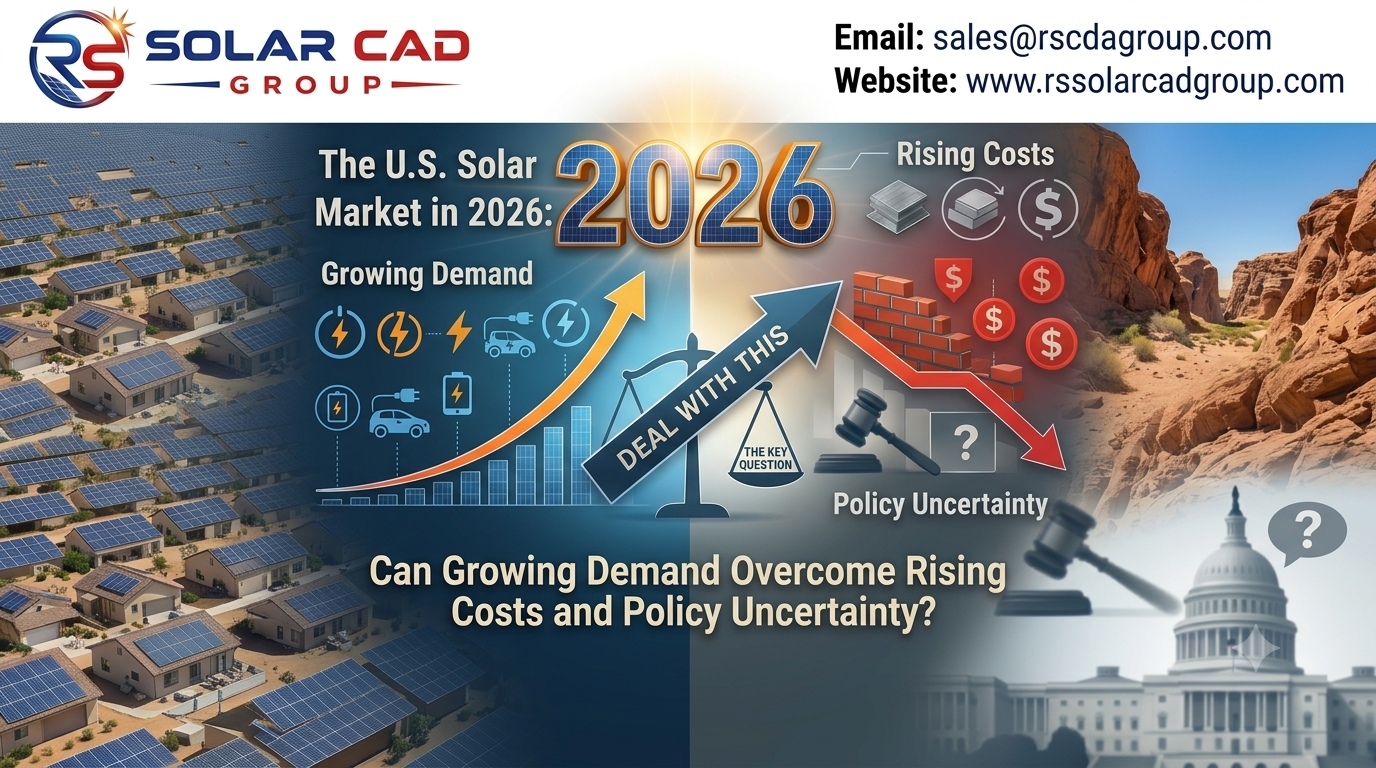
The U.S. solar industry is entering a critical phase in 2026. Rising electricity demand, expanding data center infrastructure, increasing interest in battery storage, and the need for additional power generation continue to create opportunities for solar energy. However, higher project costs, changing federal incentives, supply chain challenges, and regulatory uncertainty are making it more difficult for developers and installers to plan their next moves.
For solar installers, engineering, procurement, and construction (EPC) companies, project developers, and commercial property owners, the question is no longer simply whether solar energy will grow. The more important question is how businesses can continue delivering financially viable projects when market conditions are changing.
According to the September 2026 update from the U.S. Energy Information Administration (EIA), electricity consumption in the United States is forecast to reach approximately 4,135 billion kilowatt-hours in 2026, representing an increase of almost 2% compared with 2025. The EIA also expects solar electricity generation to increase by 21% in 2026. These forecasts highlight the continuing importance of solar energy in meeting America’s growing electricity requirements.
At the same time, industry forecasts indicate that rising demand alone will not guarantee uninterrupted growth across every solar market segment.
This article explores the major developments shaping the U.S. solar industry in 2026, the challenges affecting project economics, and the practical steps solar businesses can take to remain competitive.
1. The U.S. Solar Market in 2026: Understanding the Current Situation
The American solar industry has grown substantially over the past decade, supported by improvements in photovoltaic technology, falling equipment costs over the longer term, government incentives, and increasing demand for alternative electricity sources.
However, the market is not growing at the same rate across all sectors.
According to the U.S. Solar Market Insight report published by the Solar Energy Industries Association (SEIA) and Wood Mackenzie in September 2026, the United States installed 11.4 gigawatts of direct-current solar capacity in the second quarter of 2026. This represented a 45% increase compared with the second quarter of 2025.
Utility-scale projects accounted for most of this quarterly expansion, while residential solar continued to face pressure following the expiration of the federal residential clean energy tax credit. Despite the strong second-quarter installations, the industry forecast anticipated a 23% year-over-year contraction in total solar installations for 2026.
These figures may initially appear contradictory. How can the industry install more solar capacity in one quarter while still expecting a decline for the entire year?
The explanation lies in the difference between short-term installation activity and full-year market performance.
Some developers accelerated projects to meet tax-credit-related deadlines, bringing forward construction and installation activity. Meanwhile, other projects faced delays, higher costs, financing challenges, or uncertainty about future incentives.
Consequently, a strong quarter does not necessarily mean that every part of the industry is experiencing healthy growth.
The key takeaway: The U.S. solar market continues to offer significant opportunities, but businesses must evaluate demand, project economics, and regulatory conditions separately rather than relying on national growth figures alone.
2. Rising Electricity Demand Is Creating New Opportunities
One of the most important factors supporting the U.S. solar industry is the country’s growing electricity consumption.
Electricity demand is increasing across several sectors, including data centers, manufacturing facilities, commercial buildings, electric vehicle charging infrastructure, and residential properties.
The expansion of artificial intelligence and cloud computing has made data centers particularly important. These facilities require substantial electricity to operate servers, cooling equipment, networking systems, and supporting infrastructure.
Manufacturing expansion is also contributing to higher power requirements. As industrial facilities increase production, their demand for dependable electricity can rise significantly.
The EIA’s September 2026 outlook forecasts that commercial electricity sales will increase by 3.3% in 2026, while industrial electricity sales will rise by 1.6%. Both sectors are contributing to the country’s increasing electricity requirements.
Why does this matter for solar companies?
Growing electricity demand creates opportunities for solar developers and installers in several ways.
Commercial solar installations: Businesses may evaluate rooftop or ground-mounted solar systems to reduce their exposure to electricity costs.
Industrial solar projects: Manufacturing facilities with suitable land or roof space may explore solar generation to support their electricity requirements.
Solar-plus-storage projects: Businesses that need greater control over when they use electricity may consider combining solar systems with battery storage.
Large-scale solar development: Utilities and independent power producers may continue developing solar projects to add generation capacity to the grid.
However, increasing electricity demand does not automatically make every proposed solar project financially attractive.
A project still needs suitable site conditions, an acceptable financing structure, an appropriate system design, and a feasible grid connection.
For solar installers and EPC companies, the opportunity lies in identifying projects where these factors work together.
3. Rising Solar Project Costs Are Affecting Profitability
Although solar technology remains competitive in many electricity markets, project costs have become a significant concern in 2026.
According to a July 2026 report from Lazard, the cost of constructing solar power projects in the United States increased by approximately 18% compared with the previous year. The report identified tariffs, higher interest rates, inflationary pressures, and supply chain changes as contributing factors. Despite these increases, utility-scale solar remained competitive with other new electricity-generation options.
To understand how higher costs affect solar businesses, it is important to examine the main components of a project.
Solar panels and electrical equipment
Solar modules are only one part of the total installation cost.
A complete project may also require inverters, mounting structures, wiring, electrical protection equipment, transformers, switchgear, and other components.
Tariffs and changes in sourcing arrangements can affect the prices and availability of these materials.
When equipment prices change between the initial quotation and procurement, developers may need to revise their budgets.
Labor and installation expenses
Solar installations require qualified workers who can complete the work safely and according to applicable requirements.
Labor availability, project location, roof complexity, electrical upgrades, and installation schedules can all affect total costs.
A project that appears profitable during the initial sales stage may become less attractive if installation requires additional labor or unexpected site modifications.
Financing costs
Many commercial and utility-scale projects depend on external financing.
Higher interest rates can increase borrowing costs and reduce the financial returns available to project owners.
Longer development schedules can make this problem worse because capital may remain committed for longer before a project begins generating revenue.
Engineering and redesign costs
Incomplete site information, inaccurate measurements, incorrect equipment specifications, and late design changes can create additional work.
For example, a roof layout that does not accurately reflect obstructions or available installation space may need to be redesigned.
Similarly, an electrical drawing that does not match the selected equipment may require revisions before installation or approval.
These problems can increase labor hours, delay submissions, and affect customer satisfaction.
What can businesses do?
Solar companies cannot control every market factor, but they can improve cost management by verifying project information early, selecting appropriate equipment, reviewing designs carefully, and minimizing avoidable revisions.
Better project preparation does not eliminate market risk. It helps prevent additional costs that could otherwise make an already challenging project less profitable.
4. Federal Solar Policy Changes Are Reshaping Project Economics
Government incentives have played an important role in the development of the U.S. solar market.
However, federal policy changes introduced in 2025 altered the timeline and eligibility requirements for several clean energy tax credits.
The One Big Beautiful Bill Act, signed into law on July 4, 2025, accelerated the phaseout of certain federal clean energy incentives and introduced new requirements affecting project eligibility and supply chains.
For residential customers who purchase solar systems directly, the Section 25D residential clean energy credit ended for expenditures after December 31, 2025.
Other provisions affecting commercial and utility-scale projects follow different rules. Eligibility depends on the applicable credit, ownership structure, construction-start requirements, placed-in-service deadlines, and other statutory conditions.
As a result, residential, commercial, and utility-scale projects should not be treated as if they all follow the same incentive rules.
How do these changes affect residential solar?
The expiration of the residential customer-owned tax credit changes the financial calculations for homeowners considering a solar installation.
Previously, eligible homeowners could factor the federal credit into their expected project costs.
Without that credit, some customers may find it harder to justify the initial investment, particularly when financing costs are high.
Installers may therefore need to explain project economics more clearly, including estimated electricity savings, utility rates, financing terms, system performance, and payback assumptions.
Third-party ownership arrangements may have different eligibility rules, so installers should verify the specific structure rather than assume that all residential solar incentives have disappeared.
What about commercial and utility-scale projects?
Commercial and utility-scale developers face their own eligibility conditions and deadlines.
Some projects may qualify under applicable clean electricity investment or production credit provisions, while others may not.
The eligibility of a project can depend on when construction began, when the system is placed into service, and whether applicable sourcing or other requirements are satisfied.
Developers should obtain current tax and legal guidance before making financial commitments based on an assumed credit.
Why policy uncertainty matters
A project may take months or years to move from initial development to completion.
If incentive rules, equipment sourcing requirements, or deadlines change during this period, developers may need to reconsider financing, procurement, construction schedules, and expected returns.
For installers and EPC companies, this makes accurate project planning and clear customer communication more important than ever.
The best approach is to assess each project’s actual eligibility and financial assumptions rather than relying on general statements about solar tax credits.
5. Tariffs and Supply Chain Challenges Are Changing Equipment Decisions
Solar companies depend on equipment manufacturers, distributors, importers, and domestic suppliers to deliver components on schedule.
Changes in trade policy can affect this entire supply chain.
In its September 2026 analysis, Wood Mackenzie highlighted new U.S. trade actions affecting solar components, including a tariff and minimum import price framework announced in August 2026 and scheduled to take effect on December 4, 2026. Such measures can influence procurement decisions, although the precise impact depends on the products covered and the applicable rules.
For solar businesses, the important issue is not simply whether equipment prices increase. It is whether equipment remains available at the right price and at the right time.
Consider a commercial solar project that has already received customer approval.
If the selected modules or electrical components become more expensive or difficult to obtain, the developer may need to evaluate alternative suppliers.
However, changing equipment is not always as simple as replacing one product with another.
Alternative components may have different electrical characteristics, physical dimensions, mounting requirements, certifications, or compatibility limitations.
These differences can require additional engineering review and, in some cases, revised drawings or updated approvals.
Practical steps for solar companies
Businesses can reduce procurement-related uncertainty by:
- Obtaining updated supplier quotations before finalizing project budgets.
- Confirming equipment availability and expected delivery dates.
- Checking product specifications before approving substitutions.
- Evaluating alternative suppliers where appropriate.
- Coordinating procurement decisions with engineering and installation teams.
- Reviewing project economics when equipment costs change materially.
The goal is to avoid making commitments based on outdated pricing or unverified equipment assumptions.
6. Residential, Commercial, and Utility-Scale Solar Are Facing Different Challenges
A major mistake in evaluating the U.S. solar market is treating every project category as if it responds to market changes in the same way.
Residential, commercial, and utility-scale solar have different customers, financing structures, project timelines, and regulatory requirements.
Residential solar: Customer affordability is critical
Residential installers generally work with individual homeowners.
Their customers may be concerned about upfront costs, loan payments, electricity bills, available incentives, and the time required to recover their investment.
When incentives change or financing becomes more expensive, installers may need to spend more time explaining the financial benefits of solar.
Project design also matters. Roof orientation, shading, usable roof area, electrical equipment, and local approval requirements can affect the proposed system.
A technically suitable design that reflects the property’s actual conditions helps installers present more realistic proposals.
Commercial solar: Project economics and operational requirements matter
Commercial customers may have larger electricity requirements and more complex facilities.
Warehouses, offices, factories, retail buildings, and other commercial properties may offer substantial opportunities for rooftop or ground-mounted systems.
However, commercial projects can involve structural assessments, electrical load considerations, equipment coordination, utility requirements, and more detailed financial analysis.
The project must make sense for the customer’s electricity consumption and operational needs.
For example, a business that consumes substantial electricity during daylight hours may have a different solar investment case from one that uses most of its electricity at night.
Battery storage may help in certain situations, but its financial value depends on factors such as utility tariffs, operating schedules, equipment costs, and available incentives.
Utility-scale solar: Development timelines and grid access are essential
Utility-scale projects typically involve large sites, substantial capital investment, long development periods, and coordination with utilities and other stakeholders.
Interconnection queues, transmission capacity, permitting, equipment availability, and financing can delay projects even when electricity demand is strong.
These challenges help explain why strong interest in new power generation does not always translate immediately into completed solar installations.
For developers, managing these dependencies early is essential to reducing avoidable delays.
7. Battery Storage Is Becoming More Important to Solar Project Planning
Solar panels generate electricity when sunlight is available, but electricity demand does not always follow the same pattern.
In some locations, solar generation is strongest during the middle of the day, while electricity demand or grid prices may be higher during other hours.
Battery energy storage systems can store electricity for later use, subject to system capacity, charging conditions, conversion losses, and operating limits.
A solar-plus-storage system may help a customer use more of its solar generation, manage certain peak-demand charges, or provide backup power when designed and configured for that purpose.
However, batteries are not automatically profitable for every customer.
Their value depends on the local electricity tariff, demand-charge structure, battery cost, system efficiency, charging and discharging strategy, and any relevant incentives or grid-service arrangements.
Why this matters for installers
As more customers evaluate battery storage, installers need to understand how the battery interacts with the solar array, inverter, electrical panel, and existing equipment.
They also need to consider the customer’s objectives.
A homeowner seeking backup power may have different requirements from a commercial facility seeking to manage peak electricity demand.
The design must reflect the intended use rather than simply adding a battery to every proposal.
Solar companies that can explain these differences clearly will be better positioned to help customers choose systems that fit their needs.
8. Permitting and Utility Interconnection Can Delay Projects
Even when equipment is available and financing is arranged, solar projects may face delays during permitting and utility interconnection.
These are separate processes.
Permitting generally involves obtaining the approvals required by the relevant local authority or other responsible agency before construction can proceed.
Utility interconnection involves the technical and administrative process of connecting the solar system to the electricity grid.
The requirements vary by location, project size, system configuration, utility, and authority having jurisdiction (AHJ).
A permit submission may require site plans, roof layouts, equipment specifications, electrical drawings, structural information, and other supporting documentation.
The exact requirements depend on the project.
Common reasons for delays
Projects may encounter problems when:
- Required site information is missing.
- Equipment specifications are inconsistent across documents.
- Drawings do not reflect actual site conditions.
- Electrical details need correction.
- Structural information is incomplete.
- Local submission requirements have not been checked.
- Utility documentation does not match the proposed system.
These issues can lead to additional reviews, corrections, and resubmissions.
Importantly, complete drawings do not guarantee approval within a specific timeframe. Review schedules depend on the relevant authority or utility, and some delays occur outside the installer’s control.
Nevertheless, well-prepared documentation can reduce avoidable errors and help the project move through the review process more efficiently.
9. Why Accurate Solar Design Is Becoming a Business Advantage
In a market where equipment, financing, and customer acquisition costs can change, solar businesses need to pay attention to the parts of project delivery they can control.
Engineering and design quality is one of those areas.
A proposal that uses accurate site information and suitable equipment assumptions gives the sales team a stronger starting point.
A well-prepared permit plan set can help installers communicate project details clearly to reviewers and installation crews.
Consistent electrical drawings can also help identify coordination issues before they create expensive problems on site.
For businesses handling multiple projects, these benefits become particularly important.
Imagine an installer managing 20 projects simultaneously. If several projects require repeated corrections because of incomplete information, the team may spend additional time coordinating revisions instead of progressing other jobs.
The result can be a growing administrative workload, uncertainty about project schedules, and reduced operational efficiency.
Reliable design support can help address this problem by improving documentation consistency and providing additional capacity when the internal team is busy.
Key areas of design support
Depending on the project, professional solar design services may include:
Solar proposal design: Preparing system layouts and supporting visual materials that help customers understand the proposed installation.
PV system and layout design: Developing photovoltaic layouts based on site conditions, equipment specifications, and project requirements.
Permit-ready plan sets and revisions: Preparing submission documentation and updating drawings when changes are required.
Structural and electrical engineering support: Providing the applicable engineering analysis, documentation, and professional stamps where required and authorized.
Single-line diagrams and code-related documentation: Showing the electrical configuration of the system and addressing applicable project requirements.
Utility interconnection and HOA documentation: Supporting the preparation of documents required by the relevant utility or homeowners association, where applicable.
The specific scope should always be agreed upon before work begins.
10. How Solar Installers and EPC Companies Can Prepare for the Rest of 2026
Solar companies cannot eliminate policy changes, tariffs, interest-rate movements, or utility delays.
However, they can build a more resilient operating strategy.
Here are six practical steps.
Step 1: Recalculate project economics regularly
Avoid relying on equipment prices or financial assumptions that were prepared months earlier.
Review current quotations, financing costs, installation expenses, applicable incentives, and expected electricity savings before confirming project economics.
Where appropriate, evaluate different scenarios to understand how changes in cost or revenue could affect the project.
Step 2: Verify incentive eligibility before making promises
Federal, state, and local incentives may have different rules.
Confirm which provisions apply to the specific project and ownership structure.
Do not promise customers a tax credit or financial benefit without verifying the relevant eligibility conditions.
Step 3: Improve project documentation
Establish a consistent process for collecting site information, verifying equipment details, preparing drawings, and checking documents before submission.
This can help identify discrepancies earlier and reduce avoidable rework.
Step 4: Build flexibility into procurement
Where feasible, identify suitable alternative suppliers and understand the technical implications of changing equipment.
Never assume that different modules, inverters, or other components can be substituted without reviewing compatibility and applicable approval requirements.
Step 5: Evaluate storage based on actual customer needs
Battery storage can provide value in certain applications, but its economics are project-specific.
Compare the customer’s load profile, electricity tariff, backup requirements, and expected operating strategy before recommending a system.
Step 6: Use external design support when internal capacity is limited
Hiring and training additional designers may not always be practical when project volume changes unpredictably.
Working with a reliable external design provider can give installers additional capacity without requiring them to expand their permanent team for every increase in workload.
The provider should understand the applicable project requirements, maintain clear communication, protect project information, and deliver work within an agreed scope and schedule.
Outsourcing is most effective when it complements the installer’s existing technical and quality-control processes rather than replacing them.
11. What Is the Outlook for the U.S. Solar Industry Beyond 2026?
The long-term outlook remains influenced by two competing forces.
On one side, rising electricity consumption, data center development, manufacturing expansion, and the need for additional generation capacity continue to support solar deployment.
On the other side, project costs, policy changes, interconnection constraints, financing conditions, and supply chain uncertainty can limit how quickly projects move forward.
The September 2026 SEIA and Wood Mackenzie market update indicated that the U.S. solar fleet could nearly double over the next five years, with an estimated 44 GWdc of annual capacity additions through 2031. The report also highlighted the importance of permitting, tax-credit transitions, and other constraints.
This forecast should be understood as an industry outlook, not a guarantee that every market segment or individual company will experience growth.
Residential installers may need to adapt to changing customer economics. Commercial developers may need to pay closer attention to project costs and utility arrangements. Utility-scale developers may need to manage long development schedules and complex procurement requirements.
Businesses that respond to these differences are better positioned to identify viable opportunities.
Three trends worth watching
First, electricity demand will continue to influence project development. Data centers, industrial facilities, and other large electricity users will remain important factors in regional energy planning.
Second, solar-plus-storage solutions will receive greater attention. Their commercial value will depend on local conditions, equipment costs, and the way customers use electricity.
Third, execution quality will remain important. As businesses manage tighter budgets and changing requirements, accurate engineering, effective project coordination, and reliable documentation can help reduce avoidable delays and expenses.
The most successful companies will not necessarily be those that pursue the largest number of projects. They will be the ones that identify suitable opportunities and deliver them with disciplined financial planning and consistent execution.
12. How RS Solar CAD Group Supports Solar Businesses
At RS Solar CAD Group, we understand that solar installers and EPC companies need more than drawings alone. They need dependable design support that fits their project requirements and helps their teams manage workloads efficiently.
We support solar businesses across the United States and Canada with services covering the proposal, design, and documentation stages of solar projects.
Our services include:
- Solar Proposal Design — Supporting customer proposals with project-specific solar layouts and presentation materials.
- PV System & Layout Design — Preparing photovoltaic layouts based on the available site information and project requirements.
- Permit-Ready Plan Sets & Revisions — Supporting permit documentation and revisions according to the agreed scope.
- Structural & Electrical Engineering Support — Assisting with applicable engineering documentation and professional stamps where required and authorized.
- Single-Line Diagrams & NEC-Based Design Support — Preparing electrical documentation based on applicable project requirements.
- Utility Interconnection & HOA Documentation — Supporting relevant documentation for utility and homeowners association submissions.
Our goal is to help solar installers and EPC companies manage project documentation, support their internal teams, and handle changing workloads with greater flexibility.
Whether a business needs assistance with a residential proposal, a commercial PV layout, permit revisions, or engineering documentation, the scope and deliverables can be discussed according to the specific project.
Learn more about our services: Visit the RS Solar CAD Group website at www.rssolarcadgroup.com.
Conclusion: Demand Creates Opportunity, but Execution Determines Success
The U.S. solar market in 2026 presents a complicated but important opportunity.
Growing electricity demand, expanding digital infrastructure, and the need for additional power generation continue to support solar energy. At the same time, rising construction costs, changing federal incentives, tariffs, financing pressures, and project delays are making the business environment more demanding.
These conditions mean that solar companies must look beyond market growth forecasts.
They need to understand their customers, verify project economics, manage equipment decisions carefully, prepare accurate documentation, and identify opportunities where solar makes financial and technical sense.
For installers and EPC companies, operational efficiency can be especially valuable when project volumes fluctuate or internal teams face capacity constraints.
Reliable design support, careful planning, and clear communication cannot remove every market challenge. However, they can help businesses reduce avoidable rework, manage projects more effectively, and focus resources on the opportunities that matter most.
The future of U.S. solar will depend not only on how much electricity the country needs, but also on how effectively the industry can deliver viable projects in a changing market.
Frequently Asked Questions (FAQs)
1. Is the U.S. solar market growing in 2026?
The market continues to add substantial solar capacity, but performance differs across sectors. Strong utility-scale installations in the second quarter of 2026 occurred alongside a full-year forecast for lower overall installations. Businesses should distinguish quarterly activity from annual market expectations.
2. Why are solar project costs increasing in the United States?
Several factors contribute to higher costs, including tariffs, equipment sourcing changes, financing expenses, inflation, labor requirements, and project-specific engineering or installation challenges. The effect varies by project size, location, and equipment selection.
3. Are federal solar tax credits still available in 2026?
The federal residential clean energy credit under Section 25D ended for expenditures after December 31, 2025. Commercial and utility-scale projects may be subject to different provisions and eligibility requirements. Project owners should verify the applicable rules with a qualified tax professional.
4. Will rising electricity demand increase solar installations?
Rising electricity demand can support additional solar development, particularly in regions experiencing growth in data centers, manufacturing, and commercial activity. However, actual installations also depend on financing, grid connections, permitting, equipment availability, and project economics.
5. Why is battery storage becoming important for solar projects?
Battery storage can help customers use stored electricity later, manage certain peak-demand costs, or obtain backup power when the system is designed for that purpose. Its financial benefits depend on the customer’s electricity tariff, operating requirements, equipment costs, and system configuration.
6. How can solar installers reduce project delays?
Installers can improve project preparation by verifying site information, checking equipment specifications, preparing complete documentation, reviewing local requirements, and coordinating permitting and utility interconnection activities early.
7. How can outsourced solar design services help EPC companies?
External design support can provide additional capacity when internal teams are busy. Depending on the agreed scope, services may include proposal design, PV layouts, permit plan sets, revisions, electrical drawings, and engineering support. This can help businesses manage workloads without immediately expanding their permanent design teams.
8. What should solar companies prioritize for the remainder of 2026?
Solar businesses should prioritize accurate project costing, verified incentive eligibility, flexible procurement, suitable system design, clear documentation, and disciplined project management. Evaluating opportunities individually is more reliable than assuming that all solar markets will grow at the same rate.
Work With RS Solar CAD Group
Looking for dependable solar proposal design, PV layouts, permit plan sets, revisions, or engineering support for your upcoming projects?
RS Solar CAD Group works with solar installers and EPC companies across the United States and Canada to support their solar design and documentation requirements.
Website: www.rssolarcadgroup.com
Email: sales@rscadgroup.com
Contact our team to discuss your project requirements and explore how our solar design support can fit your workflow.