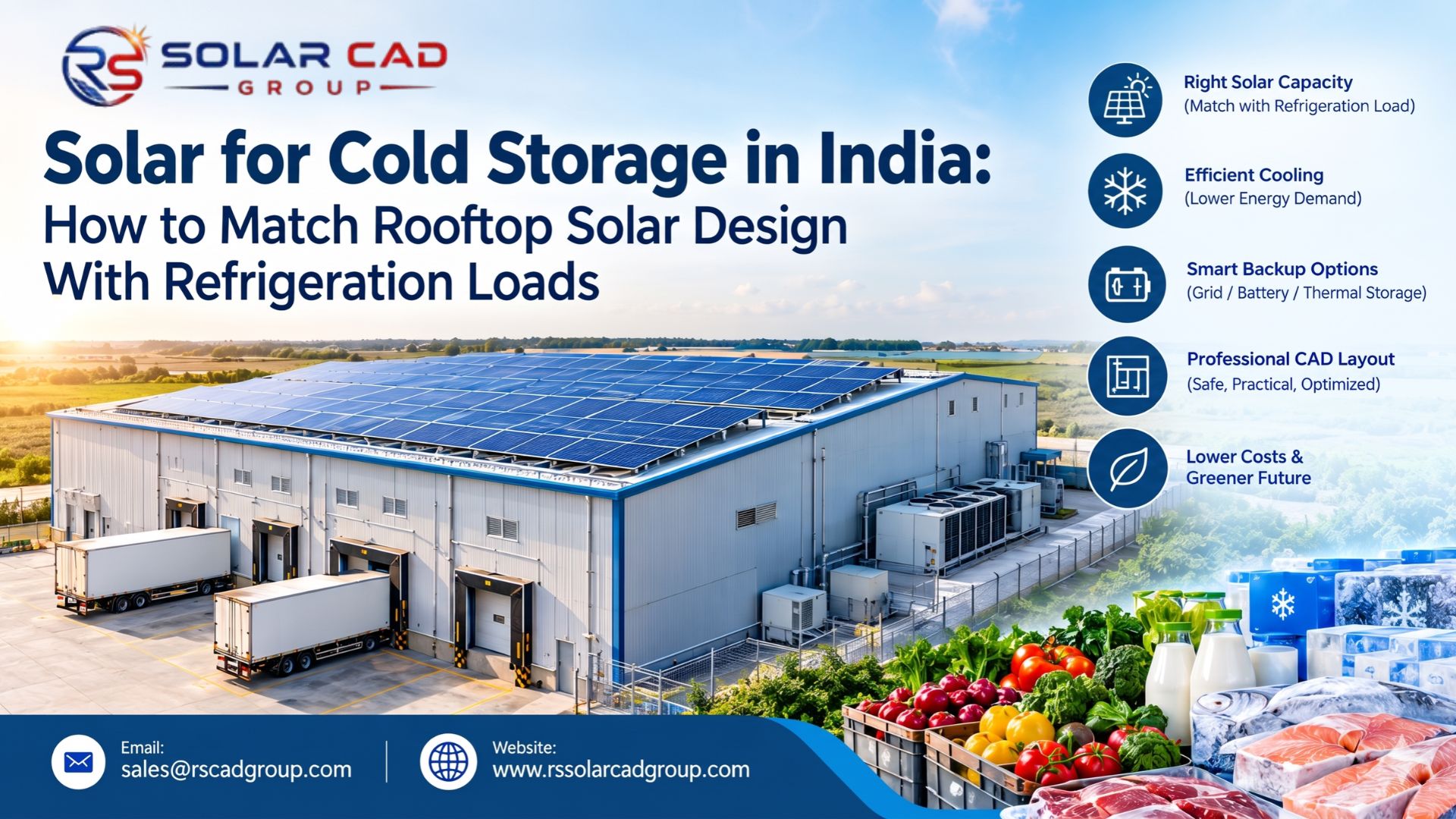
Solar for Cold Storage in India: How to Match Rooftop Solar Design With Refrigeration Loads.
Introduction
Cold storage facilities play a vital role in India’s agricultural supply chain, helping preserve fruits, vegetables, dairy products, frozen foods, and other temperature-sensitive goods. However, maintaining consistent temperatures requires substantial electricity for refrigeration compressors, condenser fans, evaporator fans, pumps, and other supporting equipment.
As electricity costs and energy-efficiency concerns become increasingly important, rooftop solar offers cold storage operators an opportunity to reduce grid electricity consumption and improve the long-term economics of their facilities.
But installing solar panels on a cold storage roof is not simply about selecting a solar capacity based on available roof space. The key is to match solar generation with the facility’s actual refrigeration load, operating schedule, and cooling requirements.
In this guide, RS Solar CAD Group explains how to approach rooftop solar design for cold storage facilities in India, from refrigeration load assessment to system sizing, inverter selection, energy storage, and performance monitoring.
Why Is Solar Energy Suitable for Cold Storage Facilities?
Unlike many commercial buildings, cold storage facilities often require cooling beyond normal business hours. Their electricity demand depends on several factors, including the type of stored produce, target temperature, outdoor weather, insulation quality, product loading, and refrigeration equipment efficiency.
Rooftop solar can supply part of this electricity demand during daylight hours, when solar generation is available.
The main benefits include:
- Reduced grid electricity consumption: Solar power can directly supply compatible refrigeration and auxiliary loads.
- Better daytime energy management: Solar generation can offset part of the facility’s daytime electricity demand.
- Potential operating cost savings: Savings depend on the system’s generation, self-consumption, tariff structure, and installation cost.
- Lower electricity-related emissions: Generating electricity from solar can reduce reliance on grid power.
- Better energy planning: Combining load monitoring with solar generation data helps operators understand and optimise their electricity use.
India’s National Centre for Cold Chain Development (NCCD) identifies renewable energy integration and energy-demand reduction as important opportunities for improving cold-chain infrastructure. <sup>1</sup>
Step 1: Understand the Refrigeration Load Before Designing Solar
The first step in rooftop solar design is understanding how much electricity the cold storage facility consumes and when that electricity is needed.
A refrigeration system’s rated capacity is not the same as its actual electrical consumption. For example, a refrigeration plant rated in kilowatts of cooling capacity cannot be treated as if it consumes the same number of kilowatts of electricity. The relationship depends on the system’s coefficient of performance (COP), operating conditions, and equipment characteristics.
A proper load assessment should cover the following components.
1. Refrigeration compressors
Compressors are usually among the most important electrical loads in a cold storage facility. Their consumption varies with cooling demand, suction and discharge conditions, ambient temperature, and compressor efficiency.
2. Condenser and evaporator fans
Fans help transfer heat and circulate air. Their operating schedules and power ratings should be included in the load calculation.
3. Pumps and auxiliary equipment
Depending on the refrigeration configuration, the facility may operate condenser-water pumps, chilled-water pumps, brine pumps, controls, and other auxiliary equipment.
4. Lighting and material-handling equipment
Cold-room lighting, warehouse lighting, conveyors, and handling equipment contribute to the total electricity demand.
5. Seasonal and operational variations
A cold storage facility may experience different loads during peak harvesting periods, high outdoor temperatures, product loading, defrost cycles, and lower-occupancy periods.
Whenever possible, collect interval-based electricity data and equipment operating records rather than relying only on the sanctioned electrical load or a single monthly electricity bill.
Step 2: Analyse the Daytime and Nighttime Load Profile
Solar panels generate electricity during daylight hours, while refrigeration may continue throughout the night.
This creates an important design consideration: the amount of electricity generated by the solar plant must be compared with the amount the cold storage can use at the same time.
For example, a facility may have a substantial refrigeration load throughout the day but also operate compressors overnight. A grid-connected rooftop solar plant can offset daytime consumption, while the grid continues supplying electricity when solar generation is insufficient.
A load profile helps answer three questions:
- How much electricity does the facility consume during solar production hours?
- How much solar electricity can be used directly on-site?
- What happens when solar generation falls below the refrigeration demand?
The answers help determine the appropriate system capacity and whether additional measures, such as thermal energy storage or battery storage, are justified.
Step 3: Calculate the Appropriate Rooftop Solar Capacity
Solar system sizing should consider both the facility’s energy consumption and the amount of solar electricity it can practically utilise.
A preliminary estimate can be developed using the following relationship:
Required solar capacity (kWp) = Target daily solar energy (kWh) ÷ Expected daily energy generation per kWp (kWh/kWp)
The expected generation per kWp must be estimated for the project location and should account for factors such as solar irradiation, shading, module orientation, temperature, inverter losses, and other system losses.
Illustrative example
Suppose a cold storage facility has an average daily electricity consumption of 1,200 kWh. After analysing its daytime load and roof conditions, the project team identifies a target of 600 kWh of daily solar generation.
If the preliminary site assessment estimates 4 kWh of net daily generation per installed kWp, the initial solar capacity estimate would be:
600 ÷ 4 = 150 kWp
This is an illustrative calculation, not a final design recommendation. The actual system capacity must be validated against hourly load data, site-specific solar yield, available roof area, electrical infrastructure, and applicable utility requirements.
Most importantly, the target of 600 kWh should represent a justified solar-generation objective, not an arbitrary percentage of total consumption.
Step 4: Design the Rooftop Layout Around Real Site Conditions
Once the preliminary capacity is estimated, the next step is to develop a practical rooftop solar layout.
Cold storage buildings require particular attention to roof access, structural safety, equipment placement, and maintenance requirements.
A professional rooftop design should consider:
Roof dimensions and usable area: Determine the actual installation area after accounting for access pathways, obstructions, setbacks, and maintenance zones.
Shading analysis: Identify shadows from parapet walls, nearby buildings, trees, vents, and rooftop equipment.
Module orientation and tilt: Evaluate the arrangement based on site latitude, roof geometry, mounting constraints, and the project’s energy-generation objectives.
Structural assessment: Confirm that the roof and mounting system can safely support the additional loads, including relevant wind loads.
Electrical routing: Plan cable routes, inverter locations, isolation devices, earthing, and protection equipment.
Maintenance access: Preserve safe routes for cleaning, inspection, repairs, and roof maintenance.
Solar CAD drawings can help project teams visualise module placement, identify layout conflicts, calculate module quantities, and coordinate electrical and structural requirements before installation.
For RS Solar CAD Group, accurate layout planning is an important part of developing a rooftop solar design that is practical to install and maintain.
Step 5: Select an Appropriate Solar and Electrical Configuration
The system configuration depends on the facility’s grid connection, operating requirements, and tolerance for power interruptions.
Grid-connected rooftop solar
A grid-connected system supplies available solar electricity to the facility’s electrical loads. The grid supplies any shortfall, subject to the applicable electrical configuration and utility rules.
This can be a suitable option where a reliable grid connection is available and the main objective is to reduce purchased electricity.
A standard grid-tied inverter generally shuts down during a grid outage for anti-islanding safety. Therefore, a conventional grid-connected solar installation must not be assumed to provide backup power during an outage.
Hybrid solar with battery storage
A properly designed hybrid system can combine rooftop solar, battery storage, grid supply, and compatible backup loads.
Battery capacity should be based on the energy required during the intended backup period, while inverter selection must account for continuous demand, starting currents, and simultaneous loads.
Because refrigeration is critical to product preservation, backup requirements should be established before selecting the battery and inverter.
Solar integrated with thermal energy storage
Thermal energy storage can help shift some refrigeration demand away from periods of low solar generation. Depending on the application, the system may store cooling energy through chilled water, ice, or suitable phase-change materials.
This approach must be designed around the product’s permissible temperature range, the refrigeration system, storage capacity, and operating strategy. Thermal storage does not automatically eliminate the need for electrical backup.
The Ministry of New and Renewable Energy (MNRE) notified guidelines for solar cold storage with thermal energy storage backup on 11 February 2025. These provide a relevant reference for dedicated solar-powered cold storage systems. <sup>2</sup>
Step 6: Reduce the Cooling Demand Before Increasing Solar Capacity
A rooftop solar plant generates electricity, but it does not correct inefficiencies in the refrigeration system itself.
Before finalising the solar capacity, operators should investigate opportunities to reduce unnecessary electricity consumption.
Important measures include:
- Improving insulation in walls, ceilings, and cold-room doors.
- Reducing unwanted air infiltration during loading and unloading.
- Maintaining evaporators, condensers, fans, and compressors.
- Reviewing compressor sequencing and control settings.
- Using variable-frequency drives where technically appropriate.
- Optimising defrost schedules and temperature setpoints.
- Monitoring refrigeration performance and abnormal energy consumption.
Better insulation and more efficient refrigeration can reduce the electricity required to maintain the target temperature. This can improve the economics of the entire energy system, including rooftop solar.
The NCCD’s cold-chain energy-transition work also highlights building-envelope improvements, equipment efficiency, monitoring, and renewable energy integration as important areas for improvement. <sup>1</sup>
Step 7: Evaluate Solar Performance Against Refrigeration Requirements
Solar performance should be assessed using both energy-generation data and refrigeration operating data.
Useful monitoring parameters include:
- Daily and monthly solar generation.
- Electricity imported from the grid.
- Electricity exported to the grid, where permitted.
- Direct solar self-consumption.
- Refrigeration plant electricity consumption.
- Cold-room temperature and temperature excursions.
- Compressor operating hours and equipment alarms.
- Energy consumption per tonne of stored product, where relevant.
A solar plant may produce the expected amount of electricity while the cold storage still experiences operational problems. For this reason, solar monitoring and refrigeration monitoring should be reviewed together.
The objective is not simply to maximise solar generation. It is to support reliable cold storage operations while reducing electricity costs and maintaining the required storage conditions.
Common Mistakes to Avoid in Cold Storage Solar Design
Sizing the plant using only the monthly electricity bill
Monthly consumption does not reveal how much electricity the facility uses during solar hours. Interval-based load analysis provides a stronger foundation for system sizing.
Treating refrigeration capacity as electrical demand
Cooling capacity and electrical input are different quantities. The refrigeration plant’s actual electrical consumption must be established from equipment data and operating measurements.
Ignoring night-time refrigeration
Solar generation is intermittent, while refrigeration requirements may continue around the clock. The design must account for the grid, batteries, thermal storage, or an appropriate combination of these.
Using the entire roof without checking access and safety
A module layout must preserve safe access and comply with structural, electrical, fire-safety, and applicable local requirements.
Assuming that a battery will automatically solve every power problem
Battery systems require appropriate capacity, power ratings, controls, protection, and a clearly defined backup strategy.
How RS Solar CAD Group Can Support Cold Storage Solar Projects
Successful rooftop solar projects depend on the coordination of energy requirements, site conditions, electrical infrastructure, and installation constraints.
RS Solar CAD Group can support the solar design workflow through relevant CAD and layout documentation, including:
- Rooftop module layout planning.
- Assessment of usable roof space and shading constraints.
- Preliminary module quantity and capacity calculations.
- Electrical layout and cable-routing documentation.
- Coordination of inverter locations and electrical equipment.
- Design documentation to support installation planning and project review.
The exact deliverables depend on the project’s scope, available drawings, engineering inputs, and applicable design requirements. Structural certification, refrigeration engineering, and electrical approvals should be provided by appropriately qualified professionals where required.
Conclusion
Rooftop solar can be a valuable energy solution for cold storage facilities in India, but the best results come from designing around the refrigeration load rather than selecting panels based on roof area alone.
A reliable design process begins with load assessment, evaluates daytime and nighttime electricity requirements, estimates site-specific solar generation, and then considers roof layout, electrical configuration, storage options, and energy-efficiency improvements.
By bringing these elements together, cold storage operators can make better-informed decisions about solar capacity, installation planning, and long-term energy performance.
RS Solar CAD Group supports practical solar design and CAD documentation to help project teams plan rooftop solar installations with greater clarity and coordination.
For your next cold storage solar project, start with the load profile, the roof layout, and a design that accounts for the facility’s real operating requirements.
Frequently Asked Questions
1. How do you size a rooftop solar system for cold storage?
Start by measuring the facility’s electricity consumption and hourly load profile. Estimate the portion of energy that solar can supply, calculate the site’s expected solar yield, and verify the proposed capacity against roof area, electrical limits, and operating requirements.
2. Can rooftop solar run a cold storage facility at night?
Solar panels do not generate electricity at night. Night-time refrigeration must be supported by the grid, a properly sized battery system, or another suitable energy arrangement. Thermal energy storage can also shift some cooling demand, depending on the facility’s design.
3. Is a battery necessary for cold storage solar?
Not always. A grid-connected system may be suitable where grid electricity is available and the objective is to offset daytime consumption. Batteries or other backup arrangements may be necessary when the project requires power during outages or greater energy independence.
4. Why is refrigeration load analysis important before installing solar?
Refrigeration equipment may operate for extended hours, and its electricity consumption changes with temperature, product loading, and ambient conditions. Load analysis helps avoid oversizing or undersizing the solar plant and supports better decisions about self-consumption and backup power.
5. What should be included in a cold storage rooftop solar CAD layout?
The layout should show module placement, roof obstructions, access pathways, mounting arrangements, inverter locations, electrical routing, and relevant installation clearances. Structural and electrical details must be coordinated with the project’s engineering requirements.