Commercial Solar & Battery Storage: Why US Businesses Are Protecting Against Grid Failur

Across the United States, power outages are becoming more frequent and more expensive. From severe storms and wildfires to aging grid infrastructure and rising electricity demand, businesses can no longer rely solely on the traditional power grid. Even a short outage can disrupt operations, damage equipment, interrupt production, and result in significant financial losses.
To reduce these risks, businesses across industries are investing in commercial solar systems combined with battery energy storage (BESS). This powerful combination not only lowers electricity costs but also provides reliable backup power during grid failures, helping companies maintain business continuity.
In this blog, we’ll explore why commercial solar and battery storage have become essential investments for U.S. businesses and how they improve resilience, reduce costs, and support long-term sustainability.
Why Grid Failures Are Increasing in the United States
The U.S. electrical grid is facing unprecedented challenges due to several factors:
- Extreme weather events such as hurricanes, wildfires, heat waves, and winter storms
- Aging transmission and distribution infrastructure
- Rapid growth in electricity demand from EV charging and data centers
- Planned utility shutoffs in wildfire-prone regions
- Peak demand causing grid instability
As outages become more common, businesses need reliable energy solutions that keep operations running regardless of utility interruptions.
The Cost of Power Outages for Businesses
Grid failures impact businesses far beyond losing electricity.
Common consequences include:
- Lost revenue from halted operations
- Manufacturing downtime
- Data loss and IT disruptions
- Spoiled inventory for food and pharmaceutical businesses
- Reduced customer satisfaction
- Employee productivity losses
- Equipment damage caused by sudden power interruptions
For many businesses, even a one-hour outage can cost thousands—or even hundreds of thousands—of dollars.
Why Commercial Solar Alone Isn’t Enough
Commercial solar significantly reduces electricity bills during daylight hours. However, traditional grid-tied solar systems automatically shut down during utility outages for safety reasons.
Without battery storage:
- Solar panels stop producing usable electricity during outages.
- Businesses remain dependent on the utility grid.
- Critical operations cannot continue during blackouts.
Battery storage solves this limitation.
How Battery Storage Works with Commercial Solar
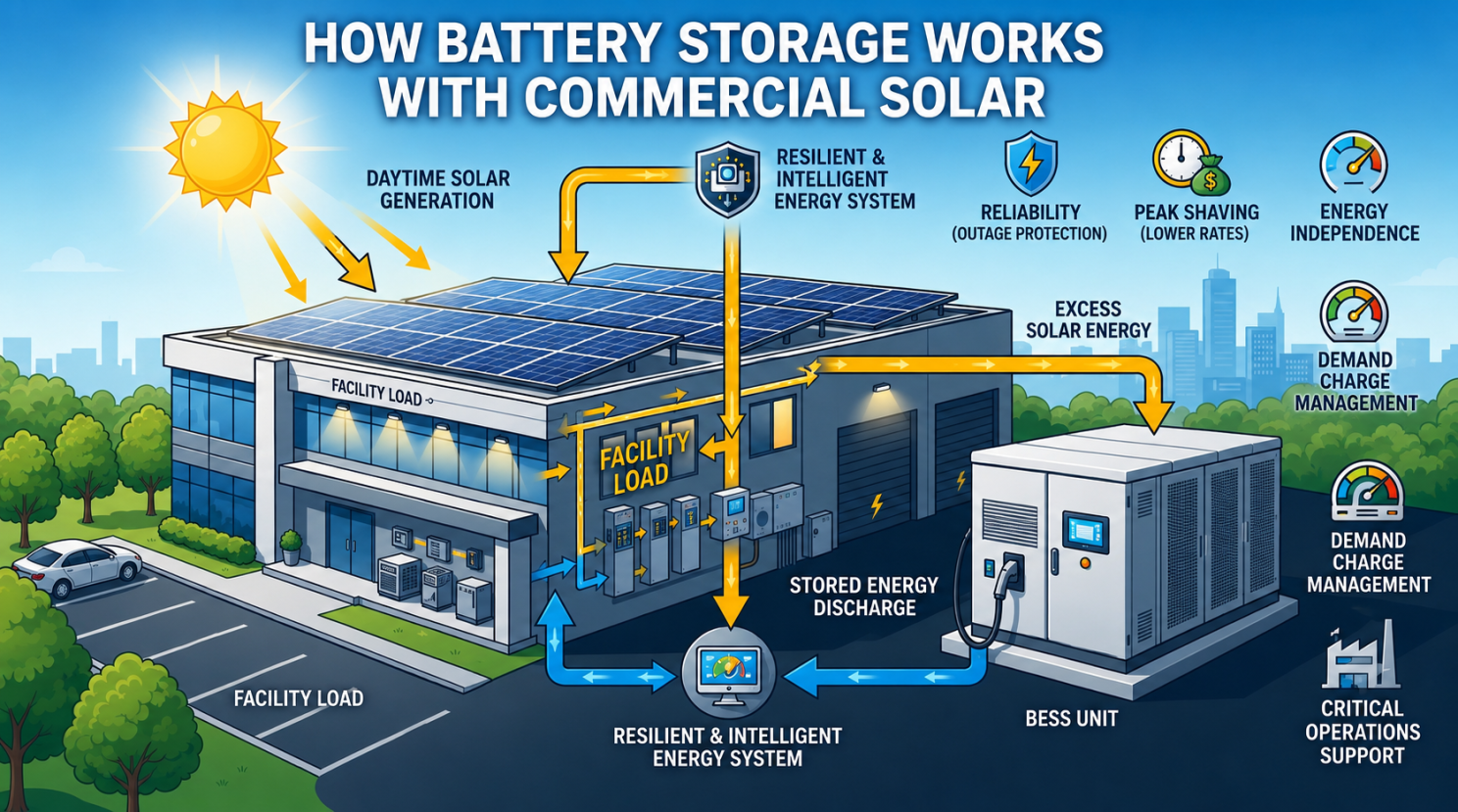
A Battery Energy Storage System (BESS) stores excess solar energy generated during the day.
That stored electricity can later be used to:
- Power facilities during outages
- Reduce electricity purchases during peak utility rates
- Improve energy independence
- Lower demand charges
- Support critical business operations
The combination creates a resilient and intelligent energy system.
Major Benefits of Commercial Solar + Battery Storage
1. Reliable Backup Power
Battery storage automatically supplies electricity when the utility grid goes down.
Critical systems remain operational, including:
- Lighting
- Servers
- Refrigeration
- Security systems
- Manufacturing equipment
- Medical devices
- Communication networks
Business operations continue with minimal disruption.
2. Lower Electricity Bills
Commercial batteries store energy when electricity is inexpensive or when solar production is highest.
Businesses can use stored energy during:
- Peak pricing periods
- High-demand afternoons
- Utility demand response events
This significantly reduces overall electricity expenses.
3. Peak Demand Charge Reduction
Many U.S. commercial utility bills include demand charges based on peak electricity usage.
Battery storage helps by:
- Discharging during peak demand
- Reducing maximum grid consumption
- Lowering monthly demand charges
For many businesses, demand charge savings represent one of the largest financial benefits.
4. Greater Energy Independence
Businesses become less dependent on utility companies.
Benefits include:
- Better protection from rising electricity prices
- Reduced exposure to grid instability
- Improved operational reliability
5. Sustainability and ESG Goals
Commercial solar and battery storage reduce greenhouse gas emissions while helping businesses achieve:
- Corporate sustainability goals
- ESG commitments
- Net-zero initiatives
- Environmental certifications
Customers and investors increasingly value companies that invest in clean energy.
Industries Benefiting Most
Commercial solar and battery storage are valuable across many industries.
Manufacturing
- Prevent costly production downtime
- Protect automated equipment
- Maintain continuous operations
Warehouses & Distribution Centers
- Keep logistics moving
- Maintain lighting and security
- Support inventory systems
Healthcare Facilities
- Ensure uninterrupted patient care
- Power medical equipment
- Maintain emergency operations
Retail Businesses
- Prevent revenue loss
- Keep payment systems operational
- Protect refrigerated inventory
Hotels
- Maintain guest comfort
- Operate HVAC systems
- Keep elevators and lighting functional
Data Centers
- Protect sensitive equipment
- Prevent data loss
- Maintain continuous uptime
Financial Incentives for U.S. Businesses
Federal and state incentives continue making commercial solar and battery storage more affordable.
Potential incentives may include:
- Federal Investment Tax Credit (ITC)
- Accelerated depreciation through MACRS
- State rebate programs
- Utility incentive programs
- Demand response payments
Businesses should consult qualified tax and energy professionals to determine eligibility.
Key Design Considerations
Before installing a commercial solar and battery system, businesses should evaluate:
- Annual energy consumption
- Peak demand profile
- Critical backup loads
- Roof or ground space availability
- Battery capacity requirements
- Utility interconnection requirements
- Local permitting and electrical codes
A properly engineered system maximizes both savings and resilience.
Why Professional Engineering Matters
Commercial solar and battery projects involve far more than equipment installation.
Professional engineering ensures:
- Accurate load calculations
- Battery sizing
- Structural analysis
- Electrical safety
- Utility compliance
- NEC compliance
- Local AHJ approval
- Long-term system reliability
A well-designed system delivers better performance while reducing permitting delays and installation issues.
Future Outlook
As electricity demand continues to rise across the United States, battery storage is becoming an essential part of commercial energy infrastructure.
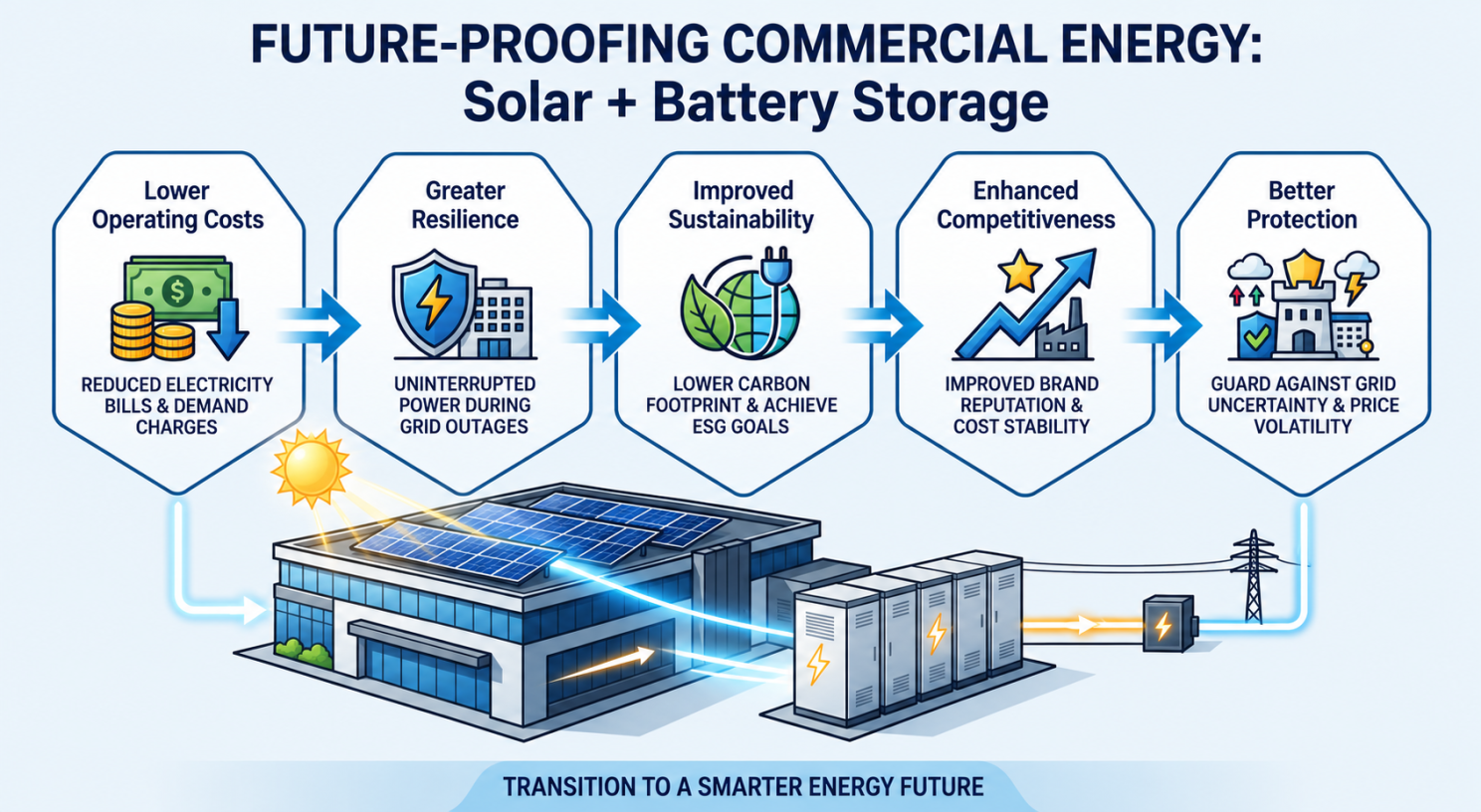
Businesses that invest today benefit from:
- Lower operating costs
- Greater resilience
- Improved sustainability
- Enhanced competitiveness
- Better protection from future grid uncertainty
Commercial solar paired with battery storage is rapidly becoming the standard for energy-conscious businesses.
Conclusion
Grid reliability can no longer be taken for granted. U.S. businesses need energy solutions that provide both cost savings and operational security.
Commercial solar combined with battery storage delivers exactly that lower electricity bills, reliable backup power, reduced demand charges, and greater energy independence.
For organizations looking to future-proof their operations, investing in a professionally engineered commercial solar and battery storage system is a smart long-term strategy that protects both business continuity and profitability.
FAQs
1. Can commercial solar power my business during a blackout?
Not by itself. Most grid-tied solar systems shut down during outages. A battery energy storage system is required to provide backup power.
2. How do batteries reduce electricity costs?
Batteries store energy when rates are low or solar production is high and discharge it during peak pricing periods, reducing energy costs and demand charges.
3. Which businesses benefit the most from battery storage?
Manufacturing facilities, warehouses, healthcare centers, retail stores, hotels, office buildings, schools, and data centers all benefit from improved energy resilience and lower operating costs.
4. Are commercial solar and battery systems eligible for incentives?
Yes. Many U.S. businesses may qualify for federal tax credits, accelerated depreciation, state incentives, and utility programs, depending on project eligibility.
5. Why is professional solar engineering important?
Professional engineering ensures the system is properly designed, code-compliant, safe, optimized for performance, and more likely to receive smooth permitting and utility approval.