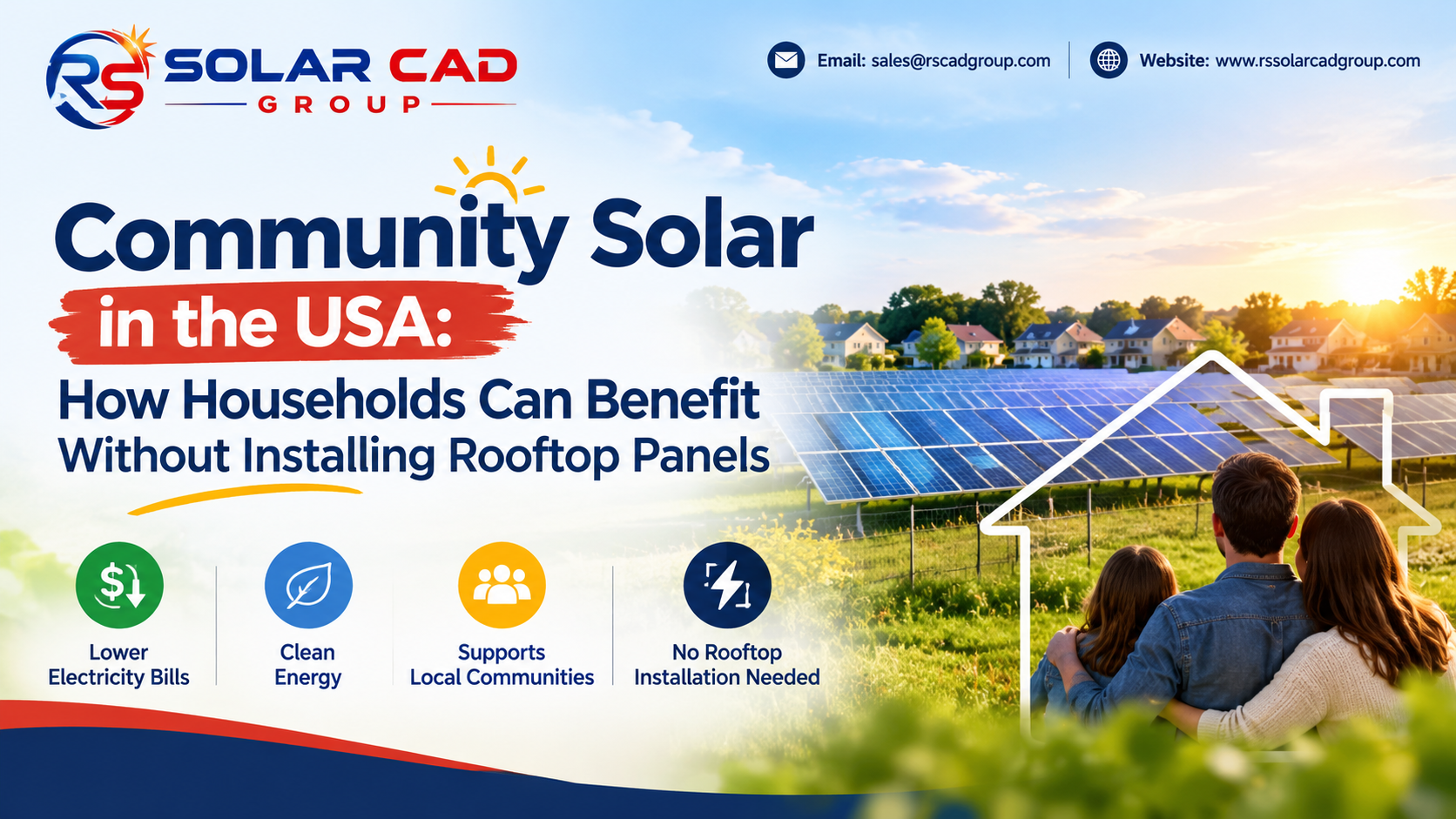
Community Solar in the USA: How Households Can Benefit Without Installing Rooftop Panels
Introduction: Making Solar Energy Accessible to Every Household
Solar energy is transforming the way households and businesses across the United States think about electricity. With growing interest in renewable energy, energy independence, and electricity bill management, more consumers are exploring alternatives to conventional power. However, despite the growing popularity of rooftop solar, installing panels at home is not a practical option for everyone.
Many Americans live in rented apartments, condominiums, or multi-unit residential buildings where they cannot independently install solar panels. Some homeowners have roofs that receive insufficient sunlight because of nearby buildings, trees, roof orientation, or limited space. Others may not want to invest in a private solar installation or manage the maintenance responsibilities associated with owning a solar energy system.
Community solar provides another way to participate in the clean energy transition without installing solar panels on a personal rooftop.
Through this model, multiple households and organizations can benefit from a shared solar installation. Instead of purchasing and maintaining their own equipment, eligible customers subscribe to a community solar project and may receive credits on their electricity bills based on the program’s rules.
According to the U.S. Department of Energy, community solar can help customers access solar energy even when they cannot install panels on their own properties. The National Laboratory of the Rockies has also documented community solar projects across the United States, demonstrating the growing importance of shared solar models in the renewable energy market.
In this comprehensive guide, we explore how community solar works, its benefits and limitations, the types of households that can participate, state-level program examples, potential savings, and the key considerations consumers should understand before enrolling.
1. What Is Community Solar?
Community solar is a renewable energy model in which multiple customers share the benefits of electricity generated by a common solar installation.
Unlike traditional rooftop solar, where panels are installed directly on a home or business, a community solar project is generally located away from the subscriber’s property. It may be built on open land, suitable commercial property, or another location where a solar installation can generate electricity efficiently.
The solar project produces electricity and delivers it to the local utility grid. Eligible subscribers receive a portion of the financial value associated with the project’s electricity generation, often in the form of credits on their utility bills.
The exact arrangement depends on the project’s ownership structure, local regulations, utility requirements, and subscription agreement.
How Is Community Solar Different From Traditional Solar Ownership?
With traditional rooftop solar, a homeowner typically purchases, leases, or finances a solar system installed on their property. The system generates electricity that can be consumed by the household, with any exported electricity handled according to the applicable utility compensation rules.
Community solar works differently. Participants do not necessarily own the solar panels or receive electricity directly from a particular panel. Instead, they participate financially in a shared project and receive benefits through an approved billing or subscription arrangement.
This distinction makes community solar particularly relevant for households that want to explore renewable energy without making physical changes to their properties.
Why Is Community Solar Important?
Access to rooftop solar depends on several factors, including property ownership, roof condition, available space, sunlight exposure, installation costs, and local regulations.
Community solar can reduce these barriers by separating participation in solar energy from ownership of a suitable rooftop.
For example, a renter living in an apartment in New York may be unable to install panels on the building. If an eligible community solar program serves the renter’s utility territory, the renter may be able to subscribe to a shared project and receive bill credits without changing the apartment or obtaining rooftop installation rights.
This flexibility helps broaden access to solar energy beyond households that can host their own systems.
2. How Does Community Solar Work in the USA?
Although program structures differ by state, many community solar arrangements follow a similar process.
Step 1: A Solar Developer Builds a Shared Solar Project
A developer identifies a suitable site, assesses its solar potential, arranges project financing, obtains required approvals, and installs photovoltaic panels.
The project may include solar modules, mounting structures, inverters, electrical equipment, monitoring systems, and grid interconnection infrastructure.
The developer or project operator is generally responsible for operating and maintaining the installation.
Step 2: The Project Connects to the Electricity Grid
Once the installation is approved and connected, it generates electricity from sunlight and supplies that electricity to the utility grid.
Solar production varies throughout the day and across seasons. Weather conditions, equipment performance, system orientation, shading, and maintenance can affect the amount of electricity generated.
Step 3: Eligible Customers Subscribe
Households, businesses, and other eligible electricity customers can enroll in an available program.
Depending on the arrangement, customers may subscribe to a specified portion of the project’s output, a defined capacity allocation, or another approved participation structure.
The subscription should be sized appropriately for the customer’s expected electricity usage and the project’s crediting rules.
Step 4: The Solar Project Generates Bill Credits
The project produces electricity, and the applicable utility or program calculates the value allocated to each subscriber.
In many programs, this value appears as a credit on the customer’s electricity bill. The subscriber may also pay a separate subscription charge to the community solar provider.
Other programs may use different billing arrangements, so customers should not assume that every project follows the same process.
Step 5: The Customer Evaluates the Net Savings
The financial benefit depends on the difference between the credits received and the subscription charges paid.
For example, if a household receives $60 in monthly bill credits and pays $48 to the subscription provider, its net monthly benefit is $12, assuming there are no other applicable charges.
This is an illustrative example, not a guaranteed saving or a representation of typical program terms.
The central principle is simple: evaluate the actual financial benefit after all subscription costs, rather than looking at bill credits alone.
3. Who Can Benefit From Community Solar?
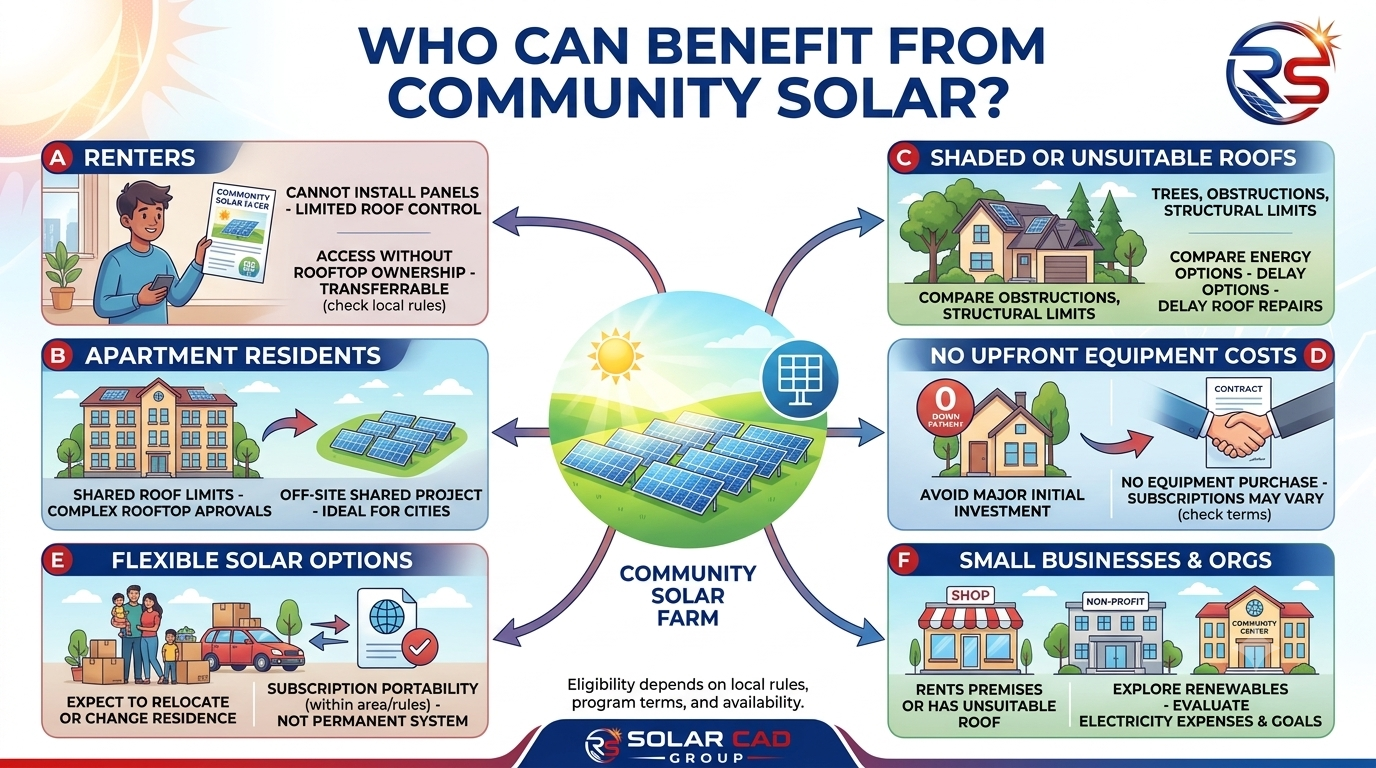
Community solar can serve several customer groups, depending on local eligibility requirements and project availability.
A. Renters Who Cannot Install Solar Panels
Renters often have limited control over a property’s roof, electrical infrastructure, and exterior modifications. Even when a building receives excellent sunlight, individual tenants may not have permission to install their own solar systems.
Community solar offers a potential alternative because participation generally does not require rooftop access.
A renter can explore an eligible project without purchasing panels or negotiating a rooftop installation with the property owner.
However, renters should check whether their subscription can be transferred if they move and whether the new address must remain within the same utility service area.
B. Apartment and Condominium Residents
Residents of multi-unit buildings may share a roof that is too small for all occupants or may have no individual control over the building’s solar infrastructure.
Installing a single rooftop system that benefits every resident can require complex ownership arrangements, building approvals, and electricity allocation procedures.
Community solar can provide another approach by allowing eligible residents to participate in a shared off-site project.
This model may be especially useful in densely populated cities where apartment living is common and individual rooftop installations are difficult.
C. Homeowners With Shaded or Unsuitable Roofs
Not every house is suitable for rooftop solar.
Nearby buildings, mature trees, roof obstructions, structural limitations, and unsuitable roof conditions can reduce the feasibility or performance of a residential solar installation.
A homeowner may also have a roof that needs replacement before solar panels can be installed economically.
Rather than immediately investing in roof repairs or a complicated installation, the homeowner can compare community solar with other available energy options.
The best choice depends on the property’s condition, electricity consumption, local utility rules, and the financial terms of available programs.
D. Households That Want to Avoid Upfront Equipment Costs
Purchasing and installing rooftop solar may require a substantial initial investment or a long-term financing agreement.
Some community solar programs offer subscriptions without an upfront equipment purchase, making participation potentially easier for households that do not want to own solar equipment.
Nevertheless, no-upfront-cost participation does not mean cost-free electricity. Monthly subscription payments, fees, and contract obligations may still apply.
Consumers should request a clear explanation of all charges before signing an agreement.
E. Households Seeking Flexible Solar Options
Some households may expect to relocate, change residences, or adjust their energy arrangements in the future.
For these customers, a community solar subscription with clear transfer or cancellation terms may be more practical than installing a permanent solar system on a property they do not intend to own long-term.
Portability is not automatic, however. It depends on the program, contract, utility territory, and applicable regulations.
F. Small Businesses and Community Organizations
Community solar is not limited to residential consumers.
Eligible small businesses, nonprofit organizations, and other electricity customers may also benefit from shared solar projects.
For organizations that rent their premises or operate in buildings with unsuitable roofs, community solar can provide a way to explore renewable energy without making major property modifications.
Businesses should evaluate the arrangement against their electricity expenses, contract obligations, accounting requirements, and sustainability objectives.
4. Major Benefits of Community Solar
Community solar offers several potential advantages, but the actual value depends on the specific project and program.
4.1 Potential Electricity Bill Savings
One of the main reasons households consider community solar is the opportunity to reduce electricity expenses.
Subscribers may receive credits that offset part of their utility bills. If the financial value of those credits exceeds the subscription charges, the customer can achieve net savings.
The amount depends on factors such as:
-
The quantity of electricity allocated to the subscriber.
-
The project’s actual electricity generation.
-
The utility’s applicable crediting rates.
-
The subscription fee and payment structure.
-
The customer’s electricity usage and billing arrangement.
-
Any administrative charges or other contractual costs.
Consumers should compare the expected net benefit with their existing electricity costs before deciding whether to enroll.
4.2 No Personal Rooftop Installation
Community solar removes the need for an individual subscriber to install panels on their home.
Customers generally do not need to arrange a personal rooftop survey, purchase mounting equipment, or modify their property’s roof.
This can be valuable for renters, apartment residents, and homeowners whose properties are unsuitable for solar installation.
4.3 No Direct Responsibility for Solar Equipment Maintenance
A privately owned rooftop solar system requires appropriate monitoring, maintenance, and occasional repairs.
Community solar subscribers generally leave equipment maintenance to the project owner or operator.
This arrangement can simplify participation because customers do not need to manage the solar panels, inverters, or mounting structures themselves.
The subscription agreement should still explain the provider’s responsibilities and how project interruptions may affect credits.
4.4 Greater Accessibility for Renters
Traditional rooftop solar is closely connected to property ownership or permission to modify a building.
Community solar separates participation from the customer’s ability to host equipment, potentially making solar energy accessible to more renters.
This is an important advantage in cities where residents may have limited control over the buildings in which they live.
4.5 Lower Barriers to Entry
Some community solar programs allow households to participate without purchasing solar equipment or paying for an individual installation.
This can reduce the financial and logistical barriers associated with rooftop solar.
However, eligibility requirements, deposits, subscription fees, and other costs vary. Customers should evaluate the entire agreement rather than relying on a provider’s advertising.
4.6 Support for Renewable Electricity Generation
Community solar projects add solar electricity generation to the energy system.
Depending on the local electricity mix and how the project’s output affects other generation, solar production can reduce the need for electricity from more carbon-intensive sources.
Subscribers can therefore participate in a broader clean energy initiative without hosting their own equipment.
The exact environmental impact depends on the project, the electricity it displaces, and the treatment of renewable energy attributes.
4.7 Opportunities for Community Participation
Shared solar projects can create opportunities for residents, local organizations, and businesses to participate in renewable energy development.
Some programs specifically seek to expand access for income-eligible households or underserved communities.
Such arrangements can help make solar participation more inclusive, provided that enrollment is transparent and customers receive meaningful financial benefits.
4.8 Potential Support for Local Economic Activity
Developing and operating a solar project can require engineering, construction, electrical work, project management, maintenance, and administrative services.
These activities may create employment and business opportunities in the project area.
The scale and distribution of these benefits vary by project and should not be assumed to be the same for every community solar installation.
5. Community Solar vs. Rooftop Solar: Which Is Better?
Community solar and rooftop solar both provide ways to participate in solar energy, but they meet different needs.
| Comparison factor | Community solar | Rooftop solar |
|---|---|---|
| Equipment location | Off-site shared installation | Customer’s property |
| Personal roof required | No | Usually |
| Property ownership | Not always necessary | Ownership or installation permission is generally needed |
| Upfront equipment purchase | Often not required | May be required, depending on financing |
| Maintenance responsibility | Generally handled by project operator | Depends on system ownership and service agreement |
| Electricity bill treatment | Program-specific credits and charges | Self-consumption and applicable export-credit rules |
| Customer control | Limited control over project equipment | Greater control if the system is owned |
| Moving home | Depends on portability and cancellation terms | System remains attached to the property unless separately arranged |
| Battery backup | Not automatically included | Possible with a suitable battery system |
| Financial outcome | Depends on subscription terms and credits | Depends on installation cost, production, electricity rates, and incentives |
When Is Community Solar the Better Option?
Community solar may be more practical when a household rents its home, lives in an apartment, has an unsuitable roof, or prefers not to own and maintain solar equipment.
It can also suit customers who want to participate without arranging a personal installation.
When Is Rooftop Solar Worth Considering?
Rooftop solar may be more attractive for homeowners with suitable roofs, sufficient sunlight, and the ability to make a long-term investment.
An owned rooftop system can provide greater control over electricity generation and may offer different long-term financial benefits.
A battery can also be integrated into a properly designed residential system, although backup functionality depends on the equipment and electrical configuration.
Neither option is universally better. A household should compare its actual costs, expected benefits, flexibility requirements, and local rules before making a decision.
6. How Much Can Households Save With Community Solar?
Community solar savings vary significantly across programs. There is no single nationwide savings rate that applies to every subscriber.
To understand the financial model, it helps to distinguish between gross bill credits and net savings.
Net savings = bill credits received − subscription payments − additional applicable charges.
Consider the following illustrative example.
| Monthly item | Example amount |
|---|---|
| Electricity bill before community solar credits | $150 |
| Community solar bill credit | $60 |
| Revised utility bill | $90 |
| Separate community solar subscription payment | $48 |
| Total electricity-related payments | $138 |
| Net monthly savings | $12 |
| Illustrative annual savings | $144 |
In this example, the customer receives $60 in credits but pays $48 to the subscription provider. The actual financial benefit is $12 per month.
The example assumes that the entire $60 credit is applied as expected and that no additional fees or other bill adjustments apply.
Actual results may be higher, lower, or even negative depending on program terms and project performance.
Factors That Influence Community Solar Savings
Credit value: Different utility territories and programs use different methods to calculate credits.
Subscription discount: Some providers charge less than the value of the credits generated by a subscriber’s allocation, while other arrangements may use different pricing structures.
Solar production: A project’s generation changes with weather, seasonal sunlight, equipment availability, and other operating conditions.
Subscription size: An allocation that does not match a household’s usage may produce a different financial outcome from the one expected.
Utility billing rules: Some charges may remain payable even when the customer receives credits.
Contract duration: The long-term value depends on the subscription’s pricing, renewal provisions, and applicable cancellation terms.
How Can Customers Estimate Their Potential Savings?
Before enrolling, households should request a written estimate showing expected bill credits, subscription charges, and any other costs.
They should compare the estimate with their recent electricity bills and ask how the figures could change if electricity rates or solar generation fluctuate.
Customers should also clarify whether the provider’s advertised savings represent gross credits or net savings after subscription payments.
This distinction is essential for making a fair comparison between community solar offers.
7. Community Solar Programs Across the United States
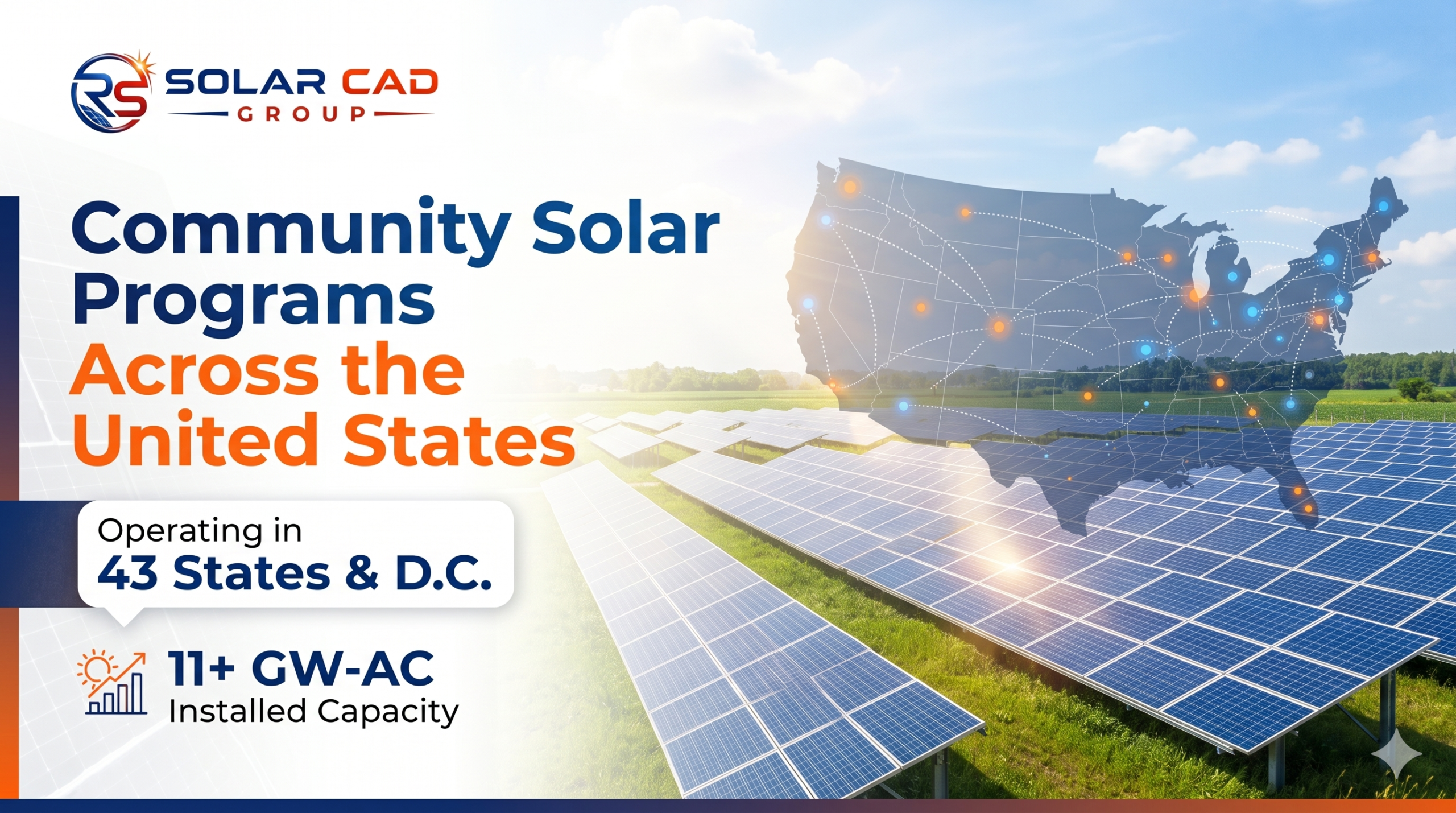
Community solar availability depends on state policy, utility service territory, project capacity, and the structure of individual programs.
According to the National Laboratory of the Rockies, community solar projects were operating in 43 states and the District of Columbia as of June 2025, with more than 11 GW-AC of installed capacity. However, the presence of a project in a state does not mean that every household in that state can subscribe.
Some states have established dedicated programs, while others have different arrangements or limited access.
New York: Shared Solar Through Bill Credits
New York has developed a community solar market through programs supported by the New York State Energy Research and Development Authority.
Eligible customers can subscribe to an off-site solar project and receive credits on their utility bills based on the project’s production and their allocated share.
This approach allows households to explore solar benefits without installing equipment on their own roofs.
Official resource: NYSERDA Community Solar — How It Works
Illinois: Illinois Shines
Illinois supports community solar through the Illinois Shines program, which includes traditional community solar and community-driven community solar categories.
Eligible customers can subscribe to participating projects without installing solar panels on their own property.
Program details, available projects, subscription terms, and consumer protections should be reviewed before enrollment.
Official resource: Illinois Shines
Massachusetts: An Established Community Solar Market
Massachusetts is among the major community solar markets in the United States.
Customers may be able to participate through arrangements that provide financial benefits associated with off-site solar generation. Eligibility, utility billing, credit structures, and available subscriptions depend on the particular program and service area.
Households should review current state guidance and the terms offered by individual providers before joining.
Minnesota: Shared Solar Opportunities
Minnesota has been an important market for community solar development.
Community solar arrangements can allow eligible customers to receive financial credits associated with shared solar generation rather than installing a system on their own properties.
Availability and participation requirements vary, so customers should confirm the current options with their utility and program administrator.
Colorado: Check Current Local Availability
Colorado has explored community solar arrangements as part of its renewable energy market.
The availability of subscriptions, eligible customer groups, and applicable bill-crediting structures depends on current program rules and individual project offerings.
Households should verify that a specific project is accepting subscribers in their utility territory before relying on potential savings.
Why State-Level Differences Matter
Community solar is not governed by one identical nationwide subscription system.
State policies can influence how projects are developed, how customers receive credits, which households qualify, and what consumer protections apply.
For this reason, customers should check their own utility territory and state program rather than relying only on general information about community solar in America.
8. How to Find a Community Solar Program Near You
Finding a suitable program involves more than searching for a solar farm in your state.
Step 1: Identify Your Electricity Utility
Check your electricity bill to identify the utility serving your address.
This matters because community solar participation often depends on whether the project and subscriber are eligible under the utility’s billing arrangements.
Step 2: Review State Energy Resources
Visit your state energy office or official renewable energy program website to learn whether community solar options are available.
Government and program websites may provide information about approved providers, participating projects, income-eligible programs, and consumer protections.
Step 3: Check Your Utility’s Community Solar Information
Some utilities publish information about shared solar programs or explain how community solar credits are applied to customer bills.
Ask whether the utility supports the specific project you are considering.
Step 4: Compare Multiple Offers
Where several providers are available, compare their subscription fees, expected credits, contract terms, cancellation provisions, and customer support.
Do not assume that two programs offer the same savings simply because they advertise similar percentages.
Step 5: Verify Project Status
Some providers accept subscriptions while a project is still being developed. In these cases, bill credits may not begin immediately.
Ask whether the project is operational, when credits are expected to appear, and what happens if the project is delayed.
Step 6: Review the Contract Before Signing
Read the agreement carefully and request a written disclosure of all charges and obligations.
Make sure you understand how the subscription works if you move, change utilities, or decide to leave the program.
9. Important Things to Check Before Joining Community Solar
A community solar subscription is a financial agreement, so customers should assess the details carefully.
9.1 Subscription Fees and Hidden Costs
Ask whether the provider charges a fixed monthly amount, a percentage of bill credits, or another type of fee.
Check for enrollment charges, deposits, administrative costs, minimum payments, and other expenses.
A program that advertises large credits may provide limited net savings if its subscription fees are also high.
9.2 Cancellation and Early Termination
Understand how to leave the program and whether any cancellation or termination fees apply.
A long-term agreement may be less suitable for a household that expects to move or change its electricity provider.
Request written clarification rather than relying solely on a salesperson’s verbal assurances.
9.3 Portability When Moving
Ask whether the subscription can move with you to a new address.
In some programs, portability is limited to a specific utility service territory or subject to additional eligibility checks.
If you expect to relocate, check these terms before enrolling.
9.4 Bill Credit Timing
Ask when credits will begin appearing on your utility bill and how frequently they are calculated.
If the project is not yet operational, there may be a delay between signing the agreement and receiving the first credit.
Understand whether subscription payments begin before or after credits become available.
9.5 Project Performance
The amount of electricity generated by a solar project can vary.
Ask how the provider handles lower-than-expected generation, maintenance interruptions, or changes in credit values.
Review the agreement to determine whether any savings estimates are guaranteed or merely projections.
9.6 Provider Reputation and Consumer Protections
Research the provider and read customer reviews with appropriate caution.
Check whether the project participates in an official state program and whether the provider supplies clear disclosures and accessible customer support.
Be cautious of pressure to sign immediately, unclear pricing, or claims of guaranteed savings that are not supported by the written contract.
9.7 Income-Eligible Programs
Some community solar initiatives include provisions intended to improve access for low- and moderate-income households.
These programs may have specific eligibility requirements or additional consumer protections.
Customers should ask whether they qualify for an income-eligible offering and whether the financial benefits differ from standard subscriptions.
10. Common Myths About Community Solar
Misunderstandings about community solar can lead households to choose a program without fully understanding the arrangement.
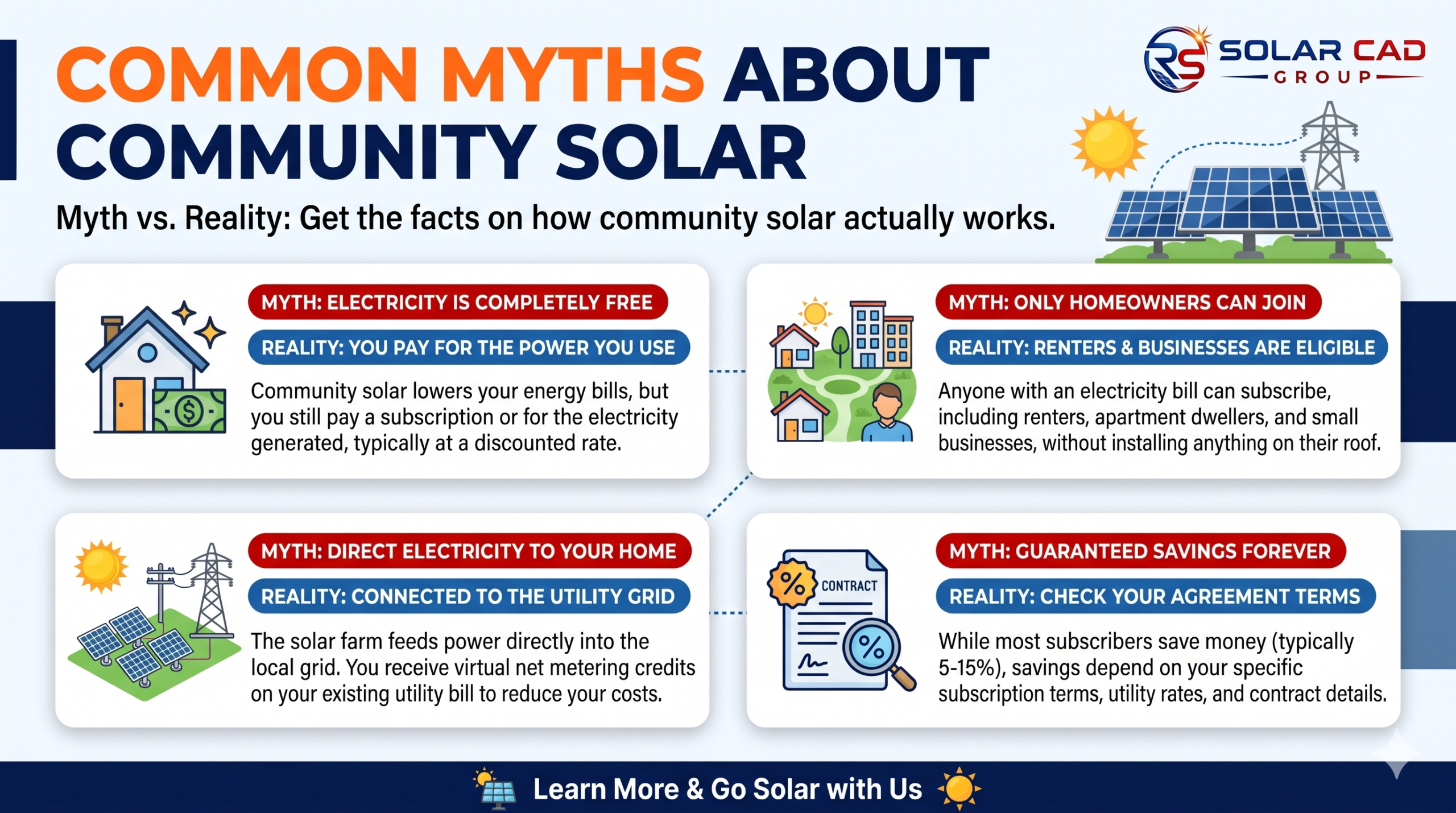
Myth 1: Community Solar Makes Electricity Completely Free
Reality: Most subscriptions involve some form of payment or financial arrangement. Savings depend on how bill credits compare with subscription charges and other applicable costs.
Myth 2: Only Homeowners Can Join
Reality: Many community solar programs are designed to include renters and other customers who cannot install panels on their own properties. Eligibility still depends on local rules and project availability.
Myth 3: Subscribers Receive Electricity Directly From the Solar Farm
Reality: The project typically supplies electricity to the utility grid. Subscribers receive financial credits or other program-defined benefits rather than a dedicated physical flow of electricity from the project to their homes.
Myth 4: Every State Offers the Same Programs
Reality: Community solar policies, utility arrangements, customer protections, and project availability differ across the United States.
Myth 5: Every Subscription Guarantees Savings
Reality: Savings depend on the agreement and the relationship between bill credits and subscription charges. Customers should verify any claimed guarantee in writing.
Myth 6: Community Solar Automatically Provides Backup Power
Reality: A typical community solar subscription does not provide backup electricity to the subscriber’s home during a power outage. Backup power requires a suitable arrangement involving equipment such as a battery and appropriate electrical systems.
Myth 7: Joining Community Solar Means You Must Own the Solar Panels
Reality: Most subscription-based arrangements do not require participants to purchase or own the equipment. Some alternative ownership models may exist, but the contract determines the customer’s rights and responsibilities.
11. The Environmental Impact of Community Solar
Community solar can contribute to the expansion of renewable electricity generation by allowing multiple customers to benefit from a shared installation.
Solar panels generate electricity without burning fuel during operation. When solar generation displaces electricity that would otherwise come from more carbon-intensive sources, it can help reduce power-sector emissions.
However, the environmental impact of a project depends on the electricity sources it displaces, the time and location of generation, the project’s construction and operation, and the treatment of renewable energy attributes.
Customers should also distinguish between subscribing to a community solar project and owning the renewable energy certificates associated with its output. In some programs, subscribers receive utility bill credits but do not receive the renewable energy certificates themselves.
Therefore, households interested in environmental claims should review the project’s documentation and understand exactly what benefits their subscription provides.
12. Community Solar and Energy Equity
One important goal of community solar is to broaden access to renewable energy beyond property owners who can install rooftop panels.
Households with limited incomes, renters, and residents of multi-unit buildings may face financial or structural barriers to traditional rooftop solar.
Programs designed with affordability and consumer protection in mind can help address some of these challenges.
Useful protections may include clear pricing disclosures, transparent savings calculations, understandable contracts, accessible complaint procedures, and fair cancellation terms.
Income-eligible programs can also create pathways for households that might otherwise be excluded from solar participation.
However, the existence of a community solar project does not automatically make it affordable for every household. Meaningful access depends on the actual financial terms, eligibility rules, and protections provided.
13. The Role of Solar Engineering and System Planning
Community solar projects require careful planning to generate electricity reliably and deliver the intended financial benefits.
Although subscribers may not need to manage the solar equipment directly, the project’s technical performance influences the amount of electricity generated and the credits that can be allocated under the applicable program.
Several engineering considerations are important.
Site Selection and Solar Resource Assessment
A suitable site should provide sufficient sunlight and space for the planned solar installation.
Engineers assess solar irradiance, shading, terrain, site access, environmental constraints, and other factors that can affect project performance.
A well-selected site can help improve expected generation and support reliable long-term operation.
System Layout and Panel Orientation
Solar panel orientation, tilt, spacing, and row arrangement influence how effectively a project uses the available sunlight.
The design must balance energy production with land constraints, shading, access pathways, equipment requirements, and maintenance needs.
Electrical Design and Grid Interconnection
Community solar projects require an electrical design that accounts for inverters, conductors, protective equipment, grounding, metering, and grid interconnection requirements.
Designers must also follow applicable electrical codes, utility requirements, and project-specific engineering standards.
Production Estimates and Performance Monitoring
Accurate energy estimates help project owners understand expected generation and communicate realistic expectations to subscribers.
Monitoring systems can help operators identify performance issues, equipment faults, and unexpected production changes.
Actual output will still vary with weather, equipment availability, and operating conditions.
Documentation and Project Coordination
Large solar projects involve coordination among developers, engineers, installers, utilities, and other stakeholders.
Clear drawings, equipment schedules, electrical documentation, and consistent design revisions help reduce errors and support project delivery.
At RS Solar CAD Group, solar design and engineering documentation are important parts of the wider solar development ecosystem. Professional planning supports the development of solar installations that must meet technical requirements while balancing performance, constructability, and project objectives.
Community solar demonstrates how the solar industry can serve customers through different project models, from individual rooftop systems to larger shared installations.
14. What Does the Future Hold for Community Solar in the USA?
Community solar has become an important part of the American solar market, offering an alternative for customers who cannot or do not want to install rooftop panels.
Its future development will depend on state policies, utility participation, project financing, subscription demand, consumer protections, and the economics of solar electricity.
More Flexible Participation Models
Program developers may continue exploring subscription structures that better suit renters, households with changing electricity usage, and customers who need flexible cancellation options.
Transparent terms and accessible enrollment will be important for building consumer confidence.
Greater Focus on Affordable Access
States and program administrators may continue developing approaches to help income-eligible households participate in renewable energy.
Effective affordability initiatives must provide meaningful net savings and protect customers from unclear fees or unsuitable contracts.
Better Digital Tools and Customer Information
Online enrollment platforms, production monitoring, billing information, and clearer disclosures can make it easier for customers to compare available programs.
Improved access to understandable information may also help households distinguish realistic savings estimates from unsupported marketing claims.
Continued Importance of Technical Performance
As the market develops, accurate system design, appropriate equipment selection, efficient project operation, and reliable monitoring will remain important.
Projects must generate electricity effectively while meeting interconnection, safety, and regulatory requirements.
Community Solar as Part of a Broader Energy Strategy
Community solar is one of several ways to expand access to renewable electricity.
Depending on their circumstances, households may combine energy-efficiency improvements with community solar, rooftop solar, or other approved clean energy options.
The most suitable solution will depend on the customer’s property, budget, electricity needs, and local energy market.
15. Frequently Asked Questions About Community Solar in the USA
Q1. What is community solar in simple terms?
Community solar allows multiple customers to benefit from electricity generated by a shared solar project. Eligible subscribers may receive credits on their electricity bills without installing solar panels on their own properties.
Q2. Can renters participate in community solar?
Yes, renters can participate in many programs if their address, utility, and customer account meet the eligibility requirements. They should review contract terms carefully, particularly if they expect to move.
Q3. Do I need to install solar panels at home?
No. A typical community solar subscription does not require panels to be installed on your home. The solar equipment is located at a shared project site.
Q4. Will community solar reduce my electricity bill?
It may reduce your total electricity-related expenses if the value of the credits you receive exceeds your subscription payments and other applicable charges. Actual savings depend on the program.
Q5. Is community solar free to join?
Some programs offer participation without an upfront equipment purchase or enrollment fee. However, monthly subscription payments or other charges may apply. Review the full agreement before enrolling.
Q6. Can I join community solar if I live in an apartment?
Potentially, yes. Apartment residents may qualify if an available project serves their utility territory and the program accepts their type of electricity account.
Q7. Is community solar available in every US state?
Availability is not uniform. Projects operate across many states, but local program rules, utility arrangements, and customer eligibility differ. Check current information for your location.
Q8. What happens if I move to another state?
Your subscription may not transfer automatically. Portability depends on the contract and program rules, and a move to another utility territory may require cancellation or a new subscription.
Q9. Does community solar provide electricity during a blackout?
A standard subscription generally does not provide backup power to your home. Backup capability requires an appropriate electrical system and equipment, such as a compatible battery installation.
Q10. How do I know whether a community solar company is legitimate?
Research the provider, verify project status, check official program resources where available, and review the contract. Ask for written information about pricing, bill credits, cancellation terms, and customer support.
Q11. Can businesses participate in community solar?
Eligible businesses and organizations may be able to subscribe to shared solar projects. Their options depend on the program, utility territory, customer type, and available project capacity.
Q12. Is community solar better than rooftop solar?
Neither option is automatically better. Community solar may be more convenient for renters or homes with unsuitable roofs, while rooftop solar may suit homeowners who want to own a system and have appropriate installation conditions.
Conclusion: Expanding Solar Access Beyond the Rooftop
Community solar is changing how households can participate in renewable energy across the United States. By allowing multiple customers to benefit from a shared solar installation, it creates an alternative for renters, apartment residents, homeowners with unsuitable roofs, and other consumers who cannot easily install traditional rooftop panels.
Its key advantages include the potential for electricity bill savings, reduced responsibility for personal solar equipment, and greater accessibility to renewable energy. At the same time, community solar requires careful evaluation of subscription charges, bill-crediting rules, project availability, contract terms, and customer protections.
Before enrolling, households should compare their options, verify the provider, and calculate the potential net benefit using realistic assumptions. A well-chosen program can offer a practical way to participate in solar energy without taking on the responsibilities of a personal rooftop installation.
As the solar industry continues to develop, shared solar projects will remain an important model for broadening access to renewable electricity. Their success depends on reliable engineering, transparent pricing, appropriate program design, and meaningful benefits for subscribers.
At RS Solar CAD Group, we recognize that the future of solar energy involves a diverse range of project types and customer needs. From rooftop installations to larger solar developments, effective design and engineering documentation help support the broader growth of solar infrastructure.
Community solar illustrates an important principle of the energy transition: access to solar energy does not have to begin with a solar panel on your own roof.
Explore the changing solar landscape, stay informed about emerging project models, and continue learning about the technologies and design practices shaping the future of renewable energy in the United States.