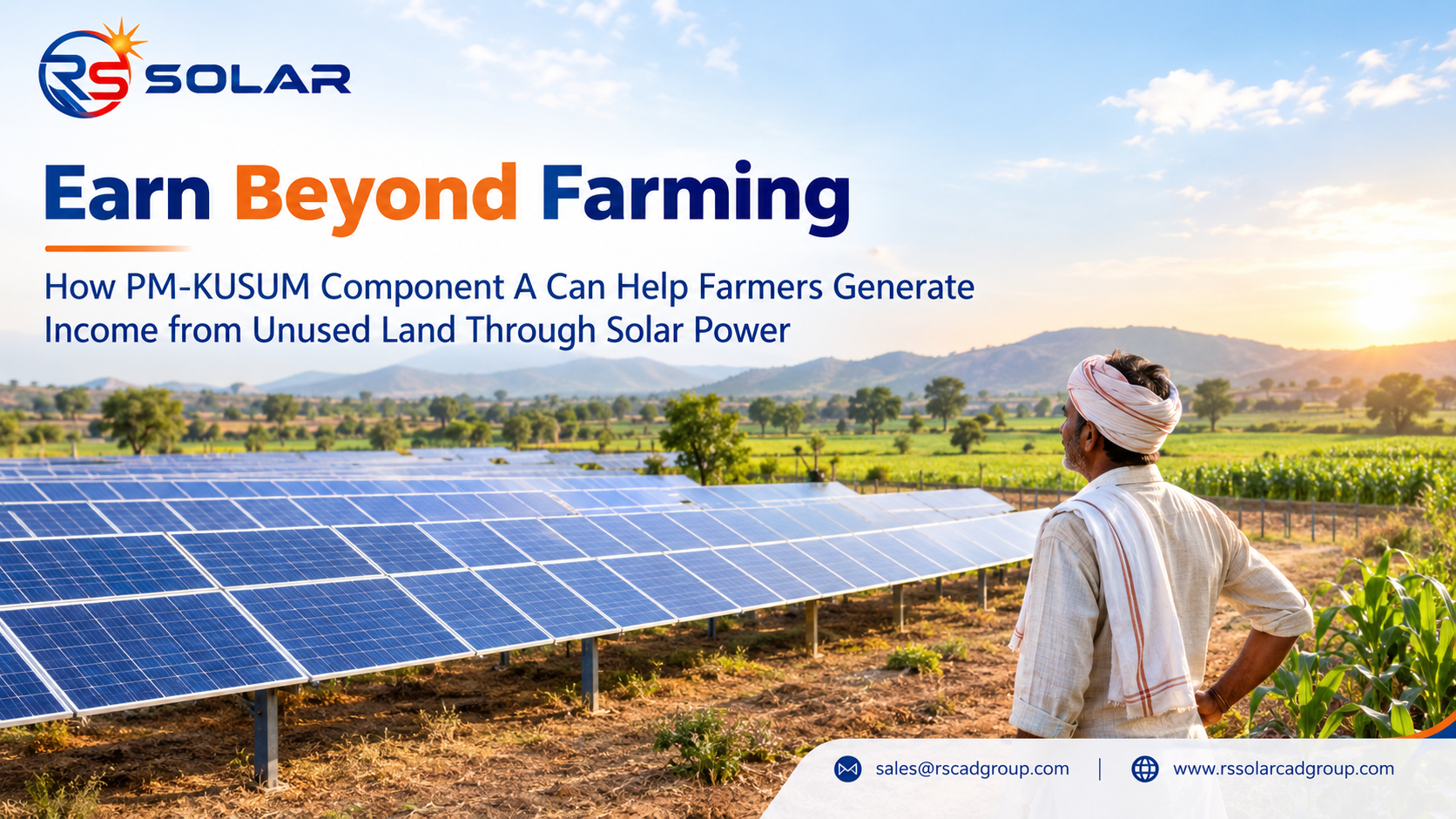
Earn Beyond Farming: How PM-KUSUM Component A Can Help Farmers Generate Income from Unused Land Through Solar Power
Can Unused Agricultural Land Become a Source of Income?
Agriculture is an essential part of India’s economy, supporting millions of families across rural communities. However, farming does not always generate a consistent income. Water shortages, changing weather conditions, rising input costs, soil quality and limited irrigation facilities can make it difficult for farmers to achieve profitable crop production.
In some regions, farmers own land that remains unused for extended periods. Certain plots may be difficult to cultivate, while others may be left fallow because of limited water availability or the high cost of agricultural operations.
This raises an important question: Can farmers put suitable unused land to productive use while creating an additional source of income?
Solar energy offers one possible opportunity.
India’s growing renewable energy sector has increased interest in using suitable land for solar power generation. With the right location, technical planning and commercial arrangements, certain agricultural land parcels may be considered for grid-connected solar projects.
The Government of India’s Pradhan Mantri Kisan Urja Suraksha evam Utthaan Mahabhiyan (PM-KUSUM) scheme was introduced to promote solar energy in agriculture and support farmers through decentralised renewable energy development.
Among its different components, PM-KUSUM Component A focuses on decentralised, grid-connected renewable energy power plants. Eligible participants may explore developing a solar power plant themselves or leasing suitable land to a project developer.
However, owning agricultural land does not automatically make someone eligible for a solar project. Land suitability, electricity grid capacity, state-level implementation, financial feasibility and the applicable approvals all play important roles.
In this guide, we explain how PM-KUSUM Component A works, how farmers can explore the opportunity, what they should consider before investing and why proper solar design and engineering are important for project development.
1. What Is the PM-KUSUM Scheme?
PM-KUSUM is a Government of India initiative designed to encourage renewable energy use in agriculture, reduce dependence on conventional electricity sources and support agricultural energy requirements.
The scheme includes three main components, each addressing a different aspect of solar energy adoption.
Component A: Decentralised Grid-Connected Solar Power Plants
Component A focuses on decentralised, grid-connected renewable energy power plants. Under the published scheme guidelines, projects generally fall within the capacity range of 500 kW to 2 MW, with smaller projects potentially permitted in specific circumstances.
These plants generate electricity that can be supplied to the local electricity distribution company, commonly known as the DISCOM, under the applicable power purchase arrangements.
Farmers, eligible groups and other permitted participants may explore establishing a project or participating through a land-leasing arrangement.
Component B: Standalone Solar Agricultural Pumps
Component B supports the installation of standalone solar agricultural pumps in eligible circumstances.
Solar pumps can help farmers access irrigation without relying entirely on conventional electricity connections or diesel-powered pumping systems.
The suitability of a solar pump depends on water requirements, the groundwater situation, the size of the agricultural operation and the applicable scheme conditions.
Component C: Solarisation of Existing Agricultural Pumps
Component C focuses on the solarisation of existing grid-connected agricultural pumps and agricultural feeders under the relevant implementation arrangements.
Its objective is to increase the use of solar energy for agricultural electricity requirements.
For farmers interested in generating electricity from unused land, Component A is the most directly relevant component. Components B and C address agricultural pumping and electricity consumption rather than the development of a standalone solar power plant on land.
Farmers should consult the official PM-KUSUM portal and their state implementing agency for the latest applicable guidelines.
2. How Does PM-KUSUM Component A Work?
The basic idea behind Component A is to encourage decentralised renewable energy generation through solar and other eligible renewable energy technologies.
Instead of relying exclusively on large power plants located far from consumers, decentralised projects can be developed at suitable locations closer to existing electricity infrastructure.
For farmers, the opportunity generally involves two possible routes.
Route 1: Develop a solar power plant.
An eligible participant arranges the investment, project development, technical design, equipment procurement, construction and operation. The generated electricity is supplied to the DISCOM according to the applicable agreement.
This model requires considerable planning, financial resources and technical coordination.
Route 2: Lease suitable land to a solar developer.
A landowner explores an agreement with an eligible developer that is interested in establishing a solar power project.
Depending on the arrangement, the developer may manage the project investment and technical execution, while the landowner receives the agreed lease payments.
The second approach may be worth considering for farmers who own suitable land but do not want to manage the complete solar installation themselves.
In both cases, the project must satisfy the applicable eligibility requirements, selection process, grid-connectivity conditions and regulatory approvals.
3. What Type of Land Can Be Considered for Solar Development?
Not every unused plot is suitable for a solar power plant. A proper assessment is necessary before deciding whether a site is worth developing.
Barren or Uncultivated Land
Barren land may offer an opportunity for solar development if it has adequate space, suitable terrain, legal access and feasible grid connectivity.
Such sites may be attractive because the owner can explore an alternative use for land that generates little or no agricultural income.
However, barren land still requires technical evaluation. Uneven terrain, flooding risks, difficult access, shading and long distances from suitable electrical infrastructure can affect project feasibility.
Fallow Agricultural Land
Fallow land is land that is temporarily or periodically left uncultivated.
Depending on local regulations, land-use requirements and scheme conditions, suitable fallow land may be considered for a solar project.
Farmers should assess whether the alternative use offers a better long-term outcome than returning the land to agricultural production.
Land Near an Electricity Substation
Proximity to an appropriate electricity substation is an important consideration.
Under the published Component A guidelines, projects are preferably located within a five-kilometre radius of the relevant substation to help reduce transmission infrastructure costs and losses.
Nevertheless, being close to a substation does not guarantee approval. The available grid capacity, technical requirements and DISCOM’s willingness to accept the proposed project must be confirmed.
Agricultural Land with Elevated Solar Structures
In suitable circumstances, elevated or stilt-mounted solar structures may allow certain agricultural activities to continue underneath or between panel rows.
This approach may be worth evaluating where continued farming is a priority.
The design must account for the crops being cultivated, equipment clearance, structural safety, construction costs, access for farm machinery and the effect of shading on agricultural productivity.
Farmers should also verify the relevant land-use and approval requirements before proceeding.
4. Who Can Benefit from PM-KUSUM Component A?
The suitability of Component A depends on the project’s applicable eligibility conditions and state-level implementation process.
Potential participants may include:
- Individual farmers who own suitable land.
- Groups of farmers exploring a collective renewable energy project.
- Farmer Producer Organisations (FPOs), where eligible.
- Cooperatives and other permitted agricultural organisations.
- Eligible project developers and other entities allowed under the applicable guidelines.
Eligibility must be confirmed for the specific project and application process.
A farmer who owns a large plot may still be unable to proceed if the relevant substation has no available capacity or if the project does not meet local requirements.
Similarly, a landowner who prefers to lease land should verify that the proposed developer and project arrangement comply with the relevant scheme provisions.
The best first step is to contact the state implementing agency or DISCOM and obtain information about project availability, eligibility, application procedures and the technical requirements for the location.
5. How Can Farmers Earn Income from a Solar Power Project?
There is no single income model that works for every landowner. The potential financial outcome depends on whether the farmer develops the project or leases the land.
Model A: Generate Electricity and Sell It to the DISCOM
Under this model, the eligible project owner develops and operates the solar power plant.
The plant generates electricity, which is supplied to the DISCOM according to the relevant power purchase agreement and tariff conditions.
The project’s revenue depends on factors such as:
- Installed generation capacity.
- Actual electricity production.
- Solar resource availability and weather.
- Plant performance and downtime.
- The applicable electricity purchase tariff.
- Operating and maintenance expenses.
- Financing costs and repayment obligations.
- Taxes, insurance and other applicable expenses.
A project may generate revenue without necessarily producing a profit. The owner must account for the initial investment and continuing expenses before estimating financial returns.
Model B: Lease the Land to a Solar Developer
In this arrangement, the landowner enters into a lease agreement with a developer interested in establishing a solar power project.
The developer may take responsibility for project development and investment, depending on the contract.
The landowner receives lease income according to the agreed terms.
Before signing, the farmer should carefully review the lease duration, payment schedule, escalation clauses, land-use restrictions, access rights, responsibility for statutory charges, default provisions and restoration requirements.
It is also important to check whether the developer has a credible project plan and the required approvals.
Lease income is not automatically guaranteed by PM-KUSUM. It depends on a valid agreement, the developer’s obligations and the commercial arrangement.
Model C: Explore a Collective Project
In some situations, a group of eligible farmers may explore participating in a common project through an appropriate organisation or permitted project structure.
Collective participation can help coordinate land access and project development, but it also requires clear agreements about ownership, financial contributions, revenue sharing, responsibilities and dispute resolution.
Professional legal and financial advice may be helpful before entering into such arrangements.
6. How Much Can Farmers Earn from Solar Land?
One of the first questions landowners ask is how much income a solar project can generate.
The answer depends on the project’s size, electricity generation, tariff, investment costs and operating model.
There is no universal earning figure that can be applied to every farm or solar installation.
For example, the revenue from a grid-connected solar plant is not the same as the lease income received by a landowner. A project owner must cover project costs, while a landowner leasing the site receives the agreed rental payments.
Several factors influence the potential return.
Land area and usable space: The site’s dimensions, shape, setbacks, access routes and electrical infrastructure determine how much capacity can practically be installed.
Electricity generation: Solar irradiation, panel orientation, shading, equipment efficiency and system losses affect annual output.
Tariff and agreement: The price paid for electricity and the terms of the power purchase agreement directly affect project revenue.
Investment and financing: Equipment, civil work, mounting structures, grid connection, interest and other costs affect profitability.
Operation and maintenance: Cleaning, inspections, repairs, equipment replacement and plant monitoring create continuing expenses.
For this reason, farmers should request a project-specific feasibility assessment instead of relying on advertisements that promise a fixed monthly income or guaranteed returns.
7. Does PM-KUSUM Component A Provide a Subsidy?
Understanding the scheme’s financial structure is essential before making an investment decision.
Component A is primarily structured around decentralised, grid-connected renewable energy generation and electricity purchase arrangements. It should not be described as a programme that automatically gives every farmer a subsidy to install a solar power plant.
The applicable financial assistance, incentives and commercial conditions depend on the current scheme guidelines, project structure and implementation arrangements.
Farmers should verify the following before committing money:
- Whether Component A is currently being implemented in their state and location.
- Whether new applications or project allocations are available.
- Whether the proposed participant and project qualify under the relevant rules.
- Which financial incentives, if any, apply to the specific project.
- The applicable electricity purchase tariff and agreement conditions.
- The approvals and financial commitments required.
Be cautious of intermediaries who promise guaranteed scheme approval, fixed returns or subsidies without providing verifiable official documentation.
Use the official PM-KUSUM portal and the relevant state agency’s notifications to confirm current information.
8. Step-by-Step Guide to Exploring a PM-KUSUM Component A Project
Farmers interested in solar development can use the following process as an initial planning guide.
Step 1: Check Current Scheme Availability
Contact the relevant DISCOM or state implementing agency.
Ask whether Component A projects are being invited in your area, whether suitable capacity is available and what the current selection or application process requires.
Do not assume that the scheme is open for applications everywhere at all times.
Step 2: Review Your Land Documents
Gather relevant ownership and land records.
Check whether the ownership is clear, whether there are co-owners, whether any disputes or encumbrances exist and whether the proposed project is permitted under local land-use rules.
Where multiple people own the land, confirm that the required parties can participate in the arrangement.
Step 3: Conduct a Preliminary Site Assessment
Evaluate the plot’s usable area, terrain, drainage, shading, road access and nearby electrical infrastructure.
A site inspection can identify potential challenges before money is committed to detailed engineering or legal processes.
Step 4: Confirm Grid Connectivity
Identify the relevant substation and consult the appropriate electricity authority regarding available capacity and connection requirements.
The feasibility of exporting electricity to the grid is a key factor in determining whether the proposed project can proceed.
Step 5: Decide Whether to Develop or Lease
Compare the two primary options.
If you intend to own the project, assess the investment requirement, financing arrangements, technical responsibilities and expected returns.
If you prefer leasing, evaluate the developer’s credentials, proposed rental terms, payment security and contractual responsibilities.
Step 6: Prepare a Financial Feasibility Assessment
Estimate capital expenditure, operating costs, expected electricity production, potential revenue and financing expenses.
Include a realistic assessment of project risks rather than relying only on the expected electricity generation.
For a lease arrangement, compare the proposed income against the duration of the lease and any restrictions on the future use of the land.
Step 7: Complete the Required Application and Agreements
Follow the relevant agency’s application or selection procedure.
Depending on the project, this may involve land documentation, technical information, financial documents, approvals, grid-connectivity arrangements and a power purchase agreement.
Step 8: Finalise Engineering and Project Design
Once the project has progressed through the relevant preliminary requirements, detailed engineering can address equipment layout, mounting structures, electrical design, protection systems, cable routing and grid-interconnection requirements.
The design must meet the applicable technical standards and project-specific conditions.
Step 9: Install, Inspect and Commission
After the necessary approvals and commercial arrangements are in place, the project can move into procurement, construction, installation, inspections and commissioning.
The plant should be operated and maintained according to applicable requirements and the project’s technical documentation.
These steps are a general overview. The actual process may differ according to the state, implementing agency, project structure and current scheme provisions.
9. What Are the Main Costs Involved in Developing a Solar Power Plant?
Farmers considering project ownership should understand that solar development involves more than purchasing solar panels.
The total investment depends on the project’s size, site conditions, equipment selection and grid connection requirements.
Solar Panels and Inverters
Solar modules generate electricity, while inverters convert the generated direct current into alternating current suitable for the intended electrical system.
Equipment specifications should be selected according to the project’s technical requirements and expected operating conditions.
Mounting Structures and Civil Work
Ground-mounted solar installations require suitable mounting structures, foundations and associated civil work.
The site conditions, wind loads, soil properties and structural design influence these requirements.
Electrical Infrastructure
The project may require cables, switchgear, protection equipment, transformers, metering and other electrical infrastructure.
Grid interconnection can also involve additional equipment and construction costs, depending on the location and technical conditions.
Land Preparation and Access
Site preparation may involve grading, drainage improvements, fencing, access roads and other work needed for safe installation and maintenance.
The exact requirements depend on the site’s condition.
Engineering, Approvals and Project Management
Technical design, engineering documentation, testing, inspections, consultancy and project coordination may form part of the development budget.
The required documentation depends on the project scope and the applicable approval process.
Operations and Maintenance
After commissioning, the plant requires regular monitoring, cleaning, inspections and repairs when needed.
A realistic financial plan should include these ongoing costs.
Farmers should obtain project-specific quotations and compare them carefully. General market estimates should not be treated as final project costs or a guarantee of profitability.
10. Why Solar Design and Engineering Matter
A solar power plant is a coordinated electrical and structural system. Its performance depends not only on the equipment selected but also on how the system is planned, installed and maintained.
Accurate solar design helps the project team identify site constraints, determine equipment placement and prepare the technical information required for construction and approvals.
PV System Layout Design
A PV layout defines how solar modules and associated equipment are arranged across the site.
The design should consider usable land area, access routes, shading, orientation, maintenance clearances and the requirements of the chosen mounting system.
An efficient layout helps the project team make informed decisions about site utilisation.
Electrical System Planning
Electrical design addresses the arrangement of modules, strings, inverters, cables, protection equipment and other system components.
The design must be appropriate for the selected equipment and comply with applicable electrical and grid-interconnection requirements.
Structural Engineering
Mounting structures must be designed for the relevant site conditions and applicable structural requirements.
Wind loads, foundation conditions, equipment configuration and installation methods all influence the structural design.
Technical Documentation and Revisions
Solar projects may require drawings, calculations, equipment schedules and other documentation for review, construction or approval.
If project conditions or equipment specifications change, the documentation may need to be revised to remain consistent with the final installation.
Coordination with Project Stakeholders
Solar project development can involve landowners, developers, engineers, equipment suppliers, installers, DISCOMs and other authorities.
Clear technical documentation and timely coordination help these stakeholders work from consistent project information.
For developers managing several installations, a well-organised design process can also help reduce avoidable rework and improve project coordination.
11. How RS Solar CAD Group Supports Solar Industry Professionals
Developing a solar project requires coordination between planning, engineering, documentation and installation teams.
Solar developers and installers may need design support to prepare project layouts, technical drawings and other documentation required for their particular scope of work.
RS Solar CAD Group provides solar design and engineering support for solar industry professionals, including:
- Solar Proposal Design: Supporting project proposals with appropriate solar system layouts and design information.
- PV System and Layout Design: Preparing layouts based on the project’s requirements and available site information.
- Permit-Ready Plan Sets and Revisions: Supporting the preparation and updating of technical plan sets for applicable project approval processes.
- Structural and Electrical Engineering Support: Providing engineering services appropriate to the agreed project scope.
- Single-Line Diagrams and NEC-Based Design: Supporting electrical documentation and design work for applicable projects.
The exact scope of documentation, applicable codes and approval requirements varies by project and jurisdiction.
For PM-KUSUM projects, the relevant Indian regulations, DISCOM requirements and applicable technical standards must take precedence. A service provider’s general solar design capabilities should not be taken as a substitute for confirming those requirements.
Learn more about our solar design and engineering services at RS Solar CAD Group.
12. What Challenges Should Farmers Consider Before Proceeding?
Although solar development can offer opportunities, farmers should understand the potential challenges before making a decision.
Limited Grid Capacity
A suitable plot may still be unsuitable for a project if the relevant substation cannot accommodate the proposed generation capacity.
Confirming grid feasibility early can help avoid unnecessary development expenses.
High Initial Investment
Developing and operating a solar power plant requires capital.
Farmers should carefully evaluate financing arrangements, repayment obligations and project economics before investing.
Land-Use and Legal Requirements
Agricultural land may be subject to state-specific rules and restrictions.
Ownership documentation, permissions and the terms under which the land can be used for a solar project should be reviewed before entering into a binding arrangement.
Project Approval Delays
The time required for selection, approvals, grid connection and construction can vary.
Farmers should avoid making financial commitments based on an assumed commissioning date before the relevant requirements are confirmed.
Unreliable Lease Offers
Landowners should be cautious when dealing with developers who promise unusually high rental payments without a clear project plan.
Verify the developer’s identity, financial capability, proposed project structure and contractual obligations. Obtain appropriate legal advice before signing.
Uncertain Financial Returns
Actual generation, expenses, tariffs and project timelines may differ from initial estimates.
A robust feasibility study should consider realistic assumptions and potential downside scenarios.
13. Is Solar Land Leasing Better Than Farming?
There is no universal answer because every property and farming operation is different.
For some landowners, continuing agriculture may offer better long-term value. For others, leasing a suitable plot may provide an alternative source of income.
The decision should consider more than the expected annual lease payment.
Farmers should compare:
- Current agricultural income and operating costs.
- The potential lease income and payment terms.
- The duration of the proposed lease.
- Whether the land may be needed for future agricultural use.
- Changes in land access and permitted activities.
- Responsibilities for maintenance, taxes and other expenses.
- The terms for restoring the land when the agreement ends.
Farmers should also consider whether the proposed arrangement allows any agricultural activities to continue.
A carefully negotiated agreement can help clarify expectations and reduce the risk of future disputes.
14. The Future of Solar Energy in Rural India
Solar energy has the potential to play an important role in India’s energy transition.
Rural areas may offer opportunities for decentralised renewable energy projects, particularly where suitable land and electrical infrastructure are available.
For farmers, solar energy can represent more than a way to generate electricity. Depending on the project, it may create an opportunity to diversify income, participate in renewable energy development or support agricultural energy requirements.
At the same time, successful project development requires realistic planning.
The availability of suitable land, grid capacity, project financing, technical expertise and clear commercial agreements will influence which projects can move forward.
As solar technologies and project development practices evolve, accurate design, appropriate equipment selection and coordinated engineering will remain important parts of reliable solar installations.
Farmers, developers and installers should continue to evaluate project opportunities using verified information and the applicable state-level requirements.
Frequently Asked Questions (FAQs)
1. What is PM-KUSUM Component A?
PM-KUSUM Component A promotes decentralised, grid-connected renewable energy power plants. Eligible participants may explore developing qualifying projects and supplying electricity to DISCOMs under the applicable arrangements.
2. Can I install a solar power plant on my barren land?
Potentially, yes. The land must meet the applicable eligibility, land-use, technical and grid-connectivity requirements. You should confirm current project availability and requirements with the relevant state agency or DISCOM.
3. What is the usual capacity of a Component A solar project?
The published guidelines generally provide for projects ranging from 500 kW to 2 MW, with smaller projects potentially permitted in specific circumstances. The applicable conditions should be verified before planning a project.
4. Can farmers earn income without purchasing solar equipment?
Farmers may explore leasing suitable land to an eligible developer. Whether a lease is possible, and the amount of income available, depends on the project structure and contractual arrangements.
5. Is a subsidy guaranteed under Component A?
No. Farmers should not assume that every Component A project receives an automatic subsidy. Verify the current scheme guidelines and the financial arrangements applicable to the specific project.
6. Is land near a substation always suitable?
No. Proximity to a substation is helpful, but available capacity, grid requirements, site conditions and project approvals must also be assessed.
7. Can farming continue beneath solar panels?
Some projects may use elevated solar structures that allow certain agricultural activities to continue. Feasibility depends on crop requirements, structural design, shading, machinery access, project costs and applicable rules.
8. How can I check whether Component A is available in my state?
Visit the official PM-KUSUM portal and contact your state implementing agency or DISCOM to verify current notifications, application availability and project requirements.
9. How long does it take to establish a solar power plant?
The timeline varies according to project selection, land documentation, grid connectivity, approvals, financing, equipment procurement and construction. No single timeline applies to every project.
10. What should I check before signing a solar land lease?
Review the rental amount, payment schedule, lease duration, escalation provisions, land-use restrictions, responsibilities for taxes and maintenance, termination provisions and restoration obligations. Seek independent legal advice before signing.
Conclusion: Turn Suitable Unused Land into a Renewable Energy Opportunity
PM-KUSUM Component A provides a framework for exploring decentralised, grid-connected renewable energy projects in India. For farmers and eligible landowners, it may create opportunities to make productive use of suitable land through solar power generation or a land-leasing arrangement.
However, a successful project depends on more than land ownership. Grid connectivity, land-use permissions, financing, technical feasibility, commercial agreements and the current scheme requirements all need to be evaluated carefully.
The most practical first step is to contact the relevant state implementing agency or DISCOM, confirm the availability of the scheme and assess the suitability of the proposed location.
For solar developers and installers, reliable project planning and accurate engineering documentation are equally important to the development process.
With careful evaluation, verified information and the right technical support, solar energy can be an opportunity worth exploring for India’s agricultural communities.
Planning a solar project or need solar design support?
RS Solar CAD Group to learn how our solar proposal design, PV layout design, plan-set preparation and engineering support services can assist solar industry professionals.