EV Charging Infrastructure in North America: What Commercial Property Owners Need to Know
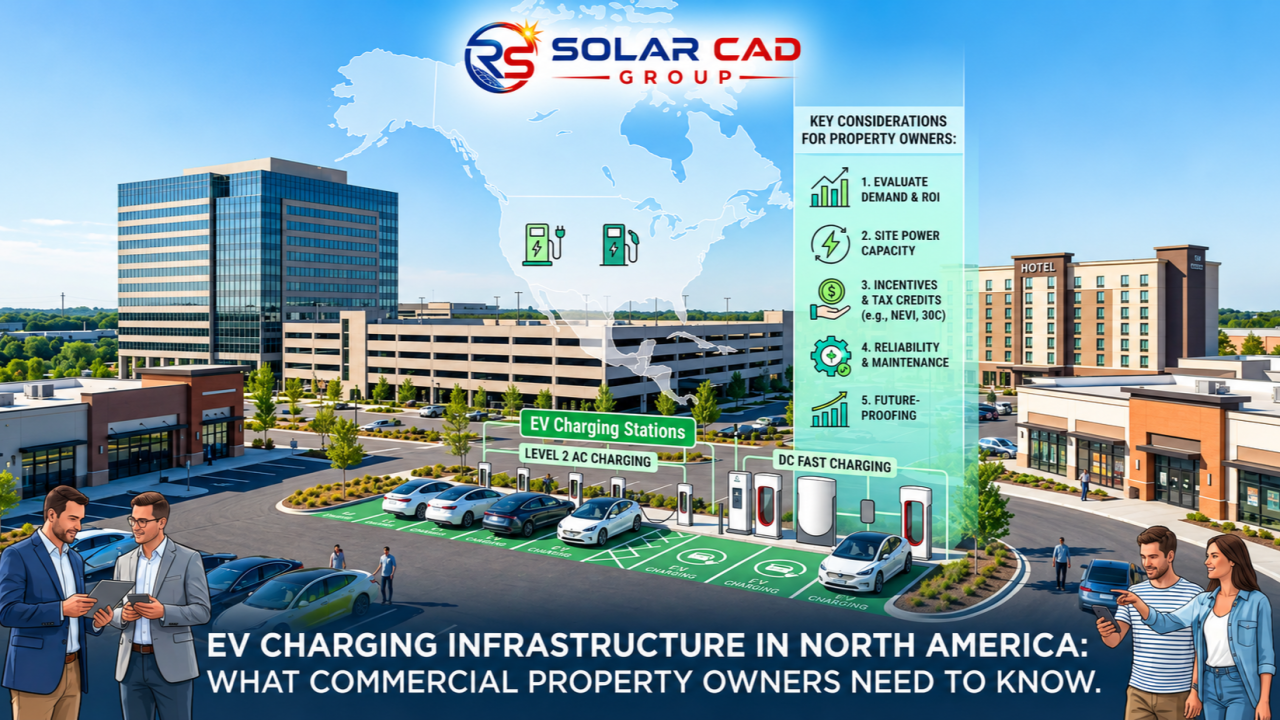
Electric vehicles (EVs) are changing the way people think about transportation, parking, energy consumption and commercial properties. As EV adoption continues to grow across the United States and Canada, charging infrastructure is becoming an increasingly important consideration for commercial property owners.
For an office building, retail center, hotel, multifamily property, warehouse or fleet facility, EV charging can provide more than a place to charge vehicles. It can improve the customer and tenant experience, support fleet electrification, strengthen a property’s sustainability strategy and potentially create a new revenue opportunity.
However, installing EV chargers is not as simple as purchasing charging equipment and connecting it to an existing electrical panel. A successful commercial EV charging project requires careful planning around electrical capacity, site layout, parking, permitting, utility requirements, accessibility, operating costs and future expansion.
This guide explains what commercial property owners in North America should consider before planning an EV charging infrastructure project.
Why EV Charging Infrastructure Matters for Commercial Properties
Commercial properties are becoming an important part of the EV charging ecosystem because vehicles often remain parked at these locations for extended periods.
Employees may spend eight hours at an office. Hotel guests may stay overnight. Customers may spend one or two hours at a shopping center. Residents may leave their vehicles parked for most of the night.
This creates different opportunities for EV charging depending on the property type.
Commercial Property Typical EV Charging Opportunity
Office Buildings Employee and visitor charging
Retail Centers Customer charging
Hotels Guest charging
Multifamily Properties Resident charging
Warehouses Employee and fleet charging
Industrial Facilities Commercial fleet charging
Hospitals Employee, visitor and fleet charging
Shopping Centers Public charging
Fleet Facilities Dedicated vehicle charging
Installing EV charging can help property owners:
- Improve tenant and customer experience
- Attract EV-driving customers and employees
- Support corporate sustainability objectives
- Prepare properties for increasing EV demand
- Support electric vehicle fleets
- Potentially create charging-related revenue
- Improve the property’s long-term infrastructure readiness
The key is to design the infrastructure according to the actual needs of the property rather than simply installing the highest-powered chargers available.
Understanding EV Charger Levels
Before planning an EV charging project, property owners should understand the basic charging categories.
Level 1 Charging
Level 1 charging generally uses standard lower-voltage electrical service and provides relatively slow charging.
It is more commonly associated with residential applications and is generally less suitable for high-demand commercial environments.
Level 2 Charging
Level 2 charging provides significantly more charging capability and is one of the most practical options for many commercial properties.
It can be suitable for:
- Offices
- Hotels
- Multifamily buildings
- Retail properties
- Workplaces
- Employee parking
- Long-duration parking locations
Because vehicles may remain parked for several hours, Level 2 charging can provide a practical balance between charging speed and electrical demand.
DC Fast Charging
DC Fast Charging (DCFC), also called Level 3 charging, can deliver substantially higher charging power and reduce charging time.
It can be useful for:
- Fleet operations
- High-turnover retail locations
- Public charging hubs
- Transportation corridors
- Commercial vehicles
- Locations where vehicles cannot remain parked for long periods
However, higher charging power can also create greater electrical infrastructure requirements.
The fastest charger is not necessarily the best charger for every commercial property.
The appropriate charging solution depends on parking duration, vehicle requirements, available electrical capacity, site conditions, utility service and the property’s business model.
What Commercial Property Owners Should Evaluate Before Installation
One of the biggest mistakes property owners can make is selecting chargers before understanding the site.
A proper EV charging project should begin with a site assessment.
1. Electrical Capacity
The first question should be:
Does the property have enough electrical capacity to support the proposed EV charging load?
The assessment may include:
- Existing electrical service
- Main service equipment
- Electrical panels
- Transformer capacity
- Available breaker capacity
- Existing building loads
- Future electrical loads
- Utility service limitations
- Load calculations
If sufficient capacity is not available, the project may require electrical upgrades or a different charging strategy.
2. Parking Layout
The physical location of chargers is equally important.
Designers should consider:
- Parking space configuration
- Vehicle circulation
- Charger accessibility
- Cable reach
- Pedestrian pathways
- Accessible parking requirements
- Signage
- Bollards and protective equipment
- Traffic flow
- Emergency access
Poor charger placement can create operational and safety problems even when the electrical design is technically correct.
3. Site Conditions
Commercial EV charging may require additional civil and electrical work, including:
- Trenching
- Conduit installation
- Concrete work
- Asphalt repair
- Equipment foundations
- Electrical equipment installation
- Underground utility coordination
- Lighting
- Signage
The distance between the charging equipment and the electrical service can have a significant impact on project complexity and cost.
4. Future Expansion
Property owners should not design only for today’s EV demand.
For example, a property might initially require four charging ports but could need eight or sixteen in the future.
A phased approach can be useful:
Phase 1:Initial charging deployment ↓
Phase 2:Additional charging ports ↓
Phase 3: Expanded electrical capacity and advanced energy management
Planning for future expansion during the initial design can help reduce costly redesign and construction work later.
EV Charging Load and Electrical Infrastructure
EV charging introduces additional electrical load to a commercial property.
Depending on the number and power level of chargers, the project may require detailed electrical analysis.
Key considerations include:
- Load calculations
- Service capacity
- Panel capacity
- Transformer requirements
- Conductor sizing
- Conduit sizing
- Overcurrent protection
- Voltage requirements
- Electrical distribution
- Demand management
- Load balancing
For example, if several DC fast chargers operate simultaneously at maximum power, the resulting demand may be significantly higher than a small group of Level 2 chargers.
This is why commercial EV charging design should consider not only the charger rating but also how and when the chargers will be used.
Smart Charging and Load Management
Smart charging can help commercial property owners manage EV charging demand.
Instead of allowing every charger to operate at maximum output at the same time, an energy management system can distribute available electrical capacity among charging stations based on site conditions and charging requirements.
Potential strategies include:
- Load balancing
- Dynamic load management
- Charging schedules
- Energy monitoring
- Peak-demand management
- Time-of-use optimization
- Remote charger monitoring
- Automatic power allocation
This can become particularly valuable when a property has limited electrical capacity or when EV charging needs to coexist with other major building loads.
Integrating EV Charging with Solar and Battery Storage
EV charging does not have to operate independently from a property’s energy system.
Commercial property owners can consider an integrated approach:
Solar PV → Energy Management System → Battery Storage + EV Chargers
Solar energy can potentially help offset electricity consumption associated with EV charging, while battery storage can help manage periods of high electrical demand.
A properly designed system may combine:
- Solar PV
- EV charging
- Battery energy storage
- Building electrical loads
- Energy management systems
This approach can be particularly attractive for commercial properties that are already planning solar installations or want to improve their overall energy management strategy.
However, solar and battery integration should be evaluated based on the property’s electrical profile, utility tariffs, available space, equipment requirements and project economics.
Permitting and Code Compliance
Commercial EV charging projects often involve more than equipment installation.
Depending on the location and project scope, property owners may need to address:
- Electrical permits
- Building permits
- Local AHJ requirements
- Zoning requirements
- Parking requirements
- Accessibility requirements
- Utility requirements
- Electrical code compliance
- Equipment certification
- Inspection
- Final approval
Requirements can vary significantly between states, provinces, municipalities and authorities having jurisdiction (AHJs).
For Canadian projects, Natural Resources Canada specifically identifies applicable local building and electrical codes as well as zoning and parking bylaws among the requirements for certain supported EV infrastructure projects.
This is why a permit-ready design should be developed according to the actual project location rather than relying on a generic EV charging layout.
EV Charging Incentives and Funding Opportunities
Incentives can help reduce the overall cost of EV charging infrastructure, but eligibility depends on project location, timing, property type and program requirements.
United States.
Commercial property owners planning EV charging infrastructure should evaluate federal, state, local and utility-level incentives as part of their project planning.
Incentive programs and tax rules can change over time. Eligibility may depend on factors such as project location, property type, charging equipment, installation requirements and the date the property is placed in service.
For this reason, property owners should verify the latest federal and local requirements before including an incentive or tax credit in their project budget.
State and utility programs may also provide opportunities for commercial EV charging projects. These programs can vary by location and may support areas such as equipment purchases, installation, electrical infrastructure or charging network deployment.
A professional project assessment can help property owners identify which incentives and funding opportunities may be relevant to their specific location and project scope.
Canada
Commercial property owners in Canada may be able to access federal, provincial, territorial, utility or local programs that support EV charging infrastructure.
Canada’s Zero Emission Vehicle Infrastructure Program (ZEVIP) supports the deployment of EV charging infrastructure across the country and is designed to increase access to charging where Canadians live, work, travel and play.
Depending on the property and project type, additional opportunities may be available through provincial governments, municipalities and utility providers.
Because funding programs, eligibility requirements and application windows can change, property owners should verify the latest program information before starting a project or including funding in their financial projections.
When planning a commercial EV charging project, it is useful to evaluate available incentives together with electrical requirements, installation costs, operating costs and future expansion needs.
How Much Does Commercial EV Charging Infrastructure Cost?
There is no single price for a commercial EV charging project.
The total project cost can depend on:
Charging Equipment
- Number of chargers
- Charger power rating
- Number of ports
- Networking capability
- Hardware features
Electrical Infrastructure
- Panels
- Transformers
- Switchgear
- Conductors
- Conduit
- Service upgrades
Site Development
- Trenching
- Concrete
- Asphalt
- Foundations
- Bollards
- Signage
Professional Services
- Engineering
- Electrical design
- Civil design
- Permit documentation
- Inspection support
Ongoing Costs
- Electricity
- Demand charges
- Network fees
- Maintenance
- Software
- Repairs
For this reason, property owners should evaluate the total project cost, rather than comparing charger equipment prices alone.
Can Commercial EV Charging Generate Revenue?
Commercial EV charging can be operated under different business models.
Free Charging
Property owners may provide charging as a customer or tenant amenity.
This approach can be useful for:
- Hotels
- Offices
- Multifamily properties
- Retail centers
Paid Charging
Property owners can charge users according to an applicable pricing structure.
Potential pricing models can include:
- Energy-based pricing
- Time-based pricing
- Flat fees
- Subscription models
The applicable rules and pricing options can vary by jurisdiction and charging network.
Fleet Charging
Businesses can use charging infrastructure for their own electric vehicles.
This can be useful for:
- Delivery fleets
- Service vehicles
- Corporate vehicles
- Commercial transportation
Property and Tenant Value
Even where charging is not operated as a direct revenue source, it can provide value as an amenity that supports tenant attraction and customer experience.
The financial performance of a charging project depends on factors such as utilization, electricity costs, demand charges, installation cost, maintenance and available incentives.
Choosing the Right EV Charging Strategy
There is no universal charging solution for every commercial property.
A general planning approach might look like this:
Property Type Potential Charging Strategy
Office Building Primarily Level 2
Hotel Level 2 with selected faster charging
Multifamily Property Primarily Level 2
Retail Center Level 2 and potentially DCFC
Fleet Facility Level 2 and/or DCFC
Warehouse Fleet and employee charging
Highway/High-Turnover Location DC Fast Charging
Hospital Level 2 for staff/visitors and fleet charging
These are general planning examples. The final design should be based on site-specific electrical, operational and regulatory requirements.
Common EV Charging Mistakes Commercial Property Owners Should Avoid
Mistake 1: Installing Chargers Without Checking Electrical Capacity
Adding EV chargers without evaluating available capacity can result in expensive electrical upgrades or operational limitations.
Mistake 2: Choosing Chargers Only Based on Charging Speed
A high-power charger is not always necessary. The best solution depends on how long vehicles remain parked.
Mistake 3: Ignoring Future Expansion
A site designed only for today’s demand may require expensive modifications when charging demand increases.
Mistake 4: Forgetting Permit Requirements
Local AHJ, electrical, building, zoning and accessibility requirements should be considered early.
Mistake 5: Poor Charger Placement
Chargers should be positioned carefully to support vehicle access, cable reach, pedestrian safety and parking operations.
Mistake 6: Ignoring Demand Charges
High-power charging can affect electricity demand and operating costs.
Mistake 7: Not Considering Solar and Battery Storage
Properties already considering solar or energy storage should evaluate whether EV charging can be integrated into the broader energy strategy.
Mistake 8: Underestimating Civil Work
Trenching, concrete, paving and underground utility work can significantly affect project cost.
Mistake 9: Ignoring Software and Networking
Networked chargers can provide information about usage, availability and energy consumption and may be important for managed charging operations.
Mistake 10: Using a Generic Design
EV charging requirements vary by location. A design should account for the applicable codes, AHJ requirements, utility requirements and site conditions.
Commercial EV Charging Project: Step-by-Step Process
A well-planned EV charging project can generally follow these stages:
Step 1: Site Assessment
Evaluate the property, parking areas and existing electrical infrastructure.
Step 2: Charging Needs Analysis
Determine who will use the chargers and how long vehicles will typically remain parked.
Step 3: Electrical Load Analysis
Evaluate existing loads and determine the additional EV charging load.
Step 4: Charger Selection
Select Level 2, DC Fast Charging or a combination based on project requirements.
Step 5: EV Charging Layout
Develop the charger and parking layout while considering accessibility, circulation and safety.
Step 6: Electrical and Civil Design
Develop electrical distribution, conduit routing, equipment locations and required civil work.
Step 7: Permit Documentation
Prepare drawings and documentation required for applicable permits and approvals.
Step 8: AHJ and Utility Coordination
Address comments, utility requirements and jurisdiction-specific requirements.
Step 9: Installation
Install charging equipment and supporting electrical/civil infrastructure.
Step 10: Inspection and Commissioning
Complete inspections, testing and commissioning before the charging system becomes operational.
USA vs. Canada: What Property Owners Should Consider
Because North America includes different regulatory environments, property owners should not assume that a design approved in one jurisdiction will automatically meet requirements in another.
United States
Commercial EV projects may involve:
- State and local electrical requirements
- AHJ review
- Utility requirements
- Accessibility requirements
- Local zoning
- Local incentives
- Federal tax-credit eligibility where applicable
The IRS also requires eligible §30C property to be located in a qualifying census tract under the applicable rules.
Canada
Canadian projects may involve:
- Provincial electrical requirements
- Municipal permitting
- Building codes
- Parking requirements
- Utility requirements
- Provincial incentives
- Federal infrastructure programs
Natural Resources Canada notes that EV charging installations may require permit submission and evaluation of existing electrical infrastructure, including upgrades where necessary.
Canada’s charging infrastructure needs are also expected to grow significantly. Natural Resources Canada estimates that under its baseline scenario, approximately 679,000 public charging ports could be required by 2040.
The Future of Commercial EV Charging
The commercial EV charging market is moving beyond basic charger installation.
Future projects are increasingly likely to incorporate:
- Smart charging
- Dynamic load management
- Solar-powered EV charging
- Battery energy storage
- Advanced energy management
- Fleet electrification
- High-power DC charging
- Networked charging stations
- Remote monitoring
- Bidirectional charging
- Vehicle-to-grid technologies
This means commercial property owners should think about EV charging as part of the property’s broader energy infrastructure, rather than as a standalone parking amenity.
Planning for electrical capacity, conduit pathways and equipment locations during an initial project can make future expansion easier.
Why Professional EV Charging Design Matters
A commercial EV charging project involves several systems working together.
A professional design can help coordinate:
- EV charging layouts
- Electrical load calculations
- Single-line diagrams
- Equipment schedules
- Conduit routing
- Electrical distribution
- Parking layouts
- Permit-ready drawings
- AHJ requirements
- Solar integration
- Battery storage integration
- Future expansion planning
At RS Solar CAD Group, we support solar and EV charging projects with design and engineering documentation tailored to project requirements.
Our capabilities can include:
- EV Charging Layout Design
- Electrical Design
- Permit-Ready Plan Sets
- Solar + EV Integration
- Battery Storage Integration
- Engineering Support
- Permit Documentation
- As-Built Drawings
For commercial property owners, EPCs and installers, the objective is not simply to place chargers on a site. It is to develop an infrastructure plan that works with the property’s electrical system, parking layout, permitting requirements and long-term energy strategy.
Final Thoughts
EV charging infrastructure is becoming an increasingly important consideration for commercial properties across North America.
The most successful projects start with planning not with charger selection.
Before investing in EV charging infrastructure, commercial property owners should evaluate:
- Who will use the chargers?
- How long will vehicles typically remain parked?
- How much electrical capacity is available?
- What electrical upgrades may be required?
- Which charger type is appropriate?
- What permits and approvals are required?
- Are incentives available?
- Should solar or battery storage be integrated?
- How will charging be managed and maintained?
- How can the infrastructure support future expansion?
A properly planned EV charging system can provide a better experience for customers, tenants and employees while helping commercial properties prepare for the growing electrification of transportation.
Planning a commercial EV charging project?
Partner with RS Solar CAD Group for professional EV charging layouts, electrical design, permit-ready plan sets and solar + battery integration support.
Email: sales@rscadgroup.com Website: www.rssolarcadgroup.com
FAQs
1. What is commercial EV charging infrastructure?
Commercial EV charging infrastructure includes EV chargers and the electrical, civil, networking and supporting systems required to charge electric vehicles at commercial properties such as offices, hotels, retail centers, warehouses, multifamily buildings and fleet facilities.
2. Which EV charger is best for a commercial property?
There is no single best charger. Level 2 charging is often suitable for locations where vehicles remain parked for several hours, while DC Fast Charging can be more appropriate for fleet, high-turnover or public charging applications.
The correct choice depends on parking duration, vehicle requirements, electrical capacity and project objectives.
3. Does a commercial property need an electrical upgrade to install EV chargers?
Not always. The answer depends on the property’s existing electrical capacity and the proposed charging load. A site assessment and electrical load analysis should be completed before installation.
4. How much does commercial EV charging infrastructure cost?
Costs vary significantly based on charger type, number of ports, electrical upgrades, trenching, conduit, civil work, engineering, permitting and installation. There is no universal installation price for every commercial property.
5. Can EV chargers be powered by solar energy?
Yes. EV charging can be integrated with solar PV systems. Commercial properties can also consider battery storage and energy management systems to coordinate solar generation, building loads and EV charging.
6. Can battery storage be combined with EV charging?
Yes. Battery storage can be integrated with EV charging infrastructure and may help manage electrical demand. The financial and technical benefits depend on the property’s load profile, utility tariff, battery system and charging requirements.
7. Do commercial EV chargers require permits?
In many jurisdictions, commercial EV charging projects require permits and inspections. Requirements can vary by state, province, municipality and AHJ.
8. Are there incentives for commercial EV charging infrastructure?
Potential federal, state, provincial, utility and local incentives may be available depending on the project location and eligibility requirements. Programs change over time, so property owners should verify current requirements before making financial assumptions.
In the U.S., the federal §30C rules have specific location and placed-in-service requirements, and the current IRS guidance should be checked before relying on the credit.
In Canada, federal and provincial programs may support EV charging infrastructure. NRCan’s ZEVIP has supported charging projects in workplaces, public places, multifamily buildings and fleet applications.
9. Should a commercial property plan for future EV charging expansion?
Yes. Designing for future expansion can help reduce the need for major electrical and civil modifications later. Property owners can consider future conduit pathways, electrical capacity, equipment locations and phased charger deployment.
10. What is smart EV charging?
Smart EV charging uses software and energy-management technology to control charging based on factors such as available electrical capacity, charging demand, schedules and energy costs.
11. Can EV charging generate revenue?
It can. Commercial property owners may charge users for electricity or charging services, depending on the applicable business model and jurisdiction. However, profitability depends on utilization, electricity costs, demand charges, installation expenses, maintenance and other factors.
12. Why should commercial property owners use professional EV charging design services?
Professional design can help coordinate electrical capacity, charger placement, parking layouts, conduit routing, permitting requirements, utility requirements and future expansion. This can reduce design conflicts and help create a more practical installation plan.
About RS Solar CAD Group
RS Solar CAD Group provides solar and EV infrastructure design support for installers, EPCs and other clean-energy professionals.
Our services include:
- Solar PV Design
- EV Charging Design
- Permit-Ready Plan Sets
- Electrical Design
- Battery Storage Integration
- Solar + EV Integration
- As-Built Drawings
- Engineering Support
- PE Stamping Support
Email: sales@rscadgroup.com Website: www.rssolarcadgroup.com