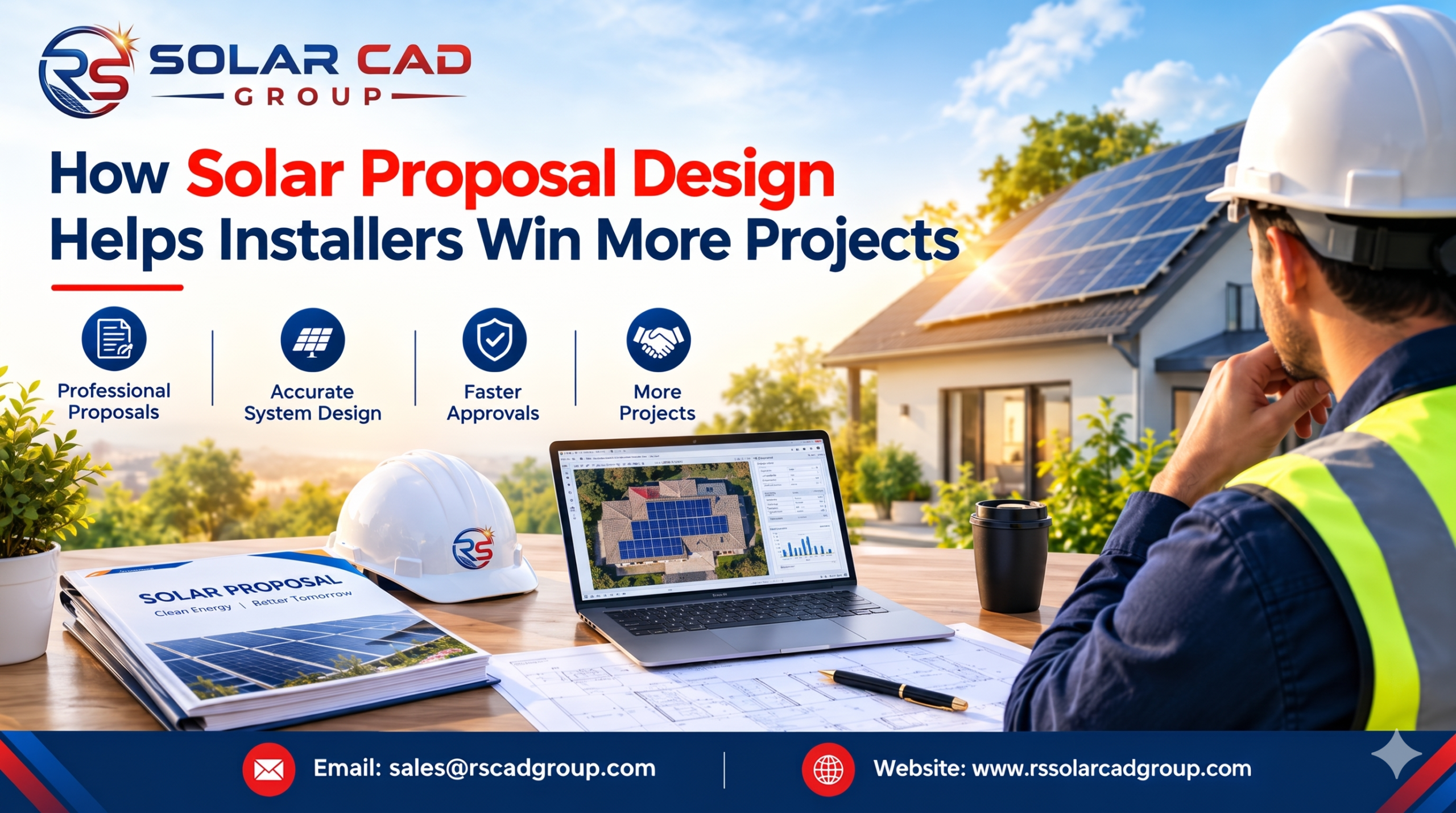
How Solar Proposal Design Helps Installers Win More Projects
Turning Solar Leads into Real Projects
The solar industry in the United States and Canada is becoming increasingly competitive. Residential homeowners, commercial property owners, and businesses are exploring solar energy to manage electricity costs, improve energy efficiency, and reduce their dependence on conventional power sources.
For solar installers and Engineering, Procurement, and Construction (EPC) companies, this creates new business opportunities. However, generating leads is only one part of the process. The real challenge is converting interested prospects into paying customers.
One of the most important tools in this process is a professional solar proposal.
A solar proposal is more than a document containing system specifications and pricing. It helps customers understand how a proposed solar system will work, what benefits it may offer, how the installation will be planned, and what they can expect from the project.
A clear, accurate, and visually appealing proposal can help installers communicate their value, answer customer questions, and make the decision-making process easier.
In this article, we explore how solar proposal design helps installers build customer confidence, stand out from competitors, and improve their chances of winning more projects.
1. Creating a Strong First Impression
First impressions matter when presenting a solar solution to a potential customer. Before making a financial commitment, customers want to understand whether the proposed system is suitable for their property and energy requirements.
A poorly organized proposal containing confusing figures, unclear layouts, or incomplete information may create doubts. Even when an installer offers excellent service, a weak presentation can make the customer hesitate.
A professionally designed solar proposal presents important information in a structured and easy-to-understand format.
It may include:
- Proposed solar system size and configuration
- Estimated energy production
- Solar panel and inverter details
- Roof layout or ground-mounted system layout
- Estimated project costs
- Expected energy savings
- Applicable assumptions and financial estimates
- Project scope and next steps
When this information is presented clearly, customers can better understand the proposed solution and evaluate the installer’s professionalism.
A strong first impression does not guarantee a sale, but it can create a better foundation for the conversation.
2. Helping Customers Understand the Value of Solar
Many customers are interested in solar energy but do not have a technical background. Terms such as kilowatts, kilowatt-hours, DC-to-AC ratios, inverter capacity, and system performance may be unfamiliar to them.
If a proposal focuses only on technical specifications, customers may struggle to understand why the recommended system is appropriate for their property.
Effective solar proposal design translates technical information into practical benefits.
For example, a proposal can explain the estimated annual energy production, the proportion of electricity demand the system may cover, and the assumptions used to calculate potential savings.
Visual charts, clear summaries, and simple comparisons can help customers understand these details without requiring extensive technical knowledge.
For residential projects, the proposal may emphasize household energy consumption, roof suitability, and estimated electricity bill savings.
For commercial projects, it may focus on business electricity demand, available roof or ground space, operational requirements, and potential long-term energy cost benefits.
When customers understand the value of the proposed system, they can make more informed decisions.
3. Making System Design Easier to Visualize
Customers often find it difficult to imagine how a solar installation will look on their property. This is particularly important for rooftop projects, where roof orientation, obstructions, usable space, and panel placement affect the design.
A solar proposal can include a preliminary system layout or a suitable visual representation to help customers understand the proposed installation.
Depending on the project, the design may illustrate:
- Solar panel placement on available roof sections
- Proposed panel quantity and arrangement
- Roof areas affected by obstructions
- Ground-mounted array configuration
- Preliminary system capacity
- Relevant equipment and system components
For installers, a well-presented layout makes it easier to explain design decisions and discuss customer concerns before moving to the next stage.
It is important to distinguish a preliminary proposal layout from a final construction or permit-ready design. Final panel placement and system specifications must be verified through the appropriate site assessment, engineering, and permitting processes.
By presenting the proposed system visually, installers can make technical discussions more accessible and help customers understand what they are considering.
4. Building Customer Trust Through Clear Information
Installing a solar system is a significant investment for many homeowners and businesses. Customers may compare multiple installers before deciding whom to hire.
During this process, transparency can make a meaningful difference.
A professional proposal should clearly communicate what is included in the project, which equipment is proposed, what the estimated costs cover, and which assumptions affect the calculations.
It should also distinguish between estimated results and guaranteed outcomes.
For example, projected energy production depends on factors such as solar irradiance, roof orientation, shading, system losses, equipment characteristics, and weather conditions. Financial estimates may also depend on electricity rates, utility compensation policies, financing terms, and applicable incentives.
Clearly explaining these assumptions helps prevent misunderstandings.
Installers should avoid exaggerated savings claims or presenting incentives as guaranteed when eligibility has not been confirmed.
When a proposal is transparent and technically consistent, it gives customers a stronger basis for evaluating the offer and helps establish a professional relationship.
5. Helping Installers Stand Out from Competitors
Customers frequently compare proposals from different solar companies. If several installers offer similar equipment and installation services, the quality of the presentation can influence how customers perceive each option.
A disorganized proposal may make it difficult to identify the actual benefits of an offer. A well-structured proposal allows customers to compare system capacity, equipment, estimated production, costs, warranties, and project scope more easily.
Installers can differentiate their proposals by including:
- A concise executive summary
- Property-specific system information
- Clear equipment descriptions
- Easy-to-read energy production estimates
- Transparent pricing and exclusions
- A professional company identity
- A clear explanation of the installation process
- Simple next steps for moving forward
The goal is not to make the proposal unnecessarily complicated or fill it with decorative graphics.
Instead, the proposal should make the installer’s value easy to understand.
A customer who can quickly identify the proposed solution and understand the reasoning behind it has a clearer basis for comparing offers.
6. Supporting Better Sales Conversations
A solar proposal can also serve as a practical tool during sales discussions.
Instead of relying entirely on verbal explanations, sales representatives can use the document to walk customers through the proposed system, estimated production, equipment selection, and project cost.
For example, if a homeowner asks why a particular system size has been recommended, the sales representative can refer to the customer’s energy consumption and the assumptions used in the system estimate.
If a commercial customer wants to understand how the installation may fit into the property’s available roof space, the representative can discuss the proposed layout and any design limitations.
A structured proposal helps sales teams maintain consistency across customer conversations.
It can also help identify unanswered questions before the customer makes a decision.
However, the proposal should support the sales conversation rather than replace it. Installers still need to listen to customer priorities, address objections, and explain the project in language appropriate to the audience.
7. Communicating Financial Benefits More Effectively
Cost is often one of the most important considerations in a solar purchase.
Customers generally want to know how much the system will cost, what electricity savings might be possible, and how long it could take for those savings to offset the investment.
A well-designed proposal organizes these figures so that customers can understand the financial picture.
Depending on the available information, a proposal may include:
- Total estimated system price
- Equipment and installation scope
- Estimated annual energy production
- Estimated annual electricity bill savings
- Financing assumptions, where applicable
- Potential incentives, subject to eligibility
- Estimated payback period, where appropriate
- Relevant ongoing costs or exclusions
Financial calculations should be based on realistic assumptions and clearly identified inputs.
For example, estimated payback can change if electricity rates, system performance, financing costs, or utility compensation arrangements change.
For commercial customers, the analysis may also need to consider operating schedules, demand charges, tariff structures, and the relationship between solar production and on-site electricity consumption.
When financial information is clearly organized, customers can evaluate the proposal more confidently and ask more specific questions.
8. Improving Proposal Preparation and Sales Efficiency
Solar installers often manage several responsibilities at once, including lead generation, site assessments, system design, customer communication, permitting, and installation scheduling.
Preparing every proposal from scratch can consume valuable time, particularly when a company receives a growing number of inquiries.
A standardized proposal design process can help reduce repetitive work.
Templates, consistent calculation methods, reusable equipment information, and organized design workflows can make proposal preparation more efficient while maintaining a professional appearance.
Where appropriate, design software and automated workflows can also help teams organize system layouts and estimated production data.
However, efficiency should never come at the expense of accuracy. Each proposal still needs to reflect the customer’s property, energy requirements, selected equipment, and project assumptions.
For growing installation businesses, outsourcing solar proposal design may be another option. An experienced external design team can support proposal preparation when internal staff are managing multiple projects or experiencing workload pressure.
This approach can help installers allocate more time to customer acquisition, sales discussions, site coordination, and project execution.
The right workflow depends on the company’s project volume, internal capabilities, turnaround requirements, and quality-control process.
9. Supporting Residential and Commercial Solar Projects
Although the purpose of a solar proposal remains similar across project types, the information presented should reflect the customer’s needs.
Residential Solar Proposals
Homeowners usually want a clear explanation of the proposed system, expected energy production, estimated electricity bill savings, equipment, and total project cost.
A residential proposal should avoid unnecessary technical complexity while providing enough information for an informed decision.
Property-specific roof layouts and understandable financial summaries can help homeowners visualize the proposed solution.
Commercial Solar Proposals
Commercial customers may require more detailed information because their energy requirements and project considerations can be more complex.
Depending on the project, a commercial proposal may address:
- Current electricity consumption and usage patterns
- Available roof or ground area
- Proposed system capacity
- Estimated energy production
- Equipment and system configuration
- Project costs and financial assumptions
- Potential operational considerations
- Preliminary project scope and design constraints
For larger projects, the proposal may also need to identify items requiring further engineering review, utility coordination, or technical assessment.
By adapting the presentation to each audience, installers can make proposals more relevant and useful.
10. Using Accurate Design Information to Reduce Confusion
A visually attractive proposal is only effective when the underlying information is reliable.
Incorrect system capacity, inconsistent equipment specifications, unrealistic production estimates, or mismatched layouts can undermine customer confidence and create problems later in the project.
Before sending a proposal, installers should verify that the important information is consistent across the document.
A practical review may include checking the system size, panel and inverter specifications, proposed layout, production assumptions, pricing, and project scope.
The team should also identify which details remain preliminary and which have been confirmed.
This is particularly important when the proposal will later be used as the starting point for detailed system design, permitting, engineering, and installation planning.
Accurate proposal information supports clearer communication between sales representatives, designers, project managers, and customers.
It can also reduce avoidable clarification requests as the project progresses.
11. Measuring Whether Solar Proposals Are Winning More Projects
Solar companies should not evaluate proposal quality based only on appearance. They should also examine how proposals perform during the sales process.
Tracking a few practical metrics can help installers identify areas for improvement.
Useful metrics include:
Proposal-to-sale conversion rate: The percentage of proposals that result in signed projects.
Time to prepare a proposal: The time required to prepare, review, and deliver a proposal to a prospect.
Customer response time: How quickly customers respond after receiving a proposal.
Revision frequency: How often proposals require changes because of missing, unclear, or incorrect information.
Sales cycle duration: The time between the initial inquiry and the customer’s decision.
Reasons for lost projects: Common reasons may include pricing, financing, project timing, competing offers, or a mismatch between the proposed solution and customer requirements.
These metrics help distinguish presentation problems from other sales challenges.
For example, if prospects consistently ask for clarification about system costs, the proposal may need a clearer pricing summary. If proposals are delivered slowly, the company may need a more efficient preparation workflow.
If customers understand the proposal but choose another installer because of price or financing, redesigning the document alone is unlikely to solve the problem.
The most effective approach combines professional presentation, accurate technical information, responsive communication, and a strong overall customer experience.
12. Choosing the Right Solar Proposal Design Support
As solar businesses grow, some installers choose to work with external solar design teams to manage proposal preparation and other technical design requirements.
When evaluating a design partner, installers should consider several factors.
Technical accuracy: Does the team understand solar system layouts, equipment specifications, and energy production assumptions?
Turnaround time: Can the team support the company’s project volume and sales deadlines?
Consistency: Can proposals follow the installer’s preferred format, branding, and information requirements?
Communication: Is the design team responsive when revisions or clarifications are needed?
Scalability: Can the service accommodate changing workloads without disrupting the sales process?
Quality control: Is there a clear process for reviewing calculations, layouts, and proposal details before delivery?
A suitable partner should understand that a solar proposal is part of the customer’s decision-making process, not simply a document to be completed as quickly as possible.
For installers with limited internal design capacity, the right support arrangement can help maintain consistency while allowing the core team to focus on sales and installation operations.
Conclusion: A Better Proposal Can Create a Better Sales Opportunity
Winning solar projects requires more than offering competitive prices or installing reliable equipment. Installers must also communicate the value of their solutions clearly and help customers make informed decisions.
A professional solar proposal brings technical information, system layouts, financial estimates, and project details together in one organized presentation.
It can help customers understand the proposed system, compare available options, evaluate expected benefits, and discuss their concerns with greater clarity.
For installers, a well-planned proposal process can improve sales conversations, support a consistent brand image, and reduce avoidable confusion.
However, no proposal can guarantee a sale. Pricing, financing, customer service, project suitability, installation quality, and market conditions also influence the final decision.
The strongest results come when professional proposal design is combined with accurate information, transparent communication, and a reliable project delivery process.
For solar installers and EPC companies looking to grow, improving the quality of their proposals is a practical step toward creating a more professional and customer-focused sales experience.
How RS Solar CAD Group Can Help
RS Solar CAD Group supports solar installers and EPC companies with solar proposal design and related solar design services for residential and commercial projects.
Our services include:
- Solar Proposal Design
- PV System and Layout Design
- Permit-Ready Plan Sets and Revisions
- Structural and Electrical Engineering Support
- Single-Line Diagrams (SLDs) and NEC-based design
- Utility Interconnection and HOA documentation support
Our goal is to help solar businesses manage design requirements with organized documentation and dependable technical support, allowing their teams to focus on customer relationships and project growth.
Whether you are managing a few residential installations or a growing commercial project pipeline, the right design support can help you maintain a more consistent workflow.
Looking for solar proposal design support for your upcoming projects?
Visit https://www.rssolarcadgroup.com/ to learn more about RS Solar CAD Group and our solar design services.
Contact: sales@rscadgroup.com
Frequently Asked Questions
1. What is solar proposal design?
Solar proposal design is the process of preparing a customer-facing document that explains a proposed solar system, including system size, equipment, estimated energy production, financial estimates, and relevant design information.
2. How does solar proposal design help installers win projects?
It helps installers communicate their solution clearly, present technical and financial information professionally, address customer questions, and make it easier for prospects to evaluate their offers. Actual sales results also depend on pricing, service quality, and other factors.
3. What should a professional solar proposal include?
A proposal typically includes system capacity, proposed equipment, estimated energy production, preliminary system layout, project pricing, estimated savings, assumptions, and the next steps. Its contents should match the project stage and customer requirements.
4. Why are solar layouts important in proposals?
Solar layouts help customers visualize the proposed panel arrangement and understand how the system may fit on their property. Final layouts must be verified during the appropriate design and engineering stages.
5. Can solar proposal design support commercial projects?
Yes. Commercial proposals can present system capacity, energy consumption, estimated production, equipment, financial assumptions, and preliminary design considerations in a format suited to business decision-makers.
6. Can installers outsource solar proposal design?
Yes. Installers may use external design support when internal teams have limited capacity or need help managing project volume. The choice should depend on technical quality, turnaround time, communication, and quality control.
7. How can installers improve their proposal-to-sale conversion rate?
They can improve proposal clarity, respond promptly to customer questions, provide realistic financial estimates, explain system benefits, maintain competitive offers, and track why proposals are won or lost.
Call to Action
Make Your Next Solar Proposal Work Harder for Your Business
Professional presentation and accurate design information can help customers understand your solar solutions and support a smoother sales process.
Partner with RS Solar CAD Group for solar proposal design and technical design support.
Website: https://www.rssolarcadgroup.com/
Email: sales@rscadgroup.com