India’s Commercial Solar Market in 2026: Latest Industry Updates, Cost-Saving Strategies & What Businesses Need to Know
India’s commercial and industrial (C&I) solar sector is entering an important phase of growth. Businesses across manufacturing, logistics, retail, healthcare, hospitality, and other industries are exploring solar energy to manage electricity expenses, strengthen energy planning, and support sustainability goals.
For many years, commercial solar decisions focused primarily on installation cost and expected savings. Today, the decision-making process is more complex. Businesses must evaluate electricity consumption patterns, rooftop suitability, open-access opportunities, financing options, regulatory requirements, equipment selection, and long-term system performance.
At the same time, solar installers and EPC companies are adapting to changing customer expectations. Businesses increasingly need accurate project assessments, transparent financial estimates, reliable system designs, and clear documentation before approving a solar investment.
India’s solar market is also experiencing significant capacity additions. According to Mercom India Research, the country added approximately 27 GW of solar capacity during the first half of 2026. Rooftop solar and open-access solar are also expanding, creating opportunities for commercial consumers and solar project developers.
Key Takeaway: Commercial solar is no longer just about installing solar panels. It is about selecting the right energy model, understanding project economics, and designing a system that meets a business’s actual requirements.
This article explores the major developments shaping India’s commercial solar market in 2026, the opportunities available to businesses, and the technical and financial considerations that solar installers and EPC companies should understand.
1. Understanding India’s Commercial and Industrial Solar Market
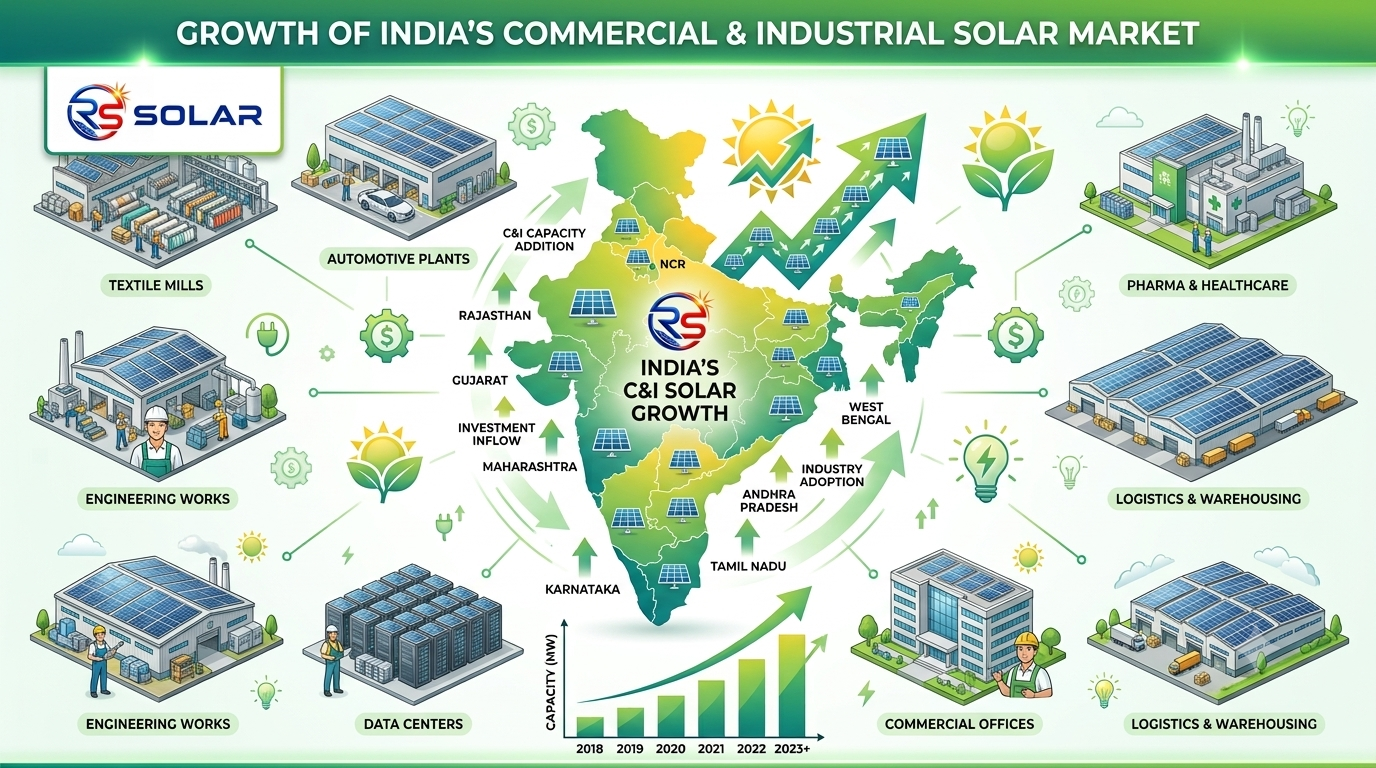
Commercial and industrial (C&I) solar refers to solar energy systems developed for businesses, factories, warehouses, offices, institutions, and other non-residential electricity consumers.
These projects can take different forms depending on the consumer’s electricity demand, site conditions, investment capacity, and energy procurement strategy.
The two widely discussed models are:
- Commercial rooftop solar: Solar panels are installed at the consumer’s premises, such as a factory roof or warehouse.
- Solar open access: Eligible businesses procure solar electricity from an off-site renewable energy project through the electricity network.
Some businesses may also explore a combination of on-site solar and off-site renewable electricity procurement.
The C&I segment is different from the residential solar market. Commercial consumers often have larger electricity loads, more complex electrical infrastructure, different tariff structures, and project requirements that vary by state and industry.
For example, a manufacturing facility operating during daylight hours may be able to use a substantial portion of its rooftop solar generation directly. A business with multiple facilities and limited rooftop space may evaluate open-access procurement instead.
This is why commercial solar projects require a detailed assessment rather than a standard system-size recommendation.
2. Latest Solar Industry Developments in India in 2026
India’s solar industry continues to expand, but capacity growth is only one part of the story. Changes in procurement requirements, financing models, and project execution timelines can also influence commercial solar decisions.
2.1 Growth in Rooftop Solar Installations
India added approximately 6.6 GW of rooftop solar capacity in the first half of 2026, according to Mercom India Research. Residential installations accounted for the majority of additions, while industrial and commercial installations also contributed to the market.
For commercial customers, this growth reflects the wider adoption of rooftop solar as a potential energy-cost management option.
However, the commercial rooftop segment should not be evaluated using residential-market assumptions. Businesses need project-specific assessments of their electricity consumption, roof conditions, system capacity, and financial returns.2.2 Expansion of Solar Open Access
Open-access solar is another important part of India’s C&I renewable energy market.
Mercom India Research reported that solar open-access capacity additions reached nearly 6 GW during the first half of 2026, representing 42% year-on-year growth. Cumulative installed solar open-access capacity stood at approximately 36 GW as of June 2026.
This model may be relevant for businesses that have limited rooftop space or higher electricity demand than their on-site roof can support.
Nevertheless, open-access economics vary by state. Grid charges, banking provisions, contract terms, and other regulatory conditions can materially affect the final cost of procured electricity.
Businesses should therefore evaluate the complete cost structure before selecting an open-access arrangement.
2.3 Solar Module Compliance and ALMM Updates
The Approved List of Models and Manufacturers (ALMM) framework is an important procurement consideration for applicable solar projects in India.
MNRE maintains ALMM lists for solar PV modules and solar PV cells. Its 2026 updates include changes and clarifications relevant to certain net-metering and open-access projects.
For EPC companies and project developers, module eligibility should be verified during procurement planning—not after equipment has already been purchased.
The applicable requirements depend on the project category, commissioning timeline, and relevant exemptions or government orders. Installers should consult the latest official MNRE notifications and project-specific requirements before confirming equipment selection.
Important for EPCs: Verify the applicable ALMM and project-specific compliance requirements before finalizing solar module procurement.
3. Why Commercial Businesses Are Investing in Solar Energy
Commercial solar can support several business objectives, but its value depends on how well the system matches the facility’s operational needs.
3.1 Reducing Dependence on Grid Electricity
Businesses that consume electricity during solar generation hours may be able to offset a portion of their grid consumption through rooftop solar.
For example, a warehouse with daytime operations may use solar electricity to support lighting, ventilation, office equipment, and other electrical loads.
The actual benefit depends on the facility’s consumption profile and the amount of solar electricity used on-site.
3.2 Improving Energy Cost Planning
Electricity expenses can affect a business’s operating budget. A properly assessed solar project may help a company plan a portion of its energy costs over the long term.
However, businesses should avoid relying on generic savings percentages. A realistic financial assessment must consider the electricity tariff, expected solar generation, system cost, financing, maintenance, and applicable charges.
3.3 Supporting Sustainability and Corporate Goals
Solar energy can contribute to a company’s renewable electricity strategy and environmental reporting objectives.
Businesses may evaluate solar as part of broader sustainability plans, particularly when customers, investors, or supply-chain partners request information about energy use and emissions.
The environmental contribution should be based on actual system generation and the company’s electricity accounting methodology.
3.4 Making Better Use of Available Rooftop Space
Large commercial buildings, factories, and warehouses may have substantial roof areas that could be assessed for solar installation.
However, not every square metre is suitable for panel placement. Rooftop access paths, shading, structural capacity, equipment, drainage, and safety clearances can affect the usable area.
A professional site assessment helps determine whether the roof can support the proposed installation.
4. Commercial Rooftop Solar vs. Open-Access Solar: What Should Businesses Choose?
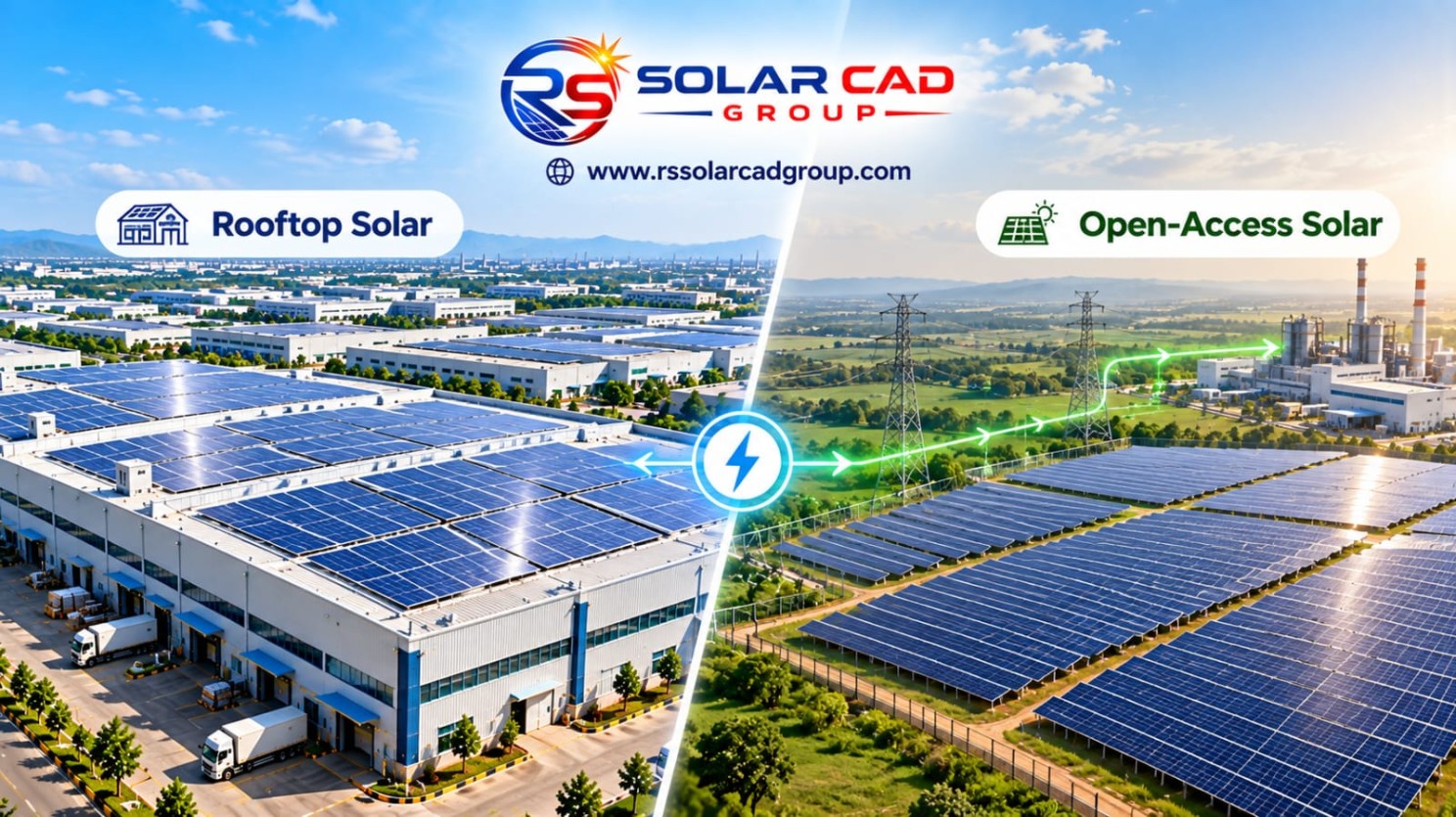
Choosing between rooftop solar and open access requires more than comparing the quoted price per unit of electricity.
Each model has different infrastructure, ownership, regulatory, and financial considerations.
4.1 When Commercial Rooftop Solar May Be Suitable
Rooftop solar may be worth evaluating when a business:
- Owns or has suitable long-term access to its premises.
- Has adequate usable roof space.
- Consumes a meaningful amount of electricity during daylight hours.
- Can accommodate the system’s installation and maintenance requirements.
- Meets the applicable grid-connection and regulatory requirements.
The system should be designed around the facility’s actual electricity demand rather than simply filling the entire roof with panels.
4.2 When Open-Access Solar May Be Worth Evaluating
Open access may be relevant when a business:
- Has high electricity consumption.
- Has limited rooftop or on-site installation space.
- Meets the applicable consumer eligibility requirements.
- Can accommodate the contract structure and associated charges.
- Has evaluated state-specific regulations and project economics.
Open access is not automatically cheaper for every consumer. The final economics depend on the complete tariff and regulatory structure.
4.3 Can Businesses Combine Both Models?
In some cases, a business may evaluate rooftop solar for on-site generation and open access for additional renewable electricity procurement.
This approach requires coordinated energy planning. Businesses should assess how each source contributes to consumption, contractual commitments, and total energy costs.
The suitability of such a strategy depends on the facility’s electricity demand, location, regulatory conditions, and commercial agreements.
5. How Businesses Can Evaluate Commercial Solar ROI
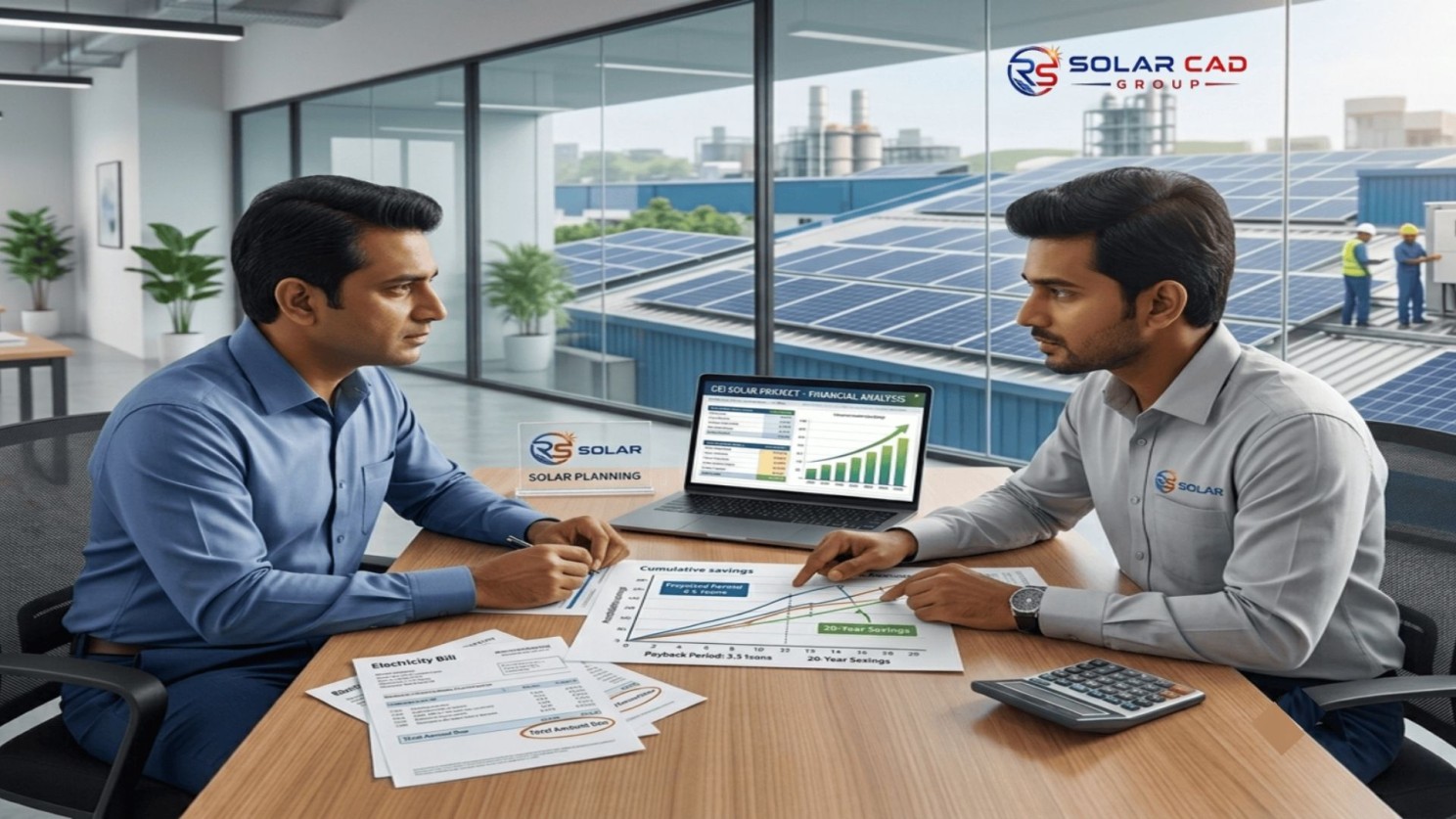
Return on investment (ROI) is often one of the most important factors in a commercial solar decision.
However, an accurate ROI estimate requires reliable input data and transparent assumptions. A proposal that focuses only on headline savings may not provide enough information for a business to make an informed investment decision.
5.1 Analyse Electricity Bills and Consumption Patterns
The first step is to understand how much electricity the facility consumes and when that consumption occurs.
Businesses should review recent electricity bills and, where available, interval or time-of-use data.
This helps the project team estimate how much solar generation may be used directly and whether the proposed system capacity is appropriate.
5.2 Calculate the Total Project Cost
The project cost may include:
- Solar PV modules
- Inverters
- Mounting structures
- DC and AC cables
- Electrical protection equipment
- Engineering and design
- Installation and commissioning
- Grid-connection work
- Monitoring and other site-specific requirements
A complete proposal should clearly identify what is included and what may be charged separately.
5.3 Estimate Solar Generation Realistically
Solar generation depends on location, orientation, shading, weather, equipment, and system losses.
A reliable estimate should document its assumptions and use realistic performance expectations.
Businesses should be cautious about guaranteed savings claims that do not account for actual site conditions or electricity consumption.
5.4 Compare Financing and Ownership Options
Commercial solar projects may be funded through direct capital expenditure (CAPEX), third-party ownership, leases, or other financing arrangements.
Each model has different implications for upfront investment, recurring payments, asset ownership, maintenance responsibilities, and long-term savings.
Businesses should compare the full financial terms—not just the initial payment or advertised monthly cost.
5.5 Consider Maintenance and Long-Term Performance
Solar projects are long-term assets. Businesses should understand the expected maintenance requirements, warranty terms, monitoring arrangements, and responsibilities for system repairs.
A financial assessment should account for operating costs and realistic performance expectations throughout the project’s useful life.
ROI Reminder: A credible commercial solar proposal should explain its assumptions, costs, expected generation, and financial limitations—not just advertise a savings percentage.
6. Key Technical Considerations Before Installing Commercial Solar
A commercial solar system must be designed around the building, electrical infrastructure, and operating requirements of the business. Poor planning can lead to avoidable installation challenges, generation losses, and additional project costs.
6.1 Rooftop Assessment and Structural Suitability
Before designing a rooftop solar system, the project team should assess the roof’s condition, usable area, structural capacity, and accessibility.
Industrial roofs may contain HVAC equipment, skylights, ventilation systems, water tanks, or other obstructions. These factors can affect panel placement and maintenance access.
The assessment should also consider wind loads, mounting methods, waterproofing, and applicable structural requirements.
6.2 Solar System Capacity and Load Matching
System capacity should be selected according to the facility’s electricity consumption, available space, grid-connection conditions, and project economics.
An oversized system may produce more electricity than the facility can use during certain periods, while an undersized system may not meet the intended energy objectives.
Accurate load analysis helps businesses and EPC companies make informed decisions about system capacity.
6.3 Inverter Selection and Electrical Design
Inverters are a critical part of commercial solar systems because they convert the DC electricity generated by solar modules into AC electricity used by the facility or supplied to the grid.
Inverter selection should consider system capacity, module configuration, voltage and current limits, operating conditions, monitoring capabilities, and applicable electrical requirements.
Electrical design should also address cable sizing, protection devices, earthing, isolation, and integration with the facility’s electrical infrastructure.
6.4 Shading, Panel Layout, and Energy Yield
Shading from nearby buildings, rooftop equipment, trees, or other obstructions can affect solar generation.
A well-planned layout should consider panel orientation, spacing, shading patterns, maintenance pathways, and roof constraints.
For larger commercial installations, accurate layout planning helps the EPC team make better use of available roof space while avoiding unnecessary design compromises.
6.5 Safety and Grid Integration
Commercial solar installations must be planned with appropriate electrical and rooftop safety measures.
Depending on the project, this may include fall protection, safe access routes, electrical isolation, earthing, protection coordination, and utility interconnection requirements.
The project team should identify applicable local regulations and technical requirements early in the design process.
7. What Solar Installers and EPC Companies Should Prepare for in 2026
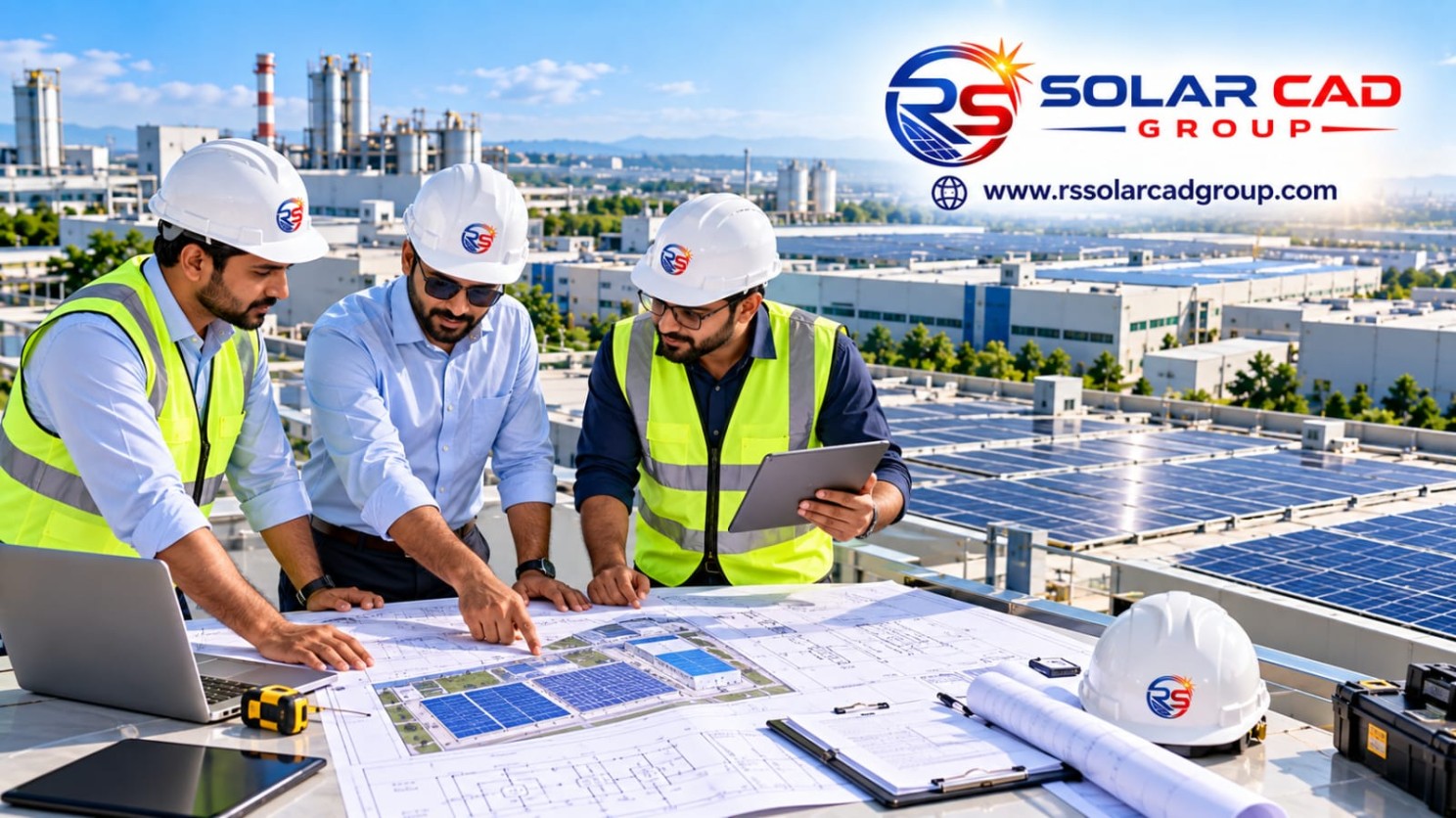
As commercial customers evaluate solar projects more carefully, EPC companies need to deliver accurate technical information, clear commercial proposals, and coordinated project execution.
7.1 More Detailed Customer Assessments
A commercial customer may have multiple buildings, different operating schedules, varying electricity tariffs, and specific business requirements.
Installers should collect the information needed to understand the project before preparing a final proposal.
Useful inputs may include electricity bills, site photographs, roof drawings, electrical details, operating schedules, and information about future facility expansion.
7.2 Stronger Focus on Design Accuracy
Commercial projects often involve larger systems and more complex site conditions than residential installations.
Accurate layouts, electrical drawings, equipment specifications, and project documentation help reduce design-related uncertainty.
A structured design review can also help identify issues before equipment procurement or on-site installation begins.
7.3 Regulatory and Procurement Planning
EPC companies should review applicable grid-connection requirements, module eligibility, project-specific approvals, and relevant state regulations.
For projects affected by ALMM requirements, verifying the current applicable list and relevant exemptions is particularly important.
Procurement decisions should be aligned with the project’s expected commissioning timeline and compliance obligations.
7.4 Clear Commercial Proposals
A professional commercial solar proposal should explain more than the system price.
It should provide a clear overview of:
- Proposed system capacity
- Major equipment and specifications
- Expected solar generation
- Financial assumptions and estimated savings
- Project scope and exclusions
- Installation timeline
- Warranty and maintenance responsibilities
Transparent proposals help business owners compare options and understand what they are purchasing.
7.5 Project Coordination and Customer Handover
Commercial installations may require coordination among business owners, facility managers, electrical contractors, engineering teams, equipment suppliers, and utilities.
A structured project workflow helps keep design, procurement, installation, and commissioning activities aligned.
At handover, customers should receive relevant system documentation, operating instructions, warranty details, and monitoring information.
8. The Role of Battery Storage in Commercial Solar
Battery storage is becoming an important consideration in broader energy-management discussions. However, a battery is not automatically required for every commercial solar project.
Its suitability depends on the business’s operating requirements, electricity tariffs, backup needs, and financial objectives.
8.1 When Battery Storage May Be Useful
A business may evaluate battery storage when it needs to:
- Support selected loads during grid outages.
- Store excess solar generation for later use.
- Manage specific peak-demand requirements.
- Improve energy flexibility where the tariff structure supports it.
The feasibility of these applications depends on the facility’s load profile, battery configuration, applicable regulations, and total project cost.
8.2 What Businesses Should Evaluate Before Adding Batteries
Before investing in storage, businesses should assess battery capacity, power rating, expected operating cycles, safety requirements, usable energy, warranty terms, and replacement considerations.
The financial analysis should compare the additional cost of storage with the specific benefits expected from its use.
For EPC companies, a customer-specific assessment is more useful than recommending battery storage as a standard component of every commercial installation.
9. Common Commercial Solar Project Mistakes to Avoid
Even a promising solar project can face challenges when important details are overlooked during planning.
9.1 Selecting System Capacity Without Load Analysis
Choosing system capacity based only on available roof space can result in a mismatch between solar generation and electricity consumption.
A load assessment should be completed before the final system size is selected.
9.2 Ignoring Roof Condition and Structural Requirements
Installing solar panels without properly assessing roof conditions can create safety, maintenance, and structural concerns.
Roof suitability should be confirmed before finalizing the design and installation plan.
9.3 Comparing Proposals Only on Price
A lower-priced proposal may differ in equipment specifications, engineering scope, warranties, installation quality, or exclusions.
Businesses should compare the complete scope and expected performance—not only the initial project cost.
9.4 Overlooking Regulatory Requirements
Applicable module requirements, grid-connection rules, and state-specific regulations can affect project feasibility and timelines.
These requirements should be reviewed before procurement and installation commitments are finalized.
9.5 Using Unrealistic Savings Estimates
Savings depend on actual electricity consumption, solar generation, tariffs, and other project-specific factors.
Businesses should request transparent assumptions and avoid relying on unsupported guarantees.
10. How RS Solar CAD Group Supports Commercial Solar Projects
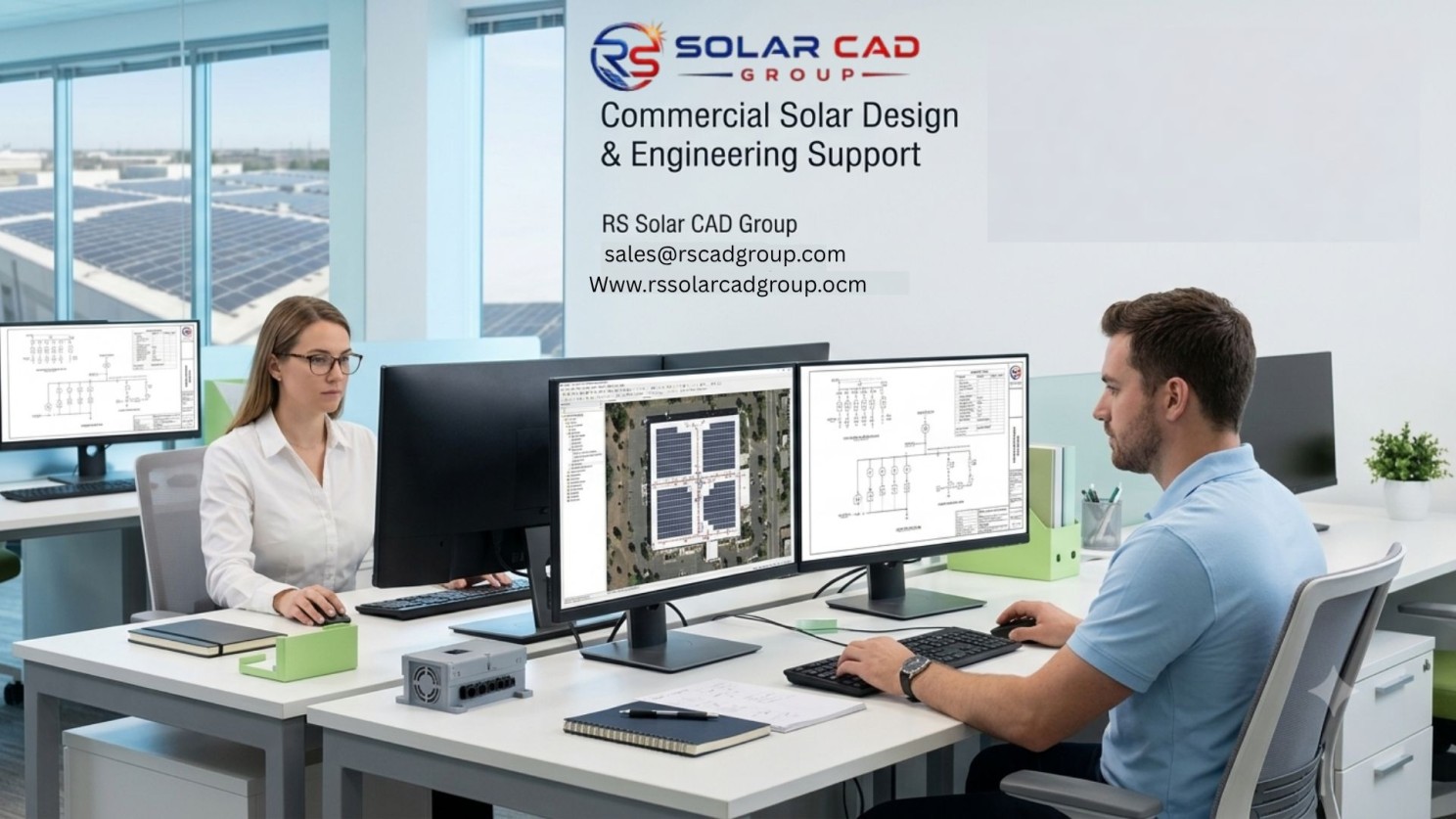
While India’s commercial solar market continues to expand, solar projects across international markets also require accurate design, engineering, and technical documentation.
RS Solar CAD Group provides solar design and engineering support to solar installers, EPC companies, and project developers, particularly in the USA and Canada.
The company supports solar professionals with services such as:
- Solar PV system design and layouts
- Solar proposal design
- Solar permit plan sets
- Electrical design and single-line diagrams (SLDs)
- Engineering documentation and design revisions
For solar installers and EPC companies, professional design support can help streamline project preparation, manage design workloads, and coordinate technical documentation.
RS Solar CAD Group’s role in this article is to highlight the importance of reliable solar design and engineering support—not to suggest that the company provides commercial solar installation services in India.
To learn more about RS Solar CAD Group’s solar design and engineering services for international solar projects, visit rssolarcadgroup.com or contact sales@rscadgroup.com.
11. The Future of Commercial Solar in India
India’s commercial solar market is developing across rooftop installations, open-access procurement, and integrated energy-management solutions.
As more businesses evaluate solar projects, decisions are likely to remain closely connected to electricity costs, operational requirements, regulatory conditions, and long-term financial feasibility.
For commercial customers, this means evaluating solar as a business investment—not simply comparing equipment prices or advertised savings.
For solar installers and EPC companies, it means delivering technically sound, well-documented, and financially transparent solutions that address each customer’s needs.
Battery storage, improved monitoring, equipment compliance, and more detailed energy assessments may also play a role in future project planning. Their value will depend on the specific application and the economics of each project.
The commercial solar opportunity is not limited to installing more panels. It is about designing energy solutions that make sense for the businesses using them.
Frequently Asked Questions (FAQ)
1. What is commercial and industrial (C&I) solar?
Commercial and industrial (C&I) solar refers to solar energy systems used by businesses, factories, warehouses, offices, and other non-residential consumers. These systems may be installed on-site or procured through eligible off-site arrangements such as open access.
2. Is commercial rooftop solar suitable for factories and warehouses?
Commercial rooftop solar may be suitable for facilities with adequate usable roof space, appropriate structural conditions, and electricity consumption that supports the project’s economics. A site assessment and load analysis should be completed before finalizing system capacity.
3. What is the difference between rooftop solar and open-access solar?
Rooftop solar is installed at the consumer’s premises, while open-access solar allows eligible consumers to procure electricity from an off-site renewable energy project through the electricity network. Their costs, regulations, and implementation requirements differ.
4. How can a business calculate commercial solar ROI?
A business should evaluate electricity consumption, applicable tariffs, total system cost, expected solar generation, financing, maintenance, and relevant grid charges. ROI estimates should use project-specific assumptions rather than generic savings percentages.
5. Is battery storage necessary for every commercial solar project?
No. Battery storage may be useful for specific backup or energy-management requirements, but it is not necessary for every installation. Its suitability depends on the business’s load profile, operating requirements, and project economics.
6. What should EPC companies check before starting a commercial solar project?
EPC companies should assess the site, roof or land conditions, electricity consumption, system capacity, equipment compatibility, applicable module requirements, grid-connection rules, documentation, and project economics.
7. What are the major factors affecting commercial solar project costs?
Major factors include system capacity, solar modules, inverters, mounting structures, electrical equipment, engineering, installation, grid-connection work, and site-specific requirements. Financing and ongoing maintenance also affect the overall financial assessment.
8. Can commercial businesses combine rooftop solar with open-access solar?
Some businesses may evaluate both models to meet different portions of their electricity demand. The suitability depends on consumption patterns, state regulations, contractual conditions, and the overall economics of the combined arrangement.
Conclusion
India’s commercial solar market in 2026 offers businesses multiple ways to evaluate renewable electricity, from rooftop solar installations to open-access procurement.
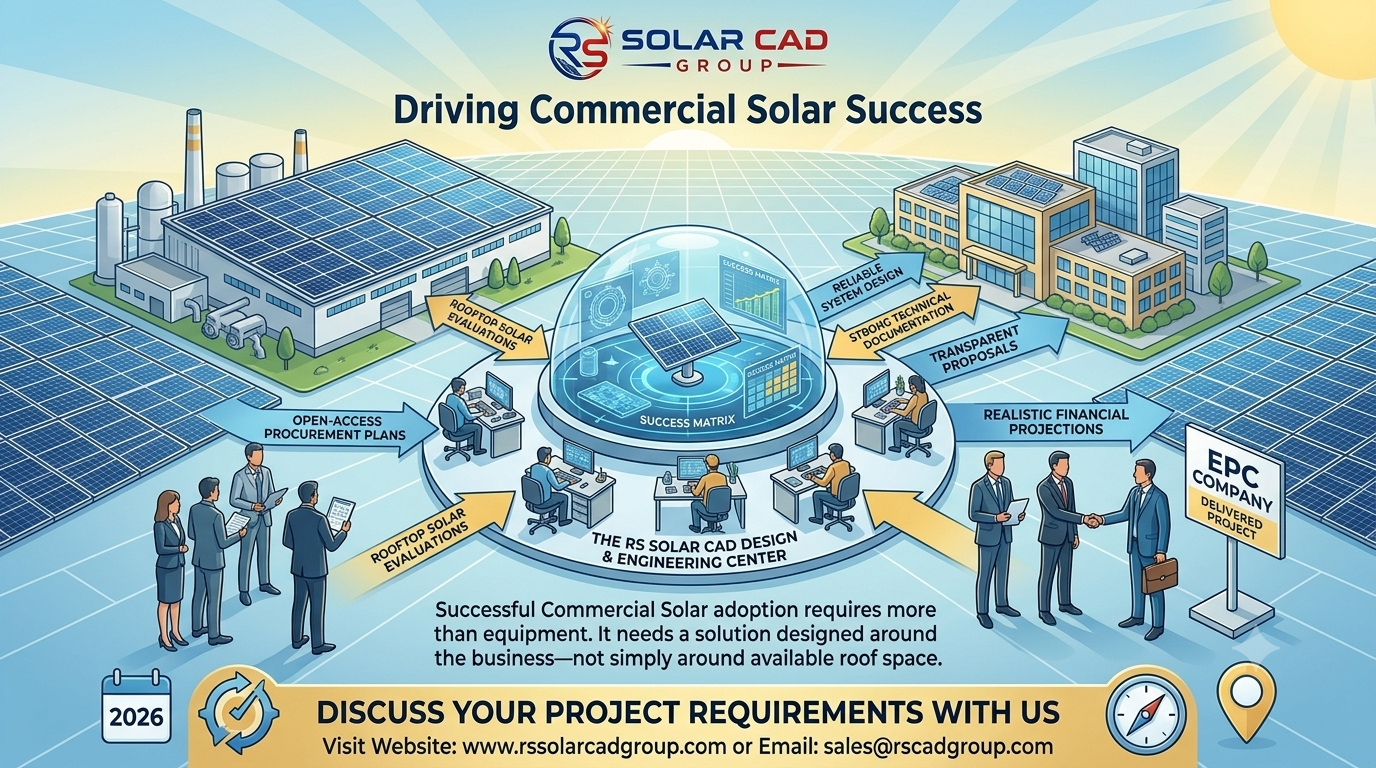
However, successful commercial solar adoption requires more than selecting equipment. Businesses need accurate energy assessments, realistic financial projections, suitable system designs, and a clear understanding of regulatory and operational requirements.
For solar installers and EPC companies, the opportunity lies in delivering reliable, well-designed projects supported by transparent proposals and strong technical documentation.
Commercial solar works best when the solution is designed around the business—not simply around the available roof space.
RS Solar CAD Group supports solar professionals with solar design and engineering services to help them prepare and coordinate commercial solar projects.
Visit Website: www.rssolarcadgroup.com or Email sales@rscadgroup.com to discuss your project requirements