PM Surya Ghar 2.0: Could Battery Storage Become the Next Big Step for Rooftop Solar in India?
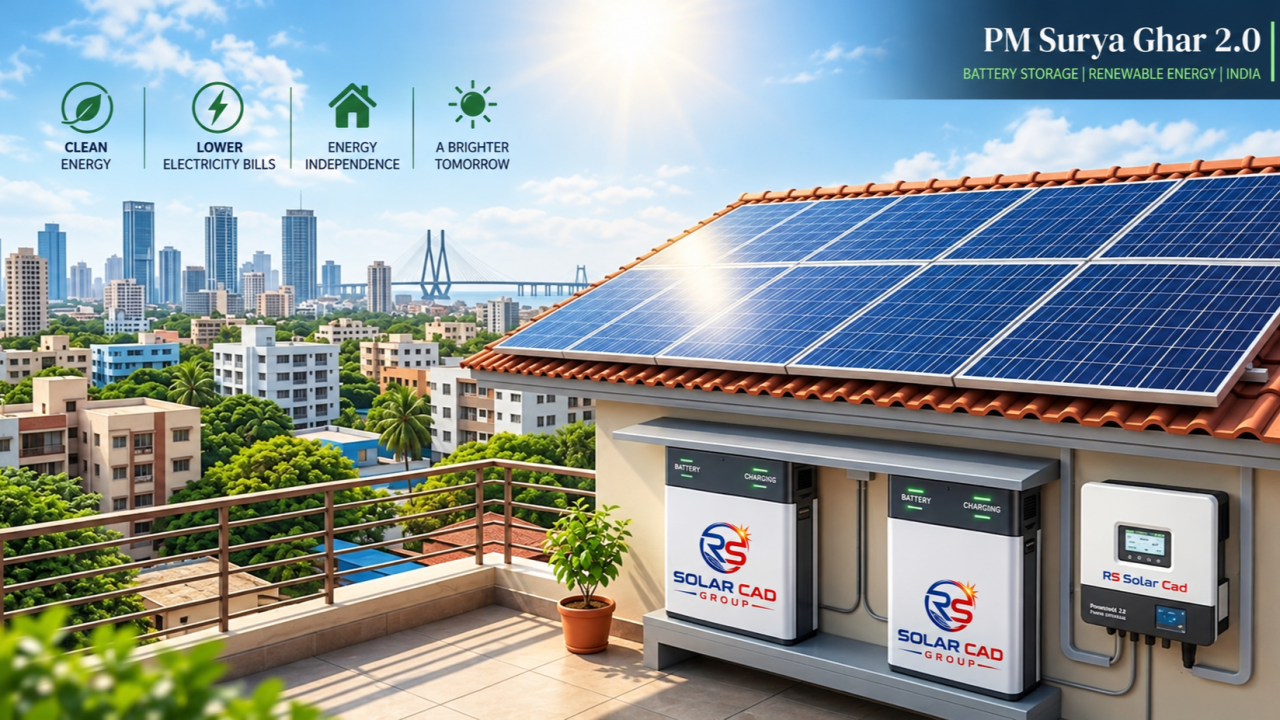
India’s rooftop solar market is entering an important new phase. Solar panels are becoming increasingly common in homes and businesses, while battery storage, hybrid inverters and smarter energy-management solutions are gaining attention.
The next question is no longer only, “How much solar can a rooftop generate?” It is also becoming: “How can that solar power be stored and used when it is needed most?”
This question is particularly relevant as India continues expanding renewable energy while working to make electricity supply more reliable and flexible.
The PM Surya Ghar: Muft Bijli Yojana has already accelerated interest in residential rooftop solar. The scheme was launched in February 2024 with the objective of supporting rooftop solar installations for one crore households and a total financial outlay of ₹75,021 crore. Under the scheme, Central Financial Assistance is provided to eligible residential consumers according to the applicable capacity structure.
Now, as battery storage becomes a bigger part of India’s energy conversation, could the next phase of rooftop solar move toward solar + battery storage?
What Is PM Surya Ghar and Why Does It Matter?
PM Surya Ghar: Muft Bijli Yojana is a Government of India initiative designed to promote grid-connected rooftop solar among residential consumers.
The scheme provides Central Financial Assistance to eligible residential consumers, with the subsidy structure covering the first 2 kW and additional capacity up to 3 kW under the applicable guidelines. Group Housing Societies and RWAs can also receive support for common facilities, including EV charging, within the scheme’s specified limits.
The official framework also requires eligible rooftop systems to meet specified technical requirements and undergo verification through the relevant distribution utility process.
This has helped make rooftop solar more accessible to Indian households.
However, a grid-connected rooftop solar system and a solar-plus-battery system are not exactly the same thing.
Why Is Battery Storage Getting More Attention?
Solar generation naturally follows sunlight.
During the day, solar panels can generate electricity, often when a household may not be using all of it. In the evening, when solar production falls, electricity demand can remain high.
Battery storage can help bridge this timing gap.
A typical solar-plus-storage system can work like this:
Solar Panels → Inverter → Home Loads + Battery → Electricity During Non-Solar Hours
Instead of using every unit of solar electricity immediately or exporting excess electricity to the grid, a battery can store part of the generated energy for later use, depending on the system design, controls, regulations and economics.
This can become particularly useful for households that have significant evening electricity consumption or want backup capability.
Is Battery Storage Already Mandatory Under PM Surya Ghar?
This is where an important distinction is needed.
As of September 10, 2026, battery storage should not be described as a confirmed mandatory requirement for residential PM Surya Ghar rooftop installations.
Recent developments have, however, put energy storage much more firmly into India’s renewable-energy policy discussion.
The Central Electricity Authority has proposed requirements under which new solar and wind projects could need to integrate energy storage from 2027. Recent reporting on the proposal says new renewable projects could eventually be required to store a portion of their installed capacity for at least two hours.
This proposal is primarily about new renewable-energy projects, not a confirmed battery mandate for every residential rooftop system under PM Surya Ghar.
Nevertheless, the direction is significant.
It shows that India is increasingly thinking beyond renewable generation alone and focusing on renewable generation + storage + grid flexibility.
Could This Influence the Future of Rooftop Solar?
Potentially, yes.
A future rooftop-solar ecosystem could increasingly include:
- Solar PV modules
- Hybrid or compatible inverters
- Battery energy storage
- Smart energy monitoring
- Load management
- Grid interaction
- EV charging
- Backup power functionality
This does not mean every home needs a battery.
Instead, battery storage should be considered based on the homeowner’s electricity consumption pattern, backup requirements, tariff structure, available space, budget, inverter compatibility and local technical requirements.
Solar Panels vs Solar + Battery: What’s the Difference?
A conventional grid-connected rooftop solar system primarily generates electricity during sunlight hours.
A solar-plus-storage system adds another layer of flexibility.
Conventional Rooftop Solar
Solar panels generate electricity during the day.
The electricity can be consumed by the household, while surplus generation may be exported to the grid according to the applicable net-metering or other regulatory arrangement.
Solar + Battery
The system can also store selected excess solar generation and make it available later, depending on the battery and inverter configuration.
This can provide benefits such as:
- Better use of solar energy generated during the day
- Greater flexibility in electricity consumption
- Potential backup capability
- Reduced dependence on grid electricity during selected periods
- Better energy management
The exact benefits depend heavily on system design and local electricity rules.
Why Hybrid Inverters Could Become More Important
If battery storage becomes more common in Indian homes, inverter selection will become increasingly important.
A hybrid inverter can coordinate solar generation, battery storage, household loads and grid interaction within a suitable system configuration.
For homeowners considering future battery integration, it may be worth discussing whether the selected inverter can support the intended battery technology and future expansion.
This is one reason professional system planning matters.
A solar system should not be designed only around panel capacity. The design should consider the complete energy flow:
Solar Generation → Inverter → Household Load → Battery → Grid
The right configuration depends on the project’s requirements.
What Does This Mean for Indian Homeowners?
For homeowners considering rooftop solar today, the important takeaway is simple:
Do not choose a system only because it has the highest panel capacity. Choose a system based on how you actually use electricity.
For example, a household with high daytime consumption may benefit significantly from conventional rooftop solar.
A household with substantial evening consumption, frequent power interruptions or a strong interest in backup capability may also want to evaluate battery storage.
Before choosing a battery, homeowners should consider:
1. Electricity Consumption Pattern
Look at when electricity is consumed—not only how many units are consumed each month.
2. Backup Requirement
If backup power is a priority, the battery and inverter need to be appropriately sized for the critical loads.
3. Battery Chemistry and Quality
Battery technology, usable capacity, cycle life, thermal management and safety features all matter.
4. Inverter Compatibility
The inverter must be compatible with the intended battery and system architecture.
5. Future Expansion
Homeowners may want to plan for additional storage or changing electricity needs later.
6. Installation Quality
Even high-quality equipment cannot deliver the expected performance if the system is poorly designed or installed.
Battery Storage Could Also Change Commercial Solar
The storage discussion is not limited to homes.
Commercial buildings often have larger and more complex electricity loads. Businesses may use solar generation during working hours while still requiring reliable electricity during evening periods or operational peaks.
Solar combined with battery storage can therefore become an important option for businesses looking at:
- Energy cost management
- Backup power
- Renewable-energy utilization
- Peak-demand management
- Energy resilience
- Future electrification
India’s wider energy sector is already moving toward greater integration of renewable generation and storage. For example, the government recently approved the PM Surya Sarovar Yojana for floating solar projects with co-located energy storage, demonstrating how storage is increasingly being considered alongside renewable generation at larger scales.
The Bigger Picture: India’s Solar Market Is Becoming an Energy Market
The future of solar in India may not simply be about installing more panels.
It could increasingly be about building complete energy systems.
That means combining:
Solar + Storage + Smart Inverters + EV Charging + Energy Management
The growth of electric vehicles can further increase the importance of this integrated approach. Residential and commercial properties may increasingly need to manage solar generation, battery charging, EV charging and conventional electricity loads together.
This creates new opportunities for installers, engineers, EPC companies and technology providers.
What Should Solar Installers Focus on Next?
As the industry evolves, installers should focus on more than module installation.
Important areas include:
- Accurate system sizing
- Proper inverter selection
- Battery compatibility
- Electrical protection
- Safe installation practices
- Monitoring systems
- Load analysis
- Regulatory compliance
- Professional documentation
- Future-ready system design
The quality of the overall system will become increasingly important as rooftop solar becomes more sophisticated.
PM Surya Ghar 2.0: What Could the Future Look Like?
The term “PM Surya Ghar 2.0” is increasingly useful as a way to discuss the possible next phase of India’s rooftop-solar ecosystem—but it should not be treated as confirmation of a specific new residential battery subsidy or mandate unless officially notified.
The broader direction, however, is clear.
India is expanding solar generation while simultaneously exploring stronger energy-storage integration across the renewable-energy sector.
If battery costs, technology and policy support continue to improve, rooftop solar systems could increasingly evolve from simple generation systems into smart, flexible home energy systems.
That could make battery storage one of the most important developments to watch in India’s next phase of rooftop solar.
Final Thoughts
India’s rooftop solar journey is moving from generation to intelligent energy management.
PM Surya Ghar has helped bring rooftop solar into the mainstream conversation for Indian households. The next evolution could involve better integration between solar panels, batteries, hybrid inverters, EV charging and the electricity grid.
Battery storage may not be necessary for every Indian home today. But the increasing focus on storage across India’s renewable-energy sector suggests that it deserves serious attention when planning the future of rooftop solar.
For homeowners and businesses, the best approach is not simply to install the maximum possible solar capacity. It is to design a system around actual electricity consumption, future needs, safety, equipment compatibility and long-term value.
How RS Solar CAD Group Can Help
RS Solar CAD Group provides solar installation and project support for residential and commercial solar projects in India, including solutions connected with rooftop solar requirements.
Our team can support customers with system planning, solar design, equipment coordination and installation-related requirements to help create practical and reliable solar solutions.
If you are planning a residential or commercial solar project in India, connect with RS Solar CAD Group to discuss your requirements.
Website: www.rssolarcadgroup.com Email: sales@rscadgroup.com
Frequently Asked Questions
1. Is battery storage mandatory under PM Surya Ghar?
No. As of September 10, 2026, battery storage should not be presented as a mandatory requirement for every residential PM Surya Ghar installation. Recent government-related developments around mandatory storage concern proposals for new renewable-energy projects and should not be confused with a confirmed residential rooftop mandate.
2. Does PM Surya Ghar provide subsidy for every solar installation?
The Central Financial Assistance under PM Surya Ghar is designed for eligible residential consumers and follows the scheme’s specified capacity and eligibility conditions. It is not a universal subsidy for every solar installation.
3. Can I add a battery to my existing rooftop solar system?
In some cases, yes, but compatibility depends on the existing inverter, system architecture, battery technology, electrical configuration and installation requirements. A professional assessment should be completed before adding storage.
4. Is a hybrid inverter necessary for battery storage?
Not necessarily in every system configuration, but a compatible hybrid or storage-capable inverter can be important for systems designed to integrate solar generation and batteries.
5. Is battery storage useful for every home?
Not necessarily. It depends on electricity consumption patterns, backup requirements, local grid conditions, electricity tariffs, system cost and the homeowner’s objectives.
6. What is the biggest future trend in Indian rooftop solar?
One of the strongest trends to watch is the integration of solar generation with energy storage, smart inverters, EV charging and intelligent energy management.
7. Can commercial properties use solar + battery storage?
Yes. Commercial solar-plus-storage systems can be designed for applications such as energy management, backup power and improving the use of renewable electricity, subject to project requirements and applicable regulations.
8. Why is battery storage becoming important in India’s renewable-energy sector?
Solar and wind generation can vary with weather and time of day. Energy storage can help shift electricity availability to periods when it is needed and can support greater flexibility and reliability in renewable-energy systems. Recent Indian policy proposals show that storage is becoming a more important part of renewable-energy planning.