The Repowering Opportunity: Why Existing Solar Systems Could Become the Next Big Market

The Next Solar Opportunity May Already Be Installed
The solar industry has traditionally focused on building new projects, expanding installation capacity, and bringing renewable energy to more homes and businesses. Across the United States and Canada, solar installers, engineering, procurement, and construction (EPC) companies, and commercial energy providers have invested significant resources in developing new solar installations.
However, another opportunity is emerging alongside new project development: improving the solar systems that are already operating.
Thousands of existing installations face challenges associated with aging equipment, declining performance, changing electricity requirements, and outdated system designs. Some systems may still operate reliably but could benefit from targeted upgrades. Others may require more extensive modernization to remain technically and economically viable.
This is where solar repowering comes into the picture.
Solar repowering involves replacing or upgrading major components of an existing photovoltaic (PV) system to improve its performance, reliability, capacity, or operational life. Depending on the project’s condition, this may involve new solar modules, modern inverters, electrical upgrades, revised layouts, or a combination of improvements.
For solar businesses, repowering offers an opportunity to serve existing customers while developing new revenue streams beyond traditional installations.
For companies operating in the U.S. and Canadian markets, understanding this opportunity today could help them prepare for the next phase of solar industry growth.
1. What Is Solar Repowering?
Solar repowering is the process of modernizing an existing solar installation by replacing or upgrading selected equipment and, when necessary, redesigning parts of the system.
It is different from routine maintenance, which generally focuses on cleaning, inspection, troubleshooting, and repairing individual components.
Repowering takes a broader view. Its purpose is to determine whether an existing system can deliver better long-term value through carefully planned improvements.
Depending on the project’s requirements, solar repowering may include:
- Replacing aging or inefficient solar panels.
- Upgrading inverters that have reached the end of their useful service life.
- Redesigning the PV array to accommodate newer equipment.
- Updating electrical components, protection systems, and wiring.
- Improving system monitoring and fault detection.
- Evaluating whether battery energy storage can be integrated.
- Reviewing mounting structures and existing electrical infrastructure.
- Updating drawings and technical documentation to reflect the proposed system.
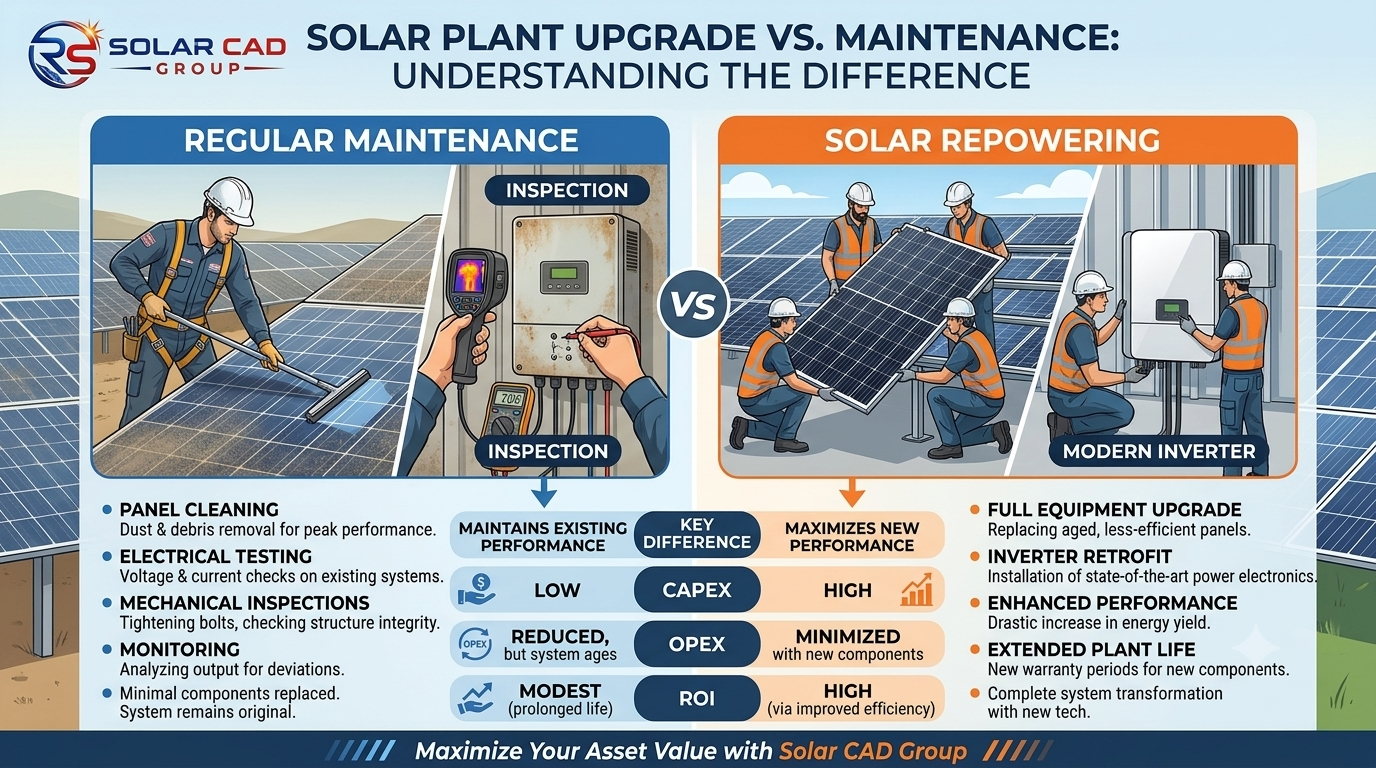
Not every project requires all these changes. A system experiencing inverter failures may need only a targeted equipment replacement, while a larger commercial installation may require extensive redesign.
The U.S. Department of Energy explains that repowering can involve installing newer PV modules and inverters, redesigning systems for updated performance and maintenance objectives, and evaluating opportunities to extend the operating life of existing assets.
The appropriate approach depends on the system’s current condition, technical limitations, operating costs, and financial objectives.
2. Why Existing Solar Installations Are Becoming More Important
The solar market is gradually developing beyond its initial emphasis on installation growth. As more systems accumulate years of operating history, owners must consider what happens after the original installation is complete.
Solar equipment does not necessarily reach the end of its useful life at the same time. Panels, inverters, electrical equipment, and mounting structures experience different operating conditions and maintenance requirements.
For example, solar modules may continue producing electricity for many years, while an inverter could require replacement sooner. A commercial system may also face new operational demands as a facility expands or its electricity consumption changes.
The National Renewable Energy Laboratory’s analysis of U.S. solar installations found a median performance loss of approximately 0.75% per year across the systems examined in its PV Fleet Performance Data Initiative. This is a fleet-level finding, not a prediction for every individual installation. Actual performance varies with equipment, climate, maintenance, and site conditions.
Source: U.S. Department of Energy, A Clearer Picture of U.S. Solar Power Performance.
For solar companies, the important point is that installed systems need ongoing performance evaluation throughout their operating lives.
An existing customer base can therefore become a valuable source of future projects. Instead of waiting for customers to commission entirely new installations, installers and EPCs can evaluate whether their current systems need repairs, component replacements, capacity improvements, or comprehensive repowering.
3. Aging Inverters Could Create a Major Upgrade Opportunity
Inverters are among the most important components to evaluate when assessing an older solar system.
Their job is to convert the direct current generated by solar panels into alternating current that can be used by electrical equipment or supplied to the grid.
Over time, inverters experience electrical, thermal, and environmental stresses. Depending on the equipment and operating conditions, components may fail, replacement parts may become difficult to obtain, and maintenance costs may increase.
An inverter replacement can therefore become a practical starting point for a broader system evaluation.
Before selecting replacement equipment, solar professionals should assess:
- Existing DC and AC system ratings.
- String configuration and voltage limits.
- Maximum input current and short-circuit current.
- Grid connection and interconnection requirements.
- Protection equipment and conductor capacity.
- Compatibility with existing monitoring systems.
- Physical installation constraints.
- Manufacturer specifications and applicable electrical codes.
A newer inverter should not automatically be assumed to be compatible with an older PV array.
For example, a replacement inverter may have different voltage limits, input requirements, or control capabilities. These differences can affect string configuration, equipment selection, and the electrical design.
A proper engineering review helps determine whether a direct replacement is appropriate or whether the system requires additional modifications.
The U.S. Department of Energy has also highlighted the importance of power electronics reliability in extending the operating life of solar energy systems.
Source: Extending Solar Energy System Lifetime with Power Electronics.
For installers and EPC companies, this creates an opportunity to combine equipment replacement with technical evaluation, updated electrical drawings, and engineering support.
4. Solar Panel Upgrades: More Than Replacing Old Modules
Solar module technology has advanced considerably over the years. Newer products may offer higher power output per panel, different dimensions, improved efficiency, and updated electrical characteristics.
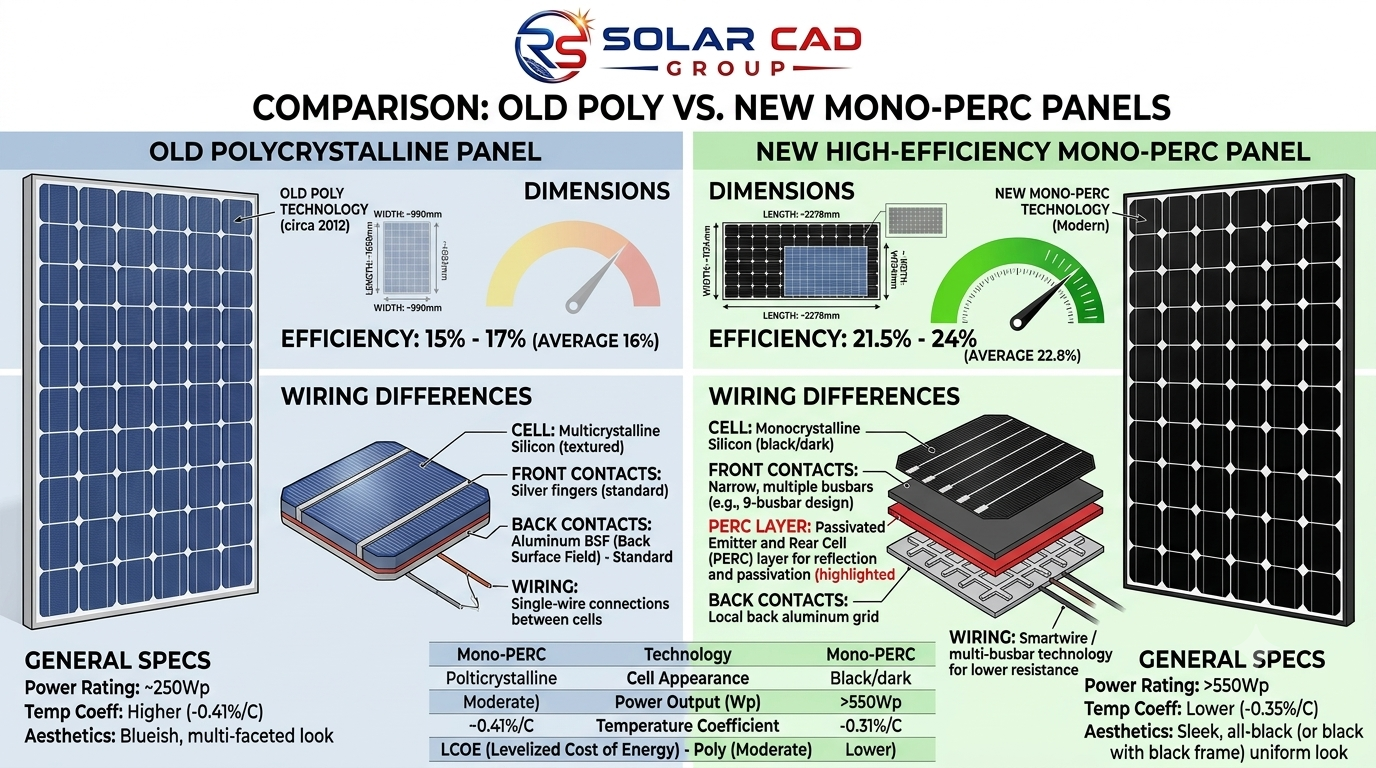
However, replacing older modules is not simply a matter of installing panels with higher wattage.
The dimensions, weight, voltage, current, mounting requirements, and electrical configuration of replacement modules must be evaluated against the existing installation.
A panel with a higher power rating may have different current characteristics or physical dimensions that affect system compatibility. If the available roof area is limited, module dimensions can also influence the final layout.
Before recommending a module upgrade, solar professionals should consider:
Available installation space: Will the new modules fit within the existing roof or ground-mount layout?
Electrical compatibility: Can the revised string configuration meet inverter voltage and current limits under expected temperature conditions?
Structural capacity: Can the existing roof and mounting system accommodate the replacement equipment and applicable loads?
Energy production: What is the realistic expected improvement after considering shading, orientation, degradation, inverter limitations, and other losses?
Installation costs: Will the existing mounting hardware and wiring remain suitable, or will additional work be required?
A technical assessment helps distinguish upgrades that deliver measurable value from replacements that increase costs without sufficient benefits.
Research published in Joule has also examined how planned module replacement can influence solar project economics and the adoption of more efficient technologies. Its findings reinforce the importance of evaluating replacement strategies carefully rather than assuming that newer equipment automatically produces a better financial outcome.
Source: Accelerating Photovoltaic Market Entry with Module Replacement.
5. Commercial and Industrial Solar Systems Offer Different Opportunities
Residential, commercial, industrial, and utility-scale systems have different repowering requirements.
For residential installers, an upgrade might involve replacing a failed inverter, updating an aging electrical design, or evaluating whether a system can accommodate additional modules or battery storage.
Commercial and industrial installations can present more complex opportunities because their energy requirements, equipment configurations, and operational constraints may be different.
A commercial facility might need to modernize its solar installation because of equipment failures, changing electricity consumption, an expansion of the building, or a requirement to improve system monitoring.
Potential projects include:
- Replacing outdated inverters across multiple arrays.
- Upgrading selected modules while retaining compatible infrastructure.
- Revising electrical layouts and system configurations.
- Evaluating battery integration.
- Modernizing monitoring and protection systems.
- Reviewing the suitability of existing mounting structures.
- Preparing updated documentation for proposed modifications.
Large projects also require careful planning around downtime. If a facility depends on solar generation to offset electricity consumption, unnecessary interruptions can affect the project’s financial performance.
A phased upgrade strategy may help reduce disruption, although the appropriate approach depends on the site’s design and operational requirements.
For EPC companies, these projects can create additional work with customers who already trust their installation and maintenance teams.
6. Why Repowering Is Different From Building a New Solar System
Repowering is attractive partly because an existing project may already have valuable infrastructure in place.
Depending on the site, this could include land access, mounting structures, equipment pads, buildings, utility interconnections, or established operational arrangements.
Retaining suitable infrastructure may reduce the need for certain development activities associated with a completely new installation.
However, existing infrastructure should never be assumed to be reusable without inspection and engineering review.
Older structures may require repairs. Electrical equipment may no longer meet the requirements of the proposed configuration. A change in system capacity may also trigger additional utility or permitting reviews.
A useful comparison is:
|
Consideration |
New installation |
Solar repowering |
|
Existing infrastructure |
Usually developed or assessed for the new project |
May be retained if suitable |
|
Equipment selection |
Based on a new system design |
Must account for existing equipment and proposed changes |
|
Site constraints |
Addressed during project development |
Existing layout and infrastructure can limit options |
|
Technical documentation |
Prepared for the new installation |
Existing drawings must be reviewed and revised as needed |
|
Utility coordination |
Required according to the new project’s circumstances |
Existing interconnection arrangements may need review or modification |
|
Financial assessment |
Based on new-project costs and expected returns |
Compares upgrade costs with continued operation and alternatives |
The economics depend on the project. A targeted inverter replacement may be more attractive than full repowering, while an extensively underperforming system may justify a more comprehensive redesign.
The goal is not to repower every older system. It is to identify projects where modernization provides a credible technical and financial advantage.
7. The Role of Solar Design and Engineering in Repowering
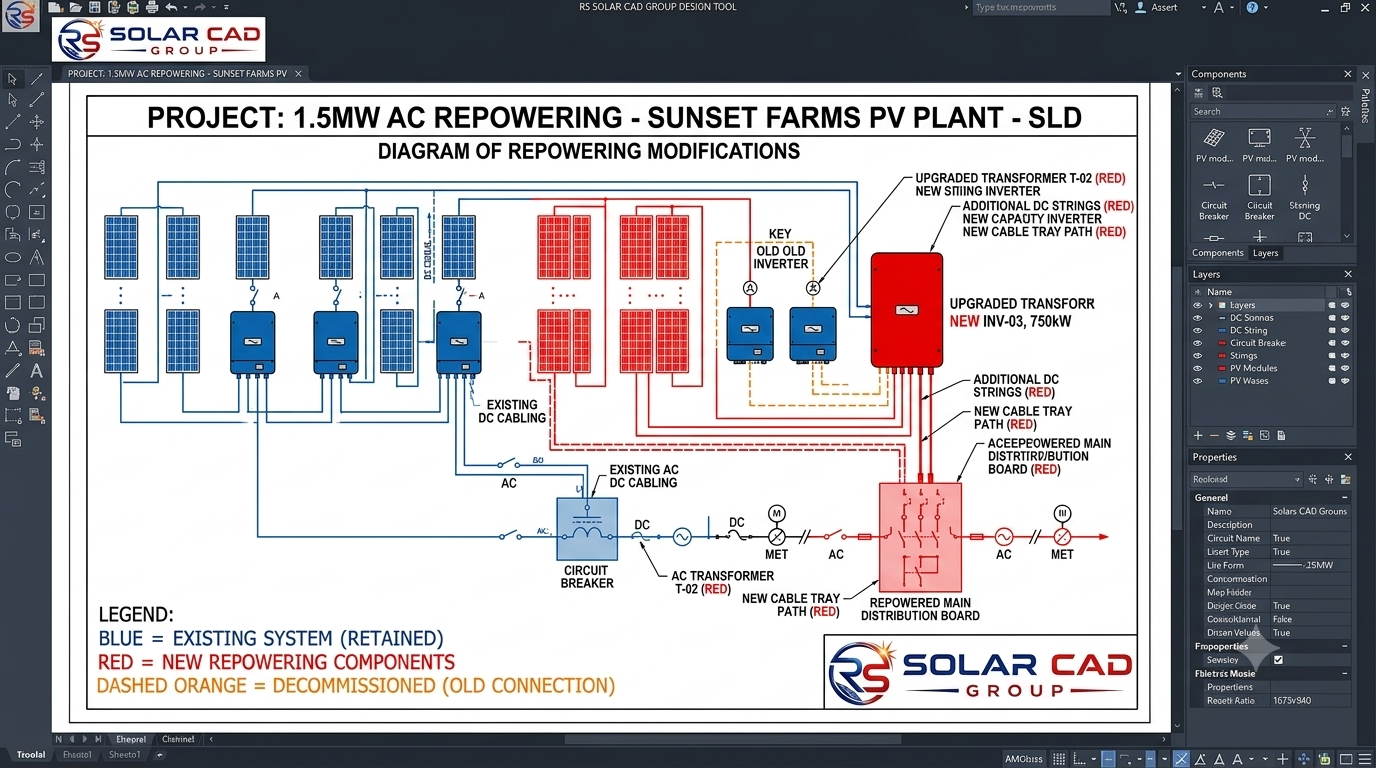
One of the most important aspects of repowering is ensuring that the proposed improvements work together as a complete system.
Replacing a panel or inverter changes more than the equipment list. Depending on the scope of work, it can affect string calculations, electrical ratings, layouts, protection requirements, structural considerations, and utility documentation.
This is where professional solar design and engineering support becomes particularly valuable.
A structured repowering workflow can include the following stages.
Stage 1: Existing System Assessment
Collect available drawings, equipment specifications, production information, inspection reports, and maintenance history.
Where necessary, verify existing conditions through site inspections and electrical testing performed by qualified personnel.
Stage 2: Technical Feasibility Review
Identify the components that need replacement and evaluate which existing components can remain.
Check compatibility between the proposed modules, inverters, electrical equipment, mounting structures, and interconnection arrangements.
Stage 3: Updated System Design
Develop the revised PV layout, string configuration, electrical calculations, equipment schedule, and other required technical details.
For larger projects, the design may also need to address construction sequencing and operational constraints.
Stage 4: Documentation and Engineering Review
Prepare the applicable drawings, specifications, and supporting documents. Depending on the jurisdiction and project scope, these may include electrical plans, single-line diagrams (SLDs), structural details, and engineering reviews or professional stamps where required.
Stage 5: Permitting and Utility Coordination
Determine which approvals, inspections, or utility reviews apply to the proposed modifications.
Requirements vary by jurisdiction, system size, project type, and the nature of the changes. Existing approval does not automatically authorize every future modification.
Stage 6: Installation and Verification
Qualified installation personnel complete the approved work and perform the required checks, testing, and commissioning activities.
The final documentation should accurately reflect the installed system.
A well-planned process reduces the risk of equipment incompatibility, incomplete documentation, and avoidable project delays.
8. The Business Opportunity for Solar Installers and EPC Companies
Repowering offers solar companies an additional way to develop their businesses without depending exclusively on new installations.
The opportunity begins with customers who already have solar equipment installed.
An installer with a portfolio of residential customers may be able to identify systems approaching an inverter replacement decision. A commercial EPC may have customers whose equipment needs a detailed performance review. An operations and maintenance provider may identify repeated failures that justify a broader upgrade assessment.
These relationships can support several service offerings.
System health assessments: Review available production data, maintenance history, and equipment condition to identify potential improvement opportunities.
Inverter replacement projects: Assess replacement compatibility and prepare the necessary design documentation.
PV module replacement: Evaluate the technical feasibility of using newer modules while retaining suitable system infrastructure.
Electrical modernization: Update system configurations, protection arrangements, and drawings where necessary.
Battery integration studies: Determine whether a storage addition is technically feasible and financially appropriate.
Multi-site repowering programs: Help customers assess multiple installations and prioritize projects based on condition, risk, and expected value.
For EPCs managing multiple customer sites, a standardized assessment process can make it easier to identify promising projects and compare their requirements.
Solar design companies can also support installers that do not have sufficient in-house engineering resources for every project. External support may help manage additional design work while the installer concentrates on customer relationships, field operations, and project delivery.
9. Why the U.S. and Canadian Markets Deserve Attention
The United States and Canada have diverse solar markets, including residential installations, commercial rooftops, industrial facilities, and larger solar projects.
These systems operate in different climates and under different electrical, structural, permitting, and utility requirements.
In the United States, projects may require coordination with local authorities having jurisdiction (AHJs), utilities, and applicable state and local requirements.
In Canada, project requirements can vary by province, territory, municipality, utility, and applicable electrical and building codes.
Climate is another consideration. Snow loads, wind exposure, temperature variation, coastal conditions, and other environmental factors can influence equipment selection and structural assessments.
Repowering plans must account for these local conditions rather than applying one standard design to every project.
Companies serving these markets can benefit from having access to design teams familiar with the documentation and coordination required for their target jurisdictions.
For installers and EPCs, this can be particularly useful when multiple projects require updated plans, revised equipment schedules, or engineering coordination at the same time.
10. Battery Storage Could Expand the Repowering Conversation
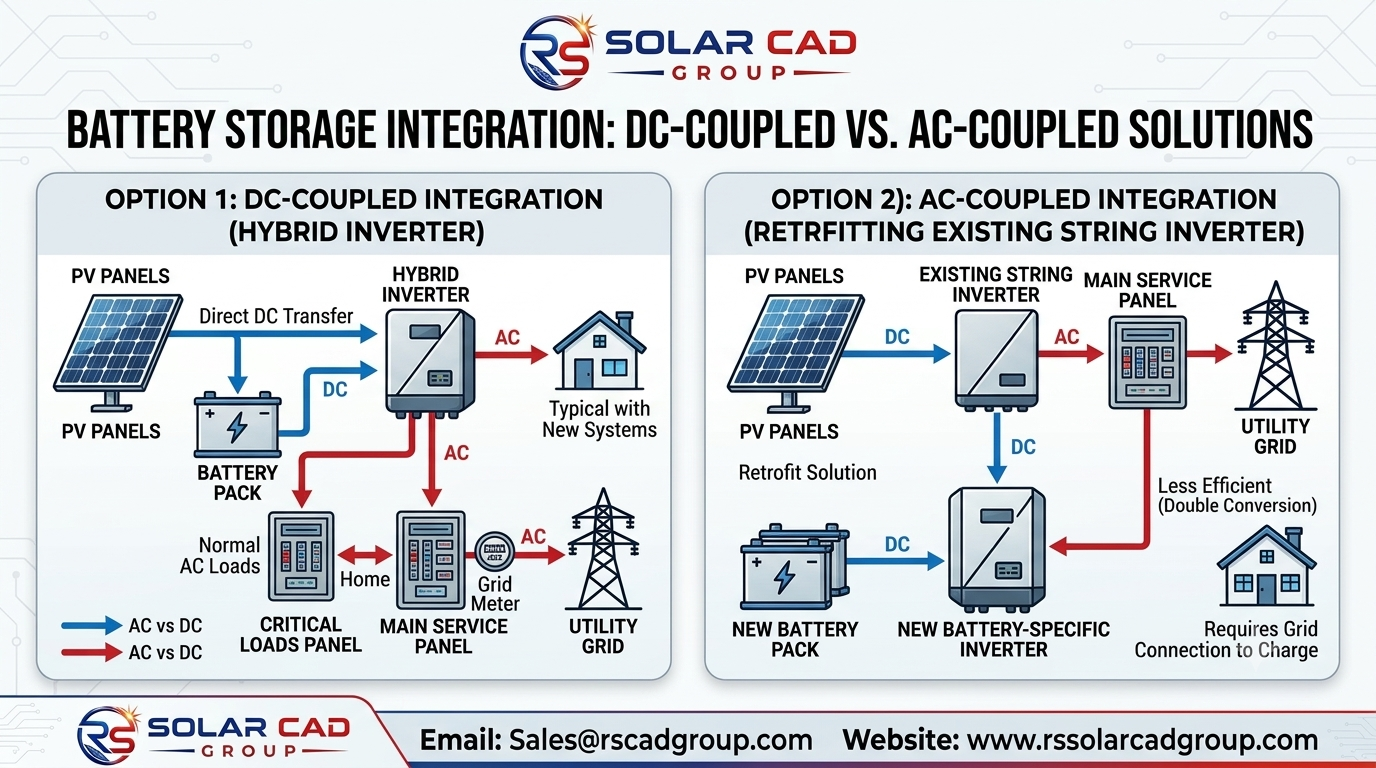
As electricity consumption patterns change, some solar owners may consider adding battery storage when upgrading an existing PV system.
Storage can potentially help a customer shift some electricity use to different times, manage selected peak-demand periods, or provide backup power when the system is specifically designed and configured for that purpose.
However, battery integration is not automatically beneficial for every existing installation.
The assessment should consider the customer’s electricity usage, utility rate structure, export arrangements, equipment compatibility, available space, safety requirements, and total project cost.
The design must also account for inverter architecture, power and energy ratings, protection, controls, and any applicable interconnection requirements.
For some customers, an inverter replacement alone may be sufficient. Others may benefit from a separate storage feasibility study.
Solar companies that can explain these alternatives clearly will be better positioned to recommend solutions based on actual customer needs rather than selling upgrades without a defined objective.
11. The Challenges Solar Companies Must Prepare For
Despite its potential, repowering is not a guaranteed growth opportunity for every project.
Older installations may have incomplete drawings, undocumented modifications, unavailable equipment specifications, or components that are difficult to identify.
The existing roof or mounting structure may require additional inspection. A proposed capacity increase could trigger utility review. Replacement equipment might not be compatible with the original system, and project costs could outweigh the expected benefits.
Solar businesses should address these challenges through a consistent evaluation process.
First, gather reliable information about the existing installation. Second, establish the technical scope before selecting replacement equipment. Third, evaluate the financial case using realistic costs and expected performance. Finally, confirm the applicable approval and commissioning requirements.
It is also important to plan for the responsible handling of removed modules and electrical equipment. Reuse, resale, recycling, and disposal options depend on the equipment’s condition and the available local infrastructure.
A disciplined approach helps solar companies avoid overpromising production improvements or recommending upgrades that do not meet the customer’s objectives.
12. How Solar Businesses Can Prepare for the Repowering Market
Solar companies do not need to wait until repowering becomes a major part of their workload to prepare for it.
They can begin by reviewing their existing customer portfolios and identifying installations with aging equipment, repeated maintenance issues, or changing energy requirements.
The next step is to establish a clear service process that connects technical evaluation with project economics.
Practical steps include:
- Create an inventory of existing customer installations and available system records.
- Identify projects with recurring inverter failures or unexplained performance changes.
- Offer structured assessments before recommending major replacements.
- Develop standard workflows for revised layouts, electrical calculations, and technical documentation.
- Establish a process for coordinating with installers, engineers, utilities, and permitting authorities.
- Track project costs and post-upgrade performance to evaluate whether the work delivered the intended results.
- Build partnerships that provide additional design or engineering capacity when internal resources are limited.
Companies that establish these processes can respond more effectively when customers begin evaluating their older solar installations.
Repowering should be treated as an extension of a company’s existing services, supported by technical evidence and customer-specific financial analysis.
Conclusion: Existing Solar Systems Could Become the Next Growth Opportunity
The next phase of solar industry development will not depend exclusively on building new installations. Maintaining, modernizing, and improving the performance of existing systems can also create meaningful opportunities for solar businesses.
Solar repowering provides a way to address aging inverters, evaluate module upgrades, modernize electrical systems, and assess whether existing installations can support new operational requirements.
For residential installers, commercial EPCs, and solar service providers across the United States and Canada, these projects can create opportunities to strengthen customer relationships and develop additional service revenue.
Success, however, depends on selecting the right projects. Equipment compatibility, structural conditions, electrical design, permitting requirements, operational constraints, and financial feasibility must all be evaluated before work begins.
Professional solar design and engineering support can help companies develop technically sound upgrade plans and prepare the documentation required for project execution.
At RS Solar CAD Group, we understand the importance of accurate solar design and engineering documentation in supporting project development and system improvements. As the market evolves, the ability to evaluate existing installations and plan appropriate upgrades can help solar businesses serve their customers throughout the life of a system—not just at the time of its initial installation.
The opportunity is already present in the installed solar base. The next step is identifying which systems are ready for improvement and how to upgrade them responsibly.
Frequently Asked Questions (FAQs)
1. What is solar repowering?
Solar repowering is the process of upgrading or replacing major components of an existing solar installation to improve performance, reliability, capacity, or operating life. It may involve replacing modules, inverters, electrical equipment, or redesigning parts of the system.
2. When should an existing solar system be considered for repowering?
Repowering may be worth evaluating when a system experiences recurring equipment failures, declining performance, increasing maintenance costs, obsolete components, or changing energy requirements. A technical and financial assessment should determine whether an upgrade is justified.
3. Is solar repowering better than installing a new system?
Not always. Repowering may allow suitable existing infrastructure to be retained, potentially reducing certain project costs. However, extensive equipment problems, structural limitations, or unfavorable upgrade economics may make a different solution more appropriate.
4. Can older solar panels be replaced without changing the entire system?
Sometimes. Replacement feasibility depends on module specifications, inverter compatibility, string configuration, mounting requirements, wiring, and the condition of the existing equipment. Engineering review is important before replacement.
5. Can battery storage be added during solar repowering?
Potentially. Battery integration depends on the existing system architecture, inverter compatibility, electrical configuration, site conditions, utility requirements, and the customer’s energy objectives. A dedicated feasibility assessment can determine whether storage is appropriate.
6. Does solar repowering require new permits?
It may. Requirements depend on the jurisdiction and the nature of the modification. Changes to system capacity, electrical equipment, structural arrangements, or grid interconnection may require revised plans, approvals, inspections, or utility coordination.
7. How can solar design services support repowering projects?
Solar design services can support existing-system assessments, updated PV layouts, electrical calculations, equipment compatibility reviews, single-line diagrams, permit documentation, and coordination with qualified engineering professionals.
8. Is solar repowering relevant to both residential and commercial projects?
Yes. Residential projects may focus on inverter replacement or targeted equipment upgrades, while commercial projects can involve larger arrays, multiple inverters, electrical modernization, and more complex operational requirements. The scope depends on the installation.
Upgrade Your Solar Project Support with RS Solar CAD Group
Planning a solar system upgrade or evaluating an existing installation? RS Solar CAD Group provides solar design and engineering support for solar installers and EPC companies serving the U.S. and Canadian markets.
Our services include:
- Solar Proposal Design
- PV System & Layout Design
- Permit-Ready Plan Sets & Revisions
- Structural & Electrical Engineering / PE-EE Stamps
- Single-Line Diagrams (SLDs) & NEC-Based Design
- Utility Interconnection & HOA Documentation
Whether you are planning a new installation or assessing an existing project, accurate design documentation can help your team move forward with greater clarity.
Contact RS Solar CAD Group
Website: https://www.rssolarcadgroup.com/
Email: sales@rscadgroup.com
Need reliable solar design and engineering support for your next project? Connect with our team to discuss your requirements.