U.S. Power Grid Security in 2026: What Renewable Energy & Solar Companies Need to Know
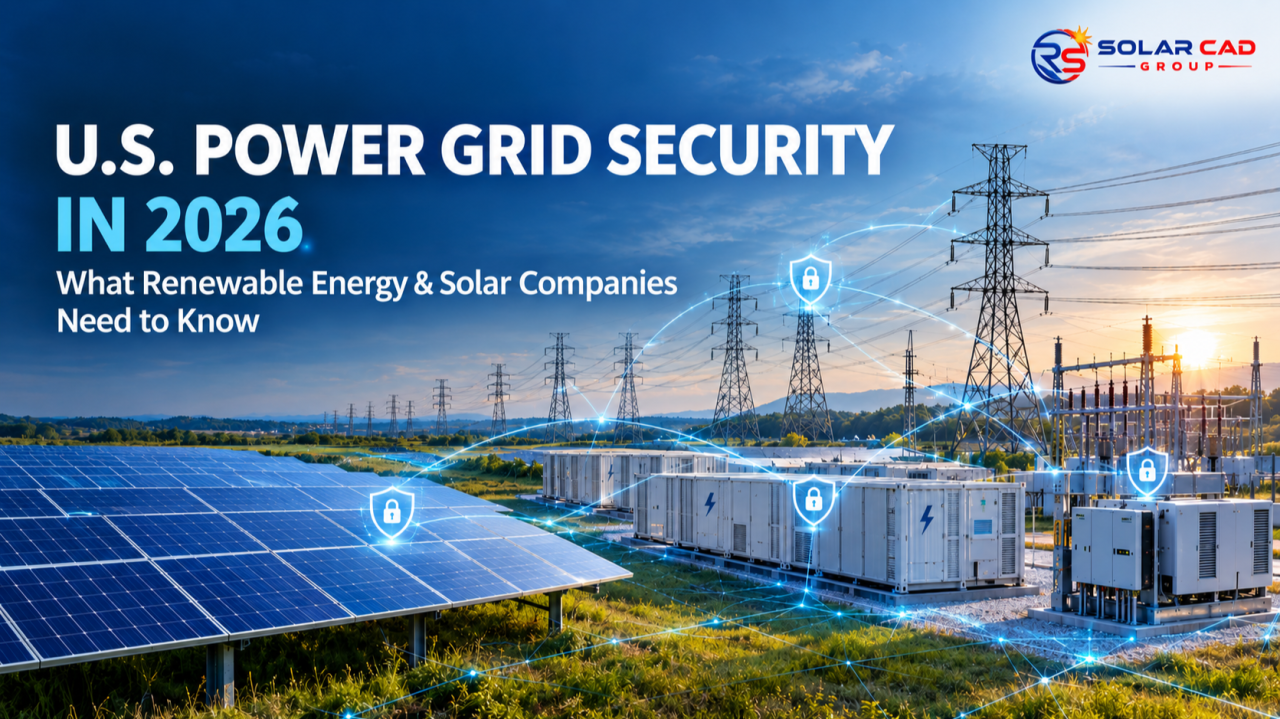
The U.S. electricity system is becoming more connected, digital, and distributed than ever before.
Solar farms, rooftop PV systems, battery energy storage systems (BESS), electric vehicle chargers, smart meters, microgrids, cloud-based monitoring platforms, and other distributed energy resources (DERs) are increasingly interacting with the electric grid.
That transformation brings major benefits but it also creates a larger cybersecurity and reliability challenge.
In 2026, grid security is no longer only a concern for utilities and large power plants. Solar developers, EPCs, installers, inverter manufacturers, DER aggregators, engineering firms, and energy-storage companies all have a role to play.
The North American Electric Reliability Corporation (NERC) has specifically identified expanding DERs and distribution-side aggregators as factors increasing the cyber attack surface of the power system.
So, what does this mean for the solar industry?
Why Is Power Grid Security Becoming More Important in 2026?
The traditional electricity grid was built around a relatively small number of large generation facilities supplying electricity through transmission and distribution networks.
Solar is changing that model.
Instead of electricity flowing from a limited number of centralized generators, thousands or even millions of connected devices can now participate in the energy system.
These include:
- Rooftop solar PV
- Utility-scale solar farms
- Battery energy storage systems
- Hybrid solar-plus-storage systems
- Microgrids
- Smart inverters
- EV charging infrastructure
- Demand-response systems
- Cloud-based energy management platforms
DOE explains that solar systems can communicate with utility control and automation systems through devices such as inverters, creating cybersecurity considerations that did not exist at the same scale in traditional generation.
The result is a much larger digital attack surface.
1. Solar Inverters Are Becoming a Critical Security Point
One of the most important components in a modern solar installation is the inverter.
An inverter does much more than convert DC electricity from solar modules into AC electricity.
Modern smart inverters can communicate with:
- Monitoring platforms
- Energy management systems
- Utilities
- Aggregators
- Cloud applications
- Battery systems
- Grid-control systems
This connectivity provides valuable functionality but it can also introduce cybersecurity risks.
DOE notes that internet-connected photovoltaic inverters and other operational-technology devices can be exposed to cyberattacks, and that attacks on grid-connected devices can potentially have physical consequences.
What solar companies should consider
When specifying or designing projects, companies should understand:
- How the inverter communicates
- What remote-access capabilities exist
- Who has administrative access
- How firmware updates are handled
- What monitoring platform is being used
- Whether communication channels are appropriately secured
- What happens if communications are interrupted
Cybersecurity therefore needs to become part of the system design conversation, rather than something considered only after installation.
2. Distributed Energy Resources Create a Bigger Attack Surface
A single compromised solar installation may have limited impact.
The bigger concern is the aggregation of thousands of connected systems.
For example, imagine thousands of residential solar-plus-storage systems being controlled through one cloud-based platform.
If an attacker gained control of the platform, the problem would potentially extend far beyond one customer.
NERC’s 2026 Critical Infrastructure Protection Roadmap specifically identifies the possibility of attackers compromising cloud-based DER aggregator platforms and sending malicious control signals to large numbers of inverters.
This is why DER cybersecurity is becoming an increasingly important industry discussion.
3. Battery Energy Storage Adds Another Layer of Complexity
Battery storage is becoming increasingly important to the U.S. energy transition.
Solar-plus-storage systems can provide:
- Backup power
- Peak shaving
- Load shifting
- Grid services
- Energy arbitrage
- Greater renewable-energy utilization
But batteries also introduce additional digital controls and communication systems.
A typical modern BESS project can involve:
Battery → BMS → PCS/Inverter → EMS → Monitoring Platform → Utility/Grid
Each connection represents another point that needs appropriate security controls.
For solar companies, this means cybersecurity planning should not stop with the PV modules.
It should extend across the complete energy system.
4. Cybersecurity and Physical Safety Are Connected
Grid cybersecurity isn’t simply about protecting data.
Electricity infrastructure is a cyber-physical system.
A malicious command affecting an inverter, battery system, or other grid-connected equipment could potentially affect physical operation.
DOE emphasizes that cyberattacks against electric-grid devices can create physical impacts, including loss of power and potential equipment or safety consequences.
That makes cybersecurity relevant to engineering teams—not only IT departments.
For solar companies, this creates an important connection between:
Cybersecurity + Electrical Engineering + Controls + System Design + Operations
5. NERC Cybersecurity Requirements Remain Important for Applicable Projects
Not every solar installation is subject to every NERC Critical Infrastructure Protection (CIP) requirement.
However, companies working on larger grid-connected resources need to understand where applicable reliability and cybersecurity requirements may affect project development and operation.
For example, NERC’s CIP standards address areas such as:
- System security management
- Configuration and vulnerability assessments
- Information protection
- Incident response
- Cybersecurity incident reporting
NERC’s CIP-008-7.1 addresses cybersecurity incident reporting and response planning. The standard’s current implementation timeline shows an effective date of July 1, 2028, following regulatory action in 2026.
Meanwhile, CIP-010-4 focuses on configuration change management and vulnerability assessments for applicable Bulk Electric System cyber systems.
Solar businesses should therefore avoid treating cybersecurity compliance as a one-size-fits-all requirement. Project size, grid connection, technology, ownership, and system classification matter.
6. Supply Chain Security Is Becoming More Important
Solar projects depend on a global technology supply chain.
Equipment can include:
- PV modules
- Inverters
- Batteries
- Transformers
- Switchgear
- Controllers
- Communications equipment
- Monitoring software
- Networking hardware
NERC’s 2026 strategic planning materials identify supply-chain assurance and protection as an important security concern, noting that highly globalized supply chains can create risks for the bulk power system.
For solar companies, this means equipment selection should consider more than:
Price + efficiency + warranty
Companies increasingly need to consider:
Security + software support + firmware management + vendor access + communications architecture + long-term reliability
7. EV Charging Is Also Part of the Grid Security Conversation
The growth of EV charging infrastructure adds another category of connected energy equipment.
Modern EV chargers can communicate with:
- Cloud platforms
- Fleet-management systems
- Payment platforms
- Building-energy systems
- Utilities
- Demand-response programs
NERC’s 2026 Critical Infrastructure Protection Roadmap specifically identifies networked EV supply equipment as a growing grid-edge attack surface.
This is particularly important for commercial properties where solar, batteries, building loads, and EV chargers may all operate together.
For example:
Solar PV + BESS + EV Chargers + Energy Management System
can create a highly capable energy ecosystem—but also a more complex cybersecurity environment.
8. Solar Engineering Teams Have a Role to Play
Cybersecurity is sometimes treated as something that belongs entirely to the IT department.
For renewable-energy projects, that approach is becoming outdated.
Engineering decisions can influence cybersecurity.
For example, project teams may need to understand:
- Inverter communication architecture
- Equipment interfaces
- Control requirements
- Monitoring systems
- Remote-access requirements
- Network connections
- Protection settings
- Utility requirements
- Equipment documentation
A well-organized electrical design package can help different stakeholders understand how the system is intended to operate.
This is one reason accurate electrical documentation and clear project engineering remain important as solar systems become more sophisticated.
9. What Should Solar EPCs Do in 2026?
Solar EPCs and installers don’t necessarily need to become cybersecurity companies.
But they should build cybersecurity awareness into their project workflow.
A practical approach includes:
1. Understand the equipment
Know what communications capabilities are built into the inverter, battery, EV charger, gateway, and monitoring equipment.
2. Control remote access
Avoid unnecessary access and ensure that authorized users and vendors are properly managed.
3. Keep software updated
Firmware and software vulnerabilities can change over time. Establish a process for tracking vendor updates.
4. Protect credentials
Default usernames and passwords should not remain in production environments.
5. Document communication pathways
Project documentation should clearly identify important equipment and communication interfaces where applicable.
6. Coordinate with utilities
Utility interconnection requirements and communication requirements should be understood before project deployment.
7. Plan for incidents
Companies should know what happens if:
- Monitoring stops
- An inverter loses communication
- A cloud platform becomes unavailable
- Unauthorized access is suspected
- Equipment behaves unexpectedly
8. Work with qualified cybersecurity professionals
For larger or more complex systems, specialized cybersecurity expertise may be necessary.
10. Cybersecurity Should Be Considered During Design—Not After Installation
One of the most important ideas for the renewable-energy industry is “cybersecurity by design.“
DOE has promoted this approach because addressing security early in the development and design process can reduce the need for expensive changes later.
For solar developers and EPCs, this means cybersecurity should be considered alongside:
- Site assessment
- System architecture
- Equipment selection
- Electrical design
- Interconnection
- Monitoring
- Commissioning
- Operations and maintenance
Waiting until a project is already installed can make security improvements more complicated and expensive.
11. What This Means for Solar Design & Engineering Companies
The role of solar engineering companies is also evolving.
As projects become more interconnected, clients increasingly need accurate technical documentation not simply a basic PV layout.
Modern project documentation may include:
- PV layouts
- Single-line diagrams
- Electrical calculations
- Equipment schedules
- Battery layouts
- EV charging layouts
- Interconnection documentation
- Structural plans
- As-built documentation
- Utility-specific requirements
- Revision responses
These documents help EPCs, installers, utilities, AHJs, engineers, and other stakeholders understand the intended system configuration.
For companies working across multiple U.S. jurisdictions, maintaining consistent and accurate documentation can also make project coordination easier.
12. DOE Is Developing Tools and Guidance for DER Cybersecurity
The U.S. Department of Energy has been working on cybersecurity resources specifically for distributed energy resources.
One example is the Distributed Energy Resource Cybersecurity Framework (DER-CF), which helps organizations identify cybersecurity vulnerabilities in renewable-energy systems and develop action plans for improving security controls.
DOE’s broader DER cybersecurity work also recognizes that utilities, regulators, DER operators, aggregators, and other stakeholders need practical approaches for protecting increasingly distributed energy infrastructure.
This is a sign that cybersecurity is becoming an integral part of the renewable-energy ecosystem rather than a separate technology issue.
13. The Future: More Connected Solar Means More Responsibility
The U.S. solar industry is moving toward increasingly intelligent energy systems.
Future projects will likely involve greater integration between:
Solar + Storage + EV Charging + Smart Buildings + Grid Controls + DER Aggregation
This can make the electricity system more flexible and resilient.
But greater connectivity also means greater responsibility.
Solar companies will need to think about not only:
“Can this system generate electricity?”
but also:
“Can this system operate securely, reliably, and safely when it is connected to a highly digital grid?”
That shift in mindset will be important throughout the remainder of the 2020s.
How RS Solar CAD Group Supports the Modern Solar Project Workflow
As solar projects become more technically complex, accurate engineering documentation becomes increasingly important.
RS Solar CAD Group supports solar EPCs, installers, contractors, and renewable-energy companies with solar design and engineering services for projects in the U.S. and other markets.
Our services include:
- Solar proposal designs
- PV layout designs
- Permit-ready plan sets
- Electrical design
- Single-line diagrams
- Structural engineering
- PE/EE stamping coordination
- Battery/ESS design
- EV charging design
- As-built drawings
- Utility/interconnection documentation
- AHJ revision support
By helping project teams maintain accurate and organized technical documentation, RS Solar CAD Group helps solar businesses keep their projects moving from design and permitting through installation.
For solar companies handling growing project volumes, outsourcing technical design and documentation can also help internal teams focus on customers, installations, and business growth.
Learn more: RS Solar CAD Group
Final Thoughts
U.S. power-grid security in 2026 is no longer only a utility-level concern.
As solar, battery storage, EV charging, smart inverters, and other distributed energy resources become increasingly connected to the grid, renewable-energy companies are becoming part of the grid’s cybersecurity ecosystem.
The most effective approach is not to wait for a cybersecurity problem.
Instead, solar businesses should consider security during equipment selection, system design, communications planning, commissioning, documentation, and ongoing operations.
The future of clean energy will not depend only on how much renewable electricity we can generate.
It will also depend on how securely, reliably, and intelligently we can connect that electricity to the grid.
Frequently Asked Questions
1. Why is cybersecurity important for solar companies?
Solar systems increasingly use connected inverters, monitoring platforms, batteries, and other digital technologies. These connections can introduce cybersecurity risks, making security an important consideration for modern solar projects.
2. Can a solar inverter be a cybersecurity risk?
Yes. Smart inverters can communicate with monitoring platforms, utilities, and other systems. Poorly secured communication or unauthorized access can create potential vulnerabilities.
3. Are all solar projects required to comply with NERC CIP standards?
No. NERC CIP requirements apply to qualifying Bulk Electric System cyber systems and are not automatically applicable to every residential or commercial solar installation. Project-specific requirements should be evaluated by qualified professionals.
4. Does battery storage create cybersecurity risks?
Yes. Battery systems use controllers, battery-management systems, power-conversion equipment, energy-management systems, and often cloud-connected monitoring. These additional digital interfaces create additional security considerations.
5. How can solar EPCs improve cybersecurity?
EPCs can start by understanding equipment communication capabilities, protecting credentials, managing remote access, maintaining software/firmware, documenting system architecture, coordinating with utilities, and involving qualified cybersecurity professionals when appropriate.
6. Why is solar design documentation relevant to cybersecurity?
Clear documentation helps project stakeholders understand equipment, system architecture, electrical connections, and operating requirements. Accurate documentation can support better coordination between EPCs, engineers, utilities, AHJs, and other project stakeholders.
7. What is DER cybersecurity?
DER cybersecurity focuses on protecting distributed energy resources such as rooftop solar, batteries, EV charging systems, and other connected energy assets from cyber threats and unauthorized control.